
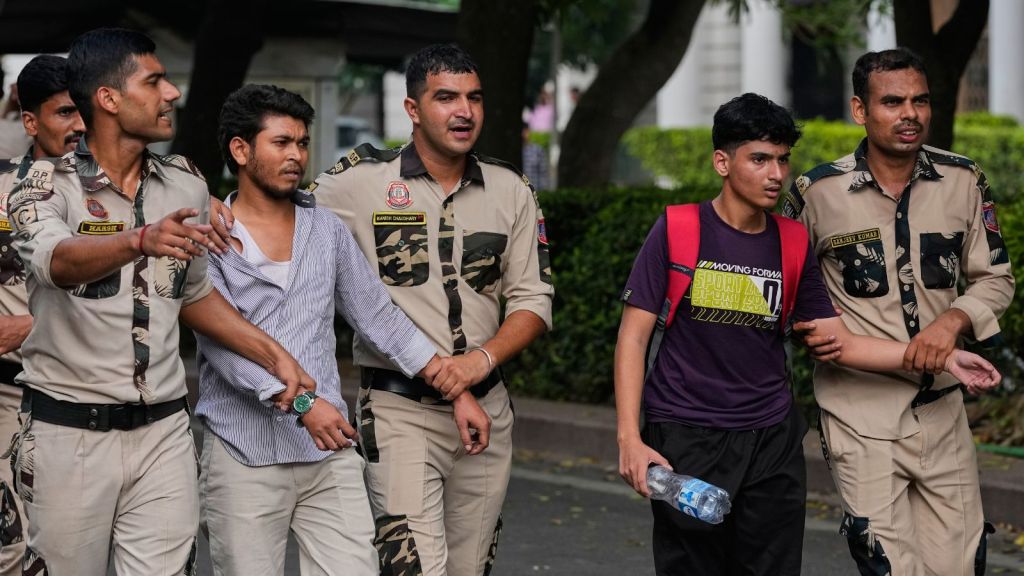
Amid the ongoing protests in the Capital, the Supreme Court on Sunday directed the authorities to ensure that there are no illegal detentions, free and smooth movement of people is allowed, Metro and train services function normally, and internet services are not disrupted — all subject to law and order conditions.
A bench of Justices Joymalya Bagchi and V Mohana held a special sitting to hear petitions challenging the restrictions put in place on Saturday, allegedly in contempt of the court’s directions on Friday to ensure there is “no complete prohibition on movement of Metro/ trains”, and the detention of protesters including political leaders.

Saying that there was a prima facie contempt case, the bench issued notices to the Centre, Delhi Police and the Delhi Metro Rail Corporation (DMRC) to file affidavits and submit compliance reports. “Having considered the submissions of the learned counsel for the parties and perused the averments in the contempt petition, we are of the opinion that the petitioners have made out a prima facie case. Accordingly, we issue notice upon the alleged contemnors. They are directed to file counter affidavit to the said petition, including a compliance report in terms of our order as aforesaid by 13.10.2026,” the bench said in its order.
The bench directed that in the interim, “Metro and rail facilities shall function normally until and unless regulations require to be imposed keeping in mind disturbance to public order as envisaged under Article 19 (2) of Constitution”.
“Free movement of people in the city shall be permitted subject to traffic regulations” and “requirement of imposition of barricades shall be reviewed forthwith keeping in mind law and order and other traffic conditions,” it said.
“Internet facilities shall remain undisturbed,” the bench said, but clarified that it was not taking away the administration’s powers to act under the Information Technology Act. “If law requires, that’s always there,” it said.
“Smooth movement of people in the city shall be permitted in accordance with law,” the bench said. “There shall not be detention, save and except by procedure established by law, particularly with regard to peaceful, unarmed assemblage of people beyond the area where Section 163 of Bharatiya Nagarik Suraksha Sanhita (BNSS) is in operation,” it said. Section 163 of BNSS empowers executive magistrates to issue urgent, temporary orders to maintain public peace and safety, like barring the assembly of five or more people.
During the hearing, the petitioners informed the bench that Section 163 of BNSS had been imposed right outside the Supreme Court. “We have been informed that a notice board stating imposition of Section 163 has been put up in and around the precincts of the Supreme Court. We direct the authority to take down this board if not already done, so that there is no apprehension with regard to ingress or egress to SC or any other court of law,” the bench said.
Appearing for the Centre, Solicitor General Tushar Mehta said internet facilities had been restored and Metro/ train services were fully functional. He also assured that lawyers, journalists and other professionals would not be impeded in the discharge of their professional duties.
At the outset, senior advocate Kapil Sibal, appearing for a petitioner, said the police were picking up people from trains. He said people were being detained from outside the demarcated area of a 4-km radius around Jantar Mantar. He said internet was suspended and 45 Metro stations were closed on Saturday, despite the court’s directions.
On Friday, a bench of Chief Justice of India Surya Kant, Justice Bagchi and Justice Mohana had directed the government to ensure that there is “no complete prohibition on movement of Metro/trains”, and “no inconvenience is caused to the citizenry of Delhi”.
Senior advocate Shadan Farasat, who was among those detained on Saturday, said he was “brutalised” along with others. “Question is not only in respect of lawyers. We are a subset of larger citizenry. We don’t have special rights as lawyers. Yesterday, situation in the city was remarkably suppressive. A person was not even allowed to stand on the street. I was thrown in a moving bus after being picked up. It’s not about individuals or lawyers but about citizens’ right to protest. The sense I got yesterday, we were one step away from police state,” he said.
Urging the bench to “restore right of citizens… to protest peacefully in the nation’s capital”, he said this was “destroyed” on Saturday.
Senior advocate Gopal Sankaranarayanan, appearing for some petitioners, referred to video grabs of the detentions and related incidents. “If your lordships notice the nature of violence being perpetrated, it’s not even a question of being proportionate. First comes necessity, then comes proportionality — necessity to detain individuals moving peacefully, unarmed, children, students, beat them… have scuffles with them, was completely uncalled for,” he said.
He urged the court to direct that free movement be restored forthwith and all barricades be removed. He also alleged the continued presence of police personnel without badges.
Senior Advocate Shoeb Alam claimed that 7,000-8,000 people were detained, raising questions about the right to protest.
“We are aware of the gargantuan detentions as you say…A bench presided by Chief Justice of India had already made it clear that Article 19(2) is not a prohibition but a regulation,” Justice Bagchi said.
Senior advocate Menaka Guruswami, who had filed a petition challenging the detention of political leaders, said the youth were being prevented from exercising their constitutional right to protest against what they feel is an unfair election system. “Something graver is at stake — what is at stake is the suspension of the citizens’ peacefully exercised constitutional rights… The last time the court had to consider such requests, such challenges, was at the time of the Emergency,” she said.
Advocate Jai Anant Dehadrai, appearing for the Delhi Police, said several police personnel had also been “brutalised” during the protests.
“Life and liberty equally sensitive — we have said that before. Be it police officer, citizen. All intervention applications will be listed. We will pass a composite order on listed matters,” Justice Bagchi said.
Justice Bagchi said the court is agnostic with regard to the individual who is subject to any wrongdoing, and its duty to protect life and liberty extends across all sections.
Responding to the submissions of the petitioners, Mehta said those detained had already been released. “There was no curtailment of any Metro service…There was zero reduction in total volume of Metro operations on October 10,” he said. He said of the total 303 Metro stations in the Capital, only 45 were closed. He said all stations were opened with effect from 10 pm on Saturday.
Justice Bagchi said the DMRC should clarify the location of the stations so the court would have a better understanding of the situation. He said the court would also like to see the advisories with regard to train services.
Apparently responding to Sibal’s comments to the media earlier that he had lost trust in the Supreme Court, Justice Bagchi also added: “We are here to instil the faith of Mr Sibal in the institution…whose confidence has been one of our surest weapons in the fight for justice.”
The bench said it would give the government time to respond to the petitions and that in the meanwhile, no advocate should be hindered from discharging professional duties. The court is likely to hear the matter again on October 13.


 Share


