


 The order leaves a harder route open, which is why nobody has taken it.
In a significant order, the Supreme Court has said that the right to access and use the Internet is a fundamental right of every individual under Article 21 read with Article 19(1)(a) of the Constitution.
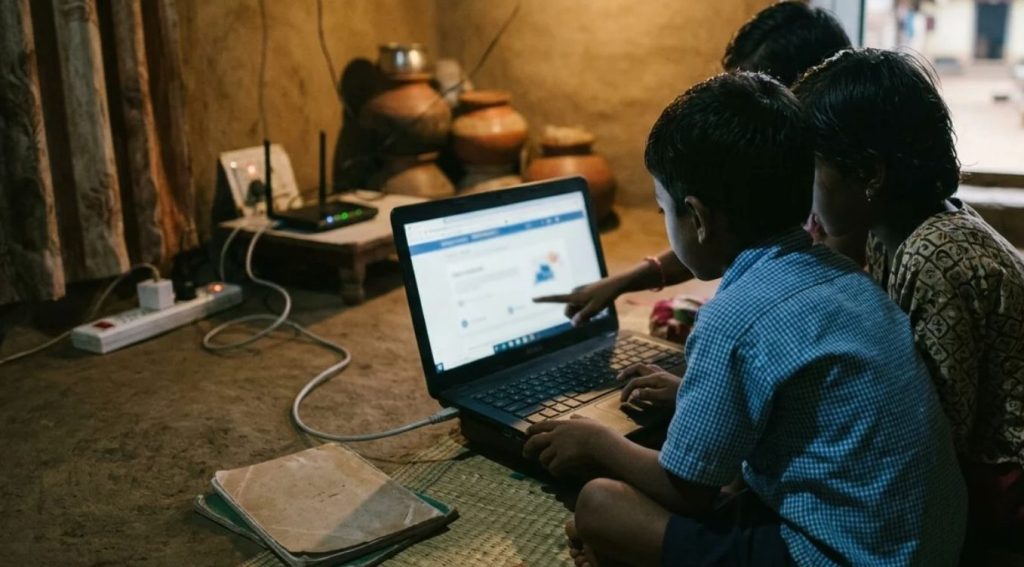
Ruling on a petition by NGO Just Rights for Children Alliance, which sought its intervention to prevent the availability of Child Sexual Exploitation and Abuse Material (CSEAM) on social media platforms, a Bench of Justices J B Pardiwala and K Vinod Chandran said in its October 15 order that a blanket restriction on children accessing the Internet is not the solution.
Calling the right to use the Internet a fundamental right, the order which was made available Saturday said, “Our children, irrespective of their age, enjoy the same rights, and to deny the same altogether would be as absurd as saying children below a certain age do not have a conscience worth protecting or a freedom of speech worth expressing. The safety of our children and their freedom are not at odds with each other.”
The ruling pointed out that in its January 10, 2020, judgment in Anuradha Bhasin vs Union of India, the Court “held that the freedom of speech and expression and the freedom to carry on any trade or business through the medium of the Internet is constitutionally protected as a fundamental right under Article 19(1)(a) and 19(1)(g) of the Constitution”. While the judgment “refrained from expressing any view on whether the right to access the Internet is, by itself, a fundamental right and left the question of law open for future discourse”, the Court said, “yet, this issue is no longer res-integra (untouched)”.
Justices Pardiwala and Chandran pointed to the April 2025 decision in Pragya Prasun & Ors. v. Union of India, where the Supreme Court held that the “right to digital access is an intrinsic component of the right to life under Article 21 of the Constitution, and that it is the obligation of the State to proactively design and implement inclusive digital ecosystems that serve not only the privileged but also the marginalised”.
Underlining the importance of the Internet as “the marketplace of ideas, creative expression and information”, and its usefulness for particularly children in remote areas and those with special needs, the Court said: “… insofar as CSEAM is concerned, the wrongdoer is the person who creates, circulates, sells or seeks out such material, and the intermediary which fails to detect and remove the same. To keep the child away from the Internet on account of such failures would be to mistake the victim for the problem.”
It added: “The means by which measures relating to age-based restrictions are achieved are themselves an overreach. Such processes, inevitably, always require identifying and ascertaining the age of each and every user, continuous collection and monitoring of sensitive data and an overall disproportionate risk of misuse and surveillance.”
However, the Court said, “this does not mean that there should be no age-based restrictions”. “We acknowledge that some form of safeguards are necessary for the safety of our children online and the moderation of the content….”
It suggested “a system that places greater emphasis on parental consent, guidance and oversight on the access to social media platforms by children along with a dedicated ‘child mode’ for such accounts with measures proportionate to the object of ensuring their safety”.
The Bench also pointed out that the experience of other jurisdictions shows that “children do not cease to use the Internet merely because the law prohibits them from doing so. They continue to use the same, albeit without the knowledge of their parents or the authorities. They move to other platforms and websites that are unregulated and even more unsafe.”
It said “such restrictions also make children who are being enticed or threatened on the Internet reluctant in reporting the same… out of fear of reprisal for using the Internet”. “This would significantly undermine the safety of our children.”
The Bench also said that keeping children away from social media platforms was no guarantee that they would not be exposed to CSEAM and similar material. “Without proper safeguards, and earnest efforts by all stakeholders… such material will continue to circulate.”
On the safety measures that may be put in place, the Court suggested “accounts being made private by default, restrictions on contacts and messages from unknown adults, moderation of advertising and content accessible to children”. Their safety “is not complete without adequate efforts towards inculcating in them the awareness to recognise danger, the confidence to speak up and the safe practices to follow, on and off the Internet”, the Court said.
It added that the government may, if needed, restrict the access of children to specific categories or services that are inherently harmful to them, such as adult content websites. “There can be no space for non-consensual, sexually exploitative and abusive material.”
The Supreme Court asked the Centre to appraise it “on the tools and technological measures that have been put in place by intermediaries for the detection and removal of CSEAM”, and “on the feasibility of industry-wide use and deployment of such tools”.