


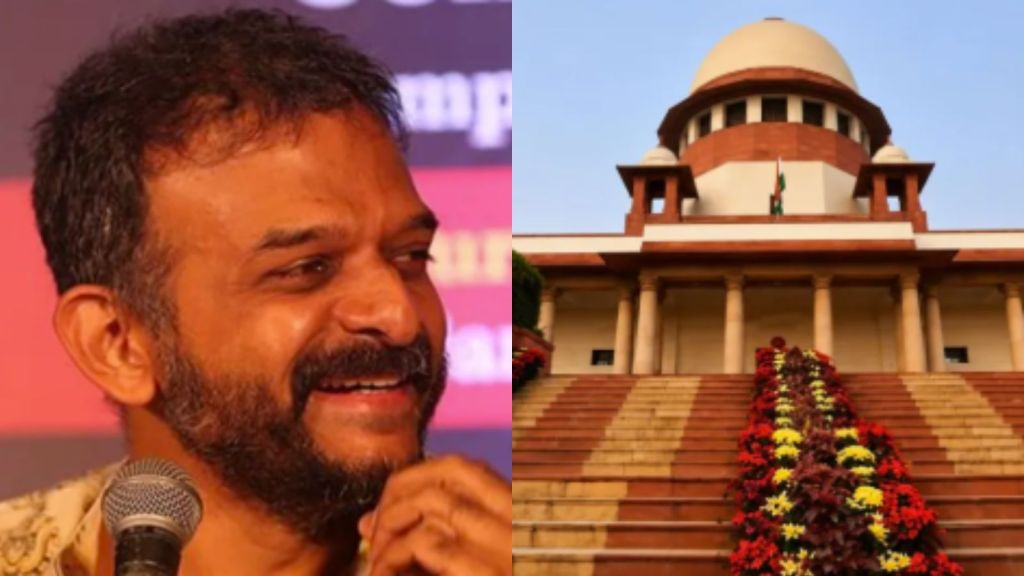
 Carnatic singer TM Krishna has moved the top court against the Centre's Vande Mataram mandate
Hearing a petition by Carnatic vocalist T M Krishna who has challenged the law mandating the singing of all six stanzas of the Vande Mataram, the Supreme Court, while reminding the Centre Tuesday about its 1986 ruling on an individual’s right not to sing the national anthem, said it was up to “a conscientious objector not to recite one or all stanzas of the national song” and the person cannot be subjected to “criminal consequences”.
It said it will examine whether refusal to sing the Vande Mataram could have penal consequences.
The hearing before a three-judge bench headed by Chief Justice of India Surya Kant also saw a heated exchange between Solicitor General Tushar Mehta and Senior Advocate and former judge S Muralidhar, appearing for Krishna.
Objecting to the challenge, Mehta said “lawmaking cannot be as per Naxalite’s ideas”. Muralidhar protested and asked Mehta to withdraw the remark, but he did not. The bench, also comprising Justice Joymalya Bagchi and Justice V Mohana, said it had “not taken note” of the comment, restricting itself to “the Constitutional issue” before it.
Krishna’s plea said the guideline on singing of all six stanzas of Vande Mataram at official functions violates the constitutional principle of secularism because the last four stanzas contain explicit Hindu references.
Justice Bagchi said, “The national song expressing homage to a particular God or form of God would not perhaps impact secularism, but your point whether a conscientious objector can be subjected to penal consequences… may require examination.”
He said the law as it stands was laid down in its ruling on Bijoe Emmanuel and Others vs State of Kerala and Others. In the 1986 case, the Supreme Court ruled that expelling students, who belonged to Jehovah’s Witnesses, for refusing to sing the national anthem, while standing respectfully in silence, violated their fundamental rights.
“We would expect that the law of the land, as declared by this Court in Bijoe Emmanuel, will govern the Act. What is the national song is not in dispute. The declaration of law in Bijoe Emmanuel is not yet questioned,” Justice Bagchi said.
Muralidhar said, “What they have done is, as far as amending the Act is concerned, they have introduced the expression national song, but the Act does not define what a national song is. It is a serious lacuna in the Act and it can be misused because they have introduced this office memorandum which is not even gazetted. I don’t know under what provision; they don’t even cite any provision.”
The Centre has amended Section 3 of the Prevention of Insults to National Honour Act, 1971, extending the same legal protection to Vande Mataram as Jana Gana Mana.
Mehta questioned the petitioner’s submissions and said, “Secularism will never be this narrow.”
Muralidhar said, “A penal statute cannot be in the realm of vagueness. You do not define what a national song is in the statute and you make it a punishable offence.”
Justice Bagchi said that “by custom and usage, the national song has always been understood as Vande Mataram”.
“But only two stanzas,” Muralidhar said. “For the first time after 80 years, they are trying to tell us it’s not two stanzas. This is why when you use the term national, there has to be some building of a public opinion. It has to be by consensus. You can’t thrust it and you cannot have penal consequences. That is what is most worrying.”
Justice Bagchi said the extent of penal consequences “requires examination”.
Mehta said, “Let’s not drag national song in this sensationalism… Every officer says Jai Hind, but Jai Hind is not mentioned in the Constitution.” Urging the bench not to issue notice, he said it will only “create a sensation which appears to be the object”.
Justice Bagchi said, “Mr. Solicitor, we are not inclined to issue any notice to create any sensation. But we would expect that the law of the land, as declared by this Court in Bijoe Emmanuel, will govern the Act… What is the national song is not in dispute… The declaration of law in Bijoe Emmanuel has still not yet been questioned… It is for the democratically elected state to decide and give aspiration to the nation as to what is the national song, two stanzas or four stanzas. But nobody who feels an infraction of Article 25, 26 rights or a conscientious objector would be subjected to (penal consequences).”
“It’s not the remit of the Court to second guess what is the national sentiments and aspirations associated with Vande Mataram. It is for the state… It is for a conscientious objector not to recite one or all stanzas of the national song, and (state is) not going to subject him to criminal consequences,” he said.
Mehta said, “Lawmaking is as per the Constitution… Lawmaking cannot be as per Naxalite’s ideas.”
Muralidhar protested: “He will withdraw the expression he used just now. This is going live. I do not want this expression from a Solicitor General of India going live. I strongly object.”
A heated exchange followed and Justice Bagchi said it was “unnecessary tension and emotion”.
Muralidhar said, “Why is the law officer using this kind of expression? This doesn’t behove a law officer.”
The CJI said the bench was confining itself to examining the legal issue. Mehta was asked to submit a counter-affidavit in two weeks.
After the order was dictated, Muralidhar once again demanded that Mehta withdraw his remarks, but the latter said, “I will repeat what I said.”
Justice Bagchi said, “We have not taken note of the comments. We restrict ourselves to the Constitutional issue.”