


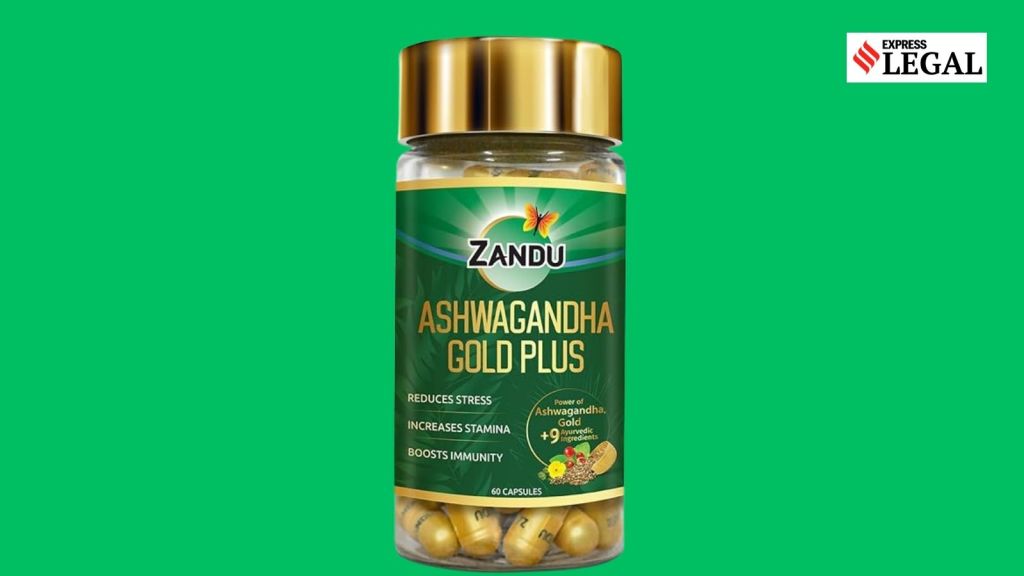
 The primary active compound of Ashwagandha is Withanolide, which is supposed to help with insomnia and boost energy, provided that in an Ashwagandha dosage of 300-600 mg, at least 5 per cent Withanolide is present. (Image source: Amazon)
The Calcutta High Court has set aside an order stopping a social media influencer and his company from publishing a review video of Emami’s Zandu Ashwagandha Gold Plus, which called the product “poison of bottle” and “cancerous”. The court said the injunction was “in the nature of a gag order stifling such free speech”.
The court said the term “cancerous” had been used in proper context, not to demean the product for the sake of it but “to make the people at large aware of the carcinogenic risk associated with consuming excessive lead and mercury.”
A bench of Justices Sabyasachi Bhattacharyya and Sandip Kumar De observed that Emami’s expert reports did not dispute the presence of lead and mercury in the quantities flagged by the social media influencer, but instead sought to “justify the same as the collateral residues of Swarna Bhasma and Yashad Bhasma.”
“The Trial Judge completely overlooked the Bonnard standard in granting ad interim injunction mechanically, which is in the nature of a gag order stifling such free speech in the larger interest of the public,” the September 22 order said.
Arpit Mangal is a social media influencer and a sports science nutritionist who reports on the findings of the scientific laboratory testing conducted by third-party laboratories on its website and also on its YouTube channel. “Zandu Ashwagandha Gold Plus” was short-listed for audit/laboratory testing on consumers’ request.
The product was tested by Eurofins Analytical Services India Private Limited, which is an FSSAI-notified, NABL and IAS accredited laboratory, for testing of the content of Withanolide, which is an essential component of Ashwagandha, and heavy metals in the product.
The primary active compound of Ashwagandha is Withanolide, which is supposed to help with insomnia and boost energy, provided that in an Ashwagandha dosage of 300-600 mg, at least 5 per cent Withanolide is present to reap the greatest health benefits and advantages.
The test reports revealed that the product contains only 0.60g of Withanolide per 100g. Hence, the content of Withanolide in the product falls significantly short of the levels expected in a standard Ashwagandha product. After level-2 testing, it revealed an even more alarming aspect of the product: the contents of two heavy metals, namely lead and mercury, were found to be well in excess of the permissible limits as per the Ayurvedic Pharmacopoeia of India.
On April 17, 2025, Emami Limited issued a legal notice claiming that its product is an Ayurvedic medicine manufactured under a drug licence as per the Drugs and Cosmetics Act, 1940. In the notice, they admitted that its product is a “formulation”, which is a proprietary and herbo-metallic and mineral formulation with various herbs, metallic and mineral compounds.
It was also alleged that Mangal’s video was defamatory and was in violation of the relevant guidelines issued by the Advertising Standards Council of India (ASCI), also referred to as the ‘ASCI Code for influencers’, which requires a person to be qualified with a medical degree or be a qualified nurse.
On April 22, 2025, Mangal replied to the notice, describing the entire process of testing. It was stated that the claims made in the video were backed by double tests from duly accredited third-party laboratories, and in terms of the API, the defence of truth is available to him.
Emami approached the trial court, which on May 3, 2025, passed an order stopping Mangal and his company from publishing or making statements about the product in any form of media.
Advocates Urmila Chakraborty, Diganta Paul and Payel Dasgupta, appearing for Mangal, argued that freedom of speech and expression, guaranteed under Article 19(1)(a) of the Constitution of India, cannot be gagged or restrained unreasonably without affording the appellants an opportunity of hearing on the injunction application.
The counsel stresses that reasonable and constructive criticism and fair comment are good defences against a claim of defamation.
The senior counsel appearing for Emami argues that Arpit Mangal was a social media influencer and his company, neither of them having any expertise in the field of Ayurveda or health and nutrition.
The court observed that the video, by its very nature, was motivated more by the need to educate the public as to the ill effects which the existence of heavy metals like lead and mercury in the plaintiff’s product might have than by commercial interest. The court noted that it was precisely such free speech in the public interest which is sought to be protected by the Bonnard principle, and set aside the interim injunction.