


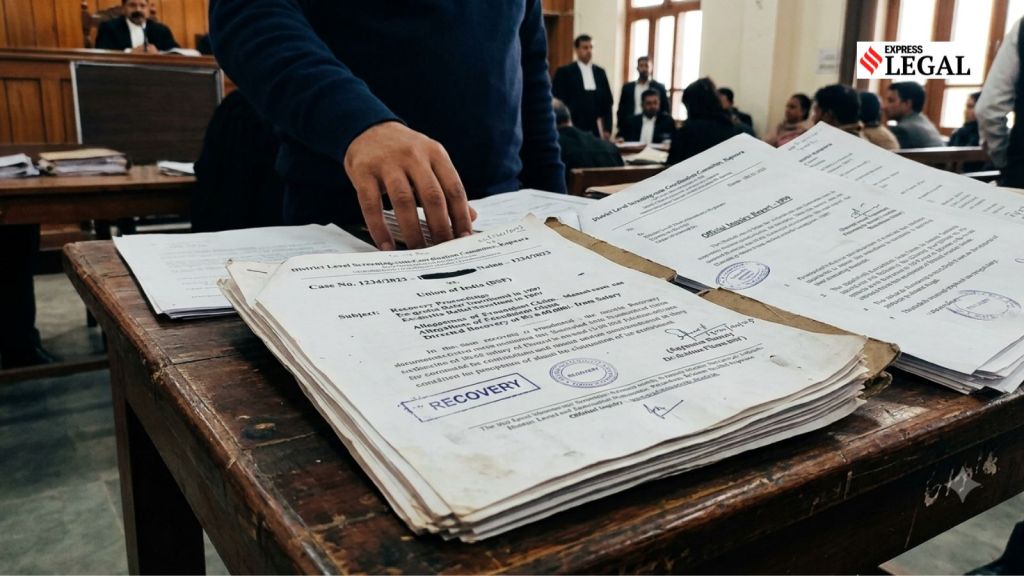
 In 2022, the authorities directed recovery of the Rs 6 lakh from his salary, and the BSF later ordered recovery in 30 instalments from August 2023. (AI-generated image)
Holding that the petitioner has utterly failed to prove that six of his family members died in 1993 at the onset of militancy in the valley, the Jammu and Kashmir and Ladakh High Court has upheld an order to recover Rs 6 lakh from a Border Security Force (BSF) personnel for fraudulently claiming ex gratia relief.
Dealing with the BSF personnel’s plea against the recovery order from his salary, Justice Rajnesh Oswal found that he falsely claimed that six of his family members were killed by militants in 1993, when they had actually migrated to Pakistan-occupied Kashmir (PoK).
“The petitioner’s lack of candor is clear from his repeatedly shifting claims. Intriguingly, while the report dated May 5, 1997, initiated solely on the petitioner’s application, states that all family members except one sister were killed, the record fails to explain why compensation was paid exclusively to the petitioner to the exclusion of his surviving sister,” the September 30 order reads.
The ruling underscored that the petitioner has utterly failed to prove that six of his family members died in the year in question. “Furthermore, it is improbable that a person whose six family members perished in 1993 would remain dormant for four long years before seeking redress,” it added.
 Justice Rajnesh Oswal noted inconsistencies in the petitioner’s version regarding the alleged deaths of his six family members.
The court said that it appears that a verification exercise was triggered following a 1999 news report exposing fraudulent compensation claims for persons alive in PoK.
The BSF personnel claimed that six of his family members were killed during militant violence in Kupwara’s Shalla Bathu village in 1993. Following a police inquiry, death certificates were issued, and the district screening-cum-coordination committee sanctioned ex gratia relief of Rs 1 lakh each for the six deceased persons, totalling Rs 6 lakh, which was paid to him in 1997.
The matter was later questioned after a 1999 newspaper report alleged that relief had been paid to families whose members had actually migrated to PoK.
A subsequent inquiry by the authorities concluded that the petitioner’s six relatives had crossed over to PoK and had not died, and that the Rs 6 lakh relief had been fraudulently obtained. Recovery proceedings were then initiated against him.
In 2022, the authorities directed recovery of the Rs 6 lakh from his salary, and the BSF later ordered recovery in 30 instalments from August 2023. The petitioner challenged the recovery before the high court, arguing that the relief had been sanctioned after official verification and that recovery was being initiated after more than 25 years without proper basis.
On behalf of the petitioner, advocate Dar Khurshid argued that the recovery proceedings have been initiated solely on the ground that the family members of the petitioner are alive and residing in PoK, but this fact is not supported by any investigating agency of India, as they cannot investigate the subject matter in PoK. Therefore, the recovery proceedings are illegal, he said.
The state, however, maintained that an inquiry had established that the six family members had migrated to PoK and that the BSF personnel had been given an opportunity to appear before the inquiry officer.
The court noted serious inconsistencies in the petitioner’s version regarding the alleged deaths of his six family members. While one document referred to a 1990 firing incident, the writ petition stated that the family members went missing in militant violence in 1993.
The court observed that although the alleged incident took place in 1993, the police daily diary entry was made only in March 1997, nearly four years later, and the death certificates were also issued later. “The petitioner has utterly failed to prove that six of his family members died in 1993. Furthermore, it is improbable that a person whose six family members perished in 1993 would remain dormant for four long years before seeking redress,” the high court observed.
It specifically noted that none of the bodies was ever handed over to the petitioner. It questioned why, if six family members had died in 1993, the petitioner remained silent for four years without making efforts to ascertain their whereabouts.
The court found that the petitioner’s claims contained “significant contradictions” and noted that the record did not explain why the compensation was paid only to him when his representation itself stated that one sister was alive.
It observed that the petitioner had failed to establish that the six family members died in 1993. The court further found that the record indicated the relief had been procured in collusion with police and revenue officials.
On the petitioner’s claim that he was not given a hearing before recovery, the court rejected the argument, noting that he had been called before the additional deputy commissioner, his statement and those of other witnesses were recorded, and he had not challenged this in his response.
The court also noted that not a single body of the allegedly deceased family members was found and held that retaining the Rs 6 lakh would amount to unjust enrichment because the basis on which the relief was granted had been established to be false.