


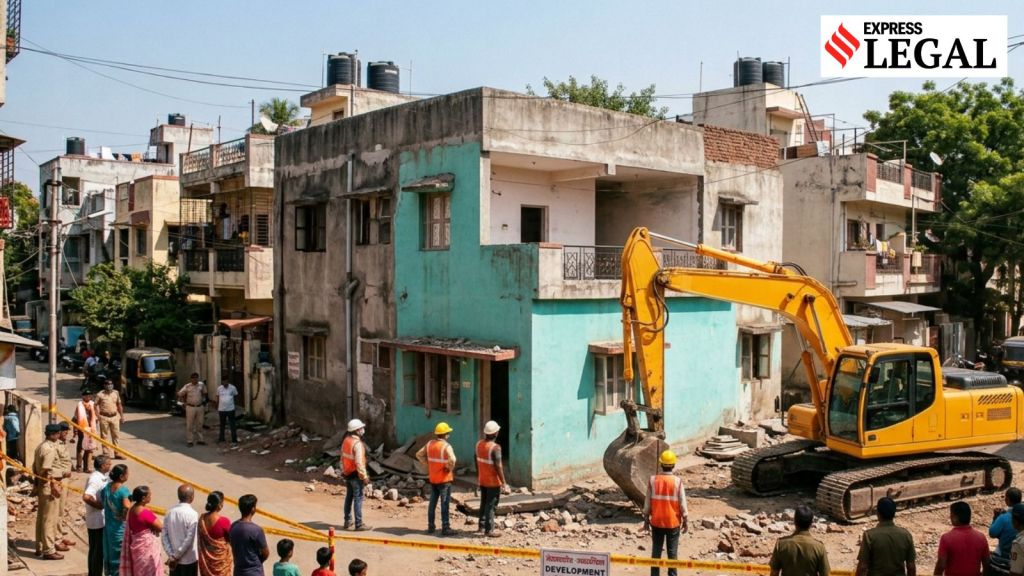
 The court noted that the demolition was carried out in the presence of state authorities. (Image generated using AI)
Calling the illegal demolition of the house similar to ‘brahma hatya’ (grave sin), the Patna High Court has directed the East Champaran administration to pay interim compensation of Rs 5.5 lakh to three petitioners whose house and boundary walls were demolished in 2017.
Justice Raj Kumar observed that the demolition of the boundary wall and the house happened in the presence of authorities without any order and yet no action was taken against the wrongdoers.
“Once the house in which a person is living is demolished, it is akin to Brahma Hatya, for which monetary compensation can only serve as a remedy to rebuild or reconstruct the house and enable the inhabitants to start a new journey. However, it cannot compensate the person or the family for the misfortune and mishap suffered by them,” the court said.
It observed that the demolition of the petitioners’ house, without any authoritative decision and in the midst of an encroachment proceeding, by a mob cannot absolve the authorities of their responsibility.
 Justice Raj Kumar awarded a total of Rs 5.5 lakh compensation to the petitioners.
The petitioners had approached the high court seeking compensation for the demolition of their structures and protection of their possession over the land. They claimed to have purchased the land through registered sale deeds. According to the petitioners, an encroachment proceeding was initiated against them in 2016-17. While the proceeding was pending, officials allegedly reached the spot with a JCB following a public gathering and the structures on the land were demolished.
The petitioners alleged that the demolition was carried out without any lawful order or authority, without affording them any opportunity of being heard and without following the procedure prescribed under law. It was further stated that the respondents failed to produce any order authorising such demolition and that the persons assembled at the spot were permitted to take away the materials from the demolished structures.
The State argued that notices had been issued in the encroachment proceedings but said that no demolition order had been passed. It also denied having any role in the demolition, claiming that the structures had been damaged by a mob.
The court observed that the right to shelter is a fundamental right enshrined under Article 21 of the Constitution. It noted that when the Constitution vests a citizen with the right to shelter, its deprivation not only violates a fundamental right, but also causes deep pain and anguish to the person and the family who suffer such a catastrophe.
“A house is not merely a building comprising four walls and a structure, but also represents an emotional connection for the family residing therein,” the court said. It further added that demolition of a house strikes at the root of a person’s identity and brings trauma to the family, which is irreparable.
The court observed that the authorities instead of taking immediate action against the unlawful action of the mob in question and identifying the culprits, drifted towards a cancellation proceeding for the Jamabandi of petitioners, without taking into consideration the suffering and turmoil in the lives of the petitioners.
The court thus directed the commissioner, East Champaran, to pay Rs 1.5 lakh to one of the petitioner and Rs 2 lakh each to the other two petitioners within two months. The court further directed the Commissioner to conduct a detailed inquiry and determine the final compensation payable to the petitioners within three months after payment of the interim compensation.