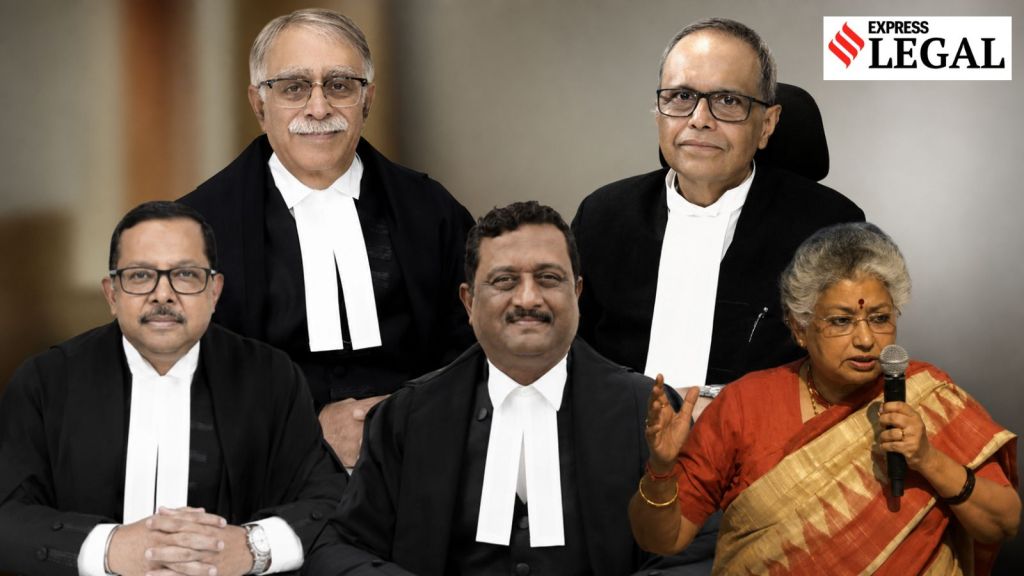
Judges have traditionally spoken through their judgments. Increasingly, however, their words are travelling beyond the courtroom — from university convocations and memorial lectures to conferences and public events, and from there to social media feeds and national headlines.
A sitting Supreme Court judge can make a remark at a weekend lecture and find it dominating online debates within hours. Retired judges, too, have become more visible public commentators. The subjects they speak on range from the independence of judiciary and constitutional values to free speech, education, religion, technology and democracy.
Beyond the Supreme Court
In the most recent example, Supreme Court judge Justice Ujjal Bhuyan defended the right of students to ask questions to those in power. Speaking at the LLM convocation of the National Law University, Delhi on August 30, he said that students cannot be threatened or subjected to punitive action for expressing views differing from those in positions of authority.
“In a democracy, the right to question is not an act of defiance. It is an essential expression of citizenship, liberty and constitutional responsibility… So when students express a different point of view, when students ask questions, they cannot be threatened. They cannot be threatened with punitive action. That is unconstitutional. That is misuse of power and office,” he said.

A day before that, Supreme Court judge Justice B V Nagarathna stated that a Bar Council that does not earn the respect of its members is “not a good sign for the legal profession”. Addressing the 13th convocation of National Law University, Delhi, Justice Nagarathna said, “The Bar Councils, whether the Central or the States, must introspect on their role and importance in upholding professional ethics, morality and professional competence. When a Bar Council does not earn the respect of its members, it is not a good sign for the legal profession.”
Her remarks come in the backdrop of demands for the resignation of Bar Council of India (BCI) Chairman Manan Kumar Mishra over an August 13 directive asking state Bar Councils not to enrol students of the 2026 batch of the NALSAR University of Law after they opposed having Chief Justice of India (CJI) Surya Kant as the chief guest at their convocation.
Story continues below this ad
On August 24, Supreme Court judge Justice Prasanna B Varale questioned the government’s priorities while speaking at a school event in Dhule, where he had studied. He said that around Rs 32 crore – just 0.1 per cent of the amount allocated for the Nashik Kumbh – could have saved 100 to 125 Marathi-medium schools from closure. He added that studying in a regional-language school had never held him back. Justice Varale said he had studied up to Class 10 in municipal and Zilla Parishad Marathi-medium schools and it helped him gain a broader perspective in life.
In another striking example, Justice Sanjay Karol, on his final day as a Supreme Court judge on August 22, reflected on what it means to be a judge. “We, as judges, are not gods. We will not get every judgment right,” he said in his farewell address, urging judges to look beyond the bare facts of a case and recognise the human being behind every litigant. He said that a petition could tell a court what had happened, but not necessarily what a person had already lost or hoped to gain from the judicial process. His remarks garnered attention across sections beyond the legal arena.
On July 25, Justice Bhuyan spoke at the Justice G P Singh Memorial Lecture at National Law Institute University (NLIU), Bhopal, about dissent, protests, arrests and delays in granting bail. One of his most important remarks was that there was “no law prohibiting consumption of chicken over the Ganga river”, questioning the criminalisation of the act and restrictive bail conditions.
In an interview with The Indian Express, former Supreme Court judge Sudhanshu Dhulia a 100% agreed with the statements of Justice Bhuyan, calling it a “very courageous and an apt comment”. He said, “On how much judges should speak, there has to be a certain restraint considering the nature of the job, because sometimes these matters come before you and then you are in a fix whether you have already made a comment on it. A certain degree of restraint has to be there among judges, no doubt.”
Story continues below this ad
Justice Dhulia wanted us to remember that a “judge is also a citizen of this country”, and asked, “The very fact that he’s a judge of a higher court, a constitutional court, doesn’t mean that he ceases to be a citizen. Who would disagree with this statement?”
A week later, on August 1, Justice Bhuyan questioned the opacity surrounding the decisions of the Supreme Court Collegium while speaking in Delhi at the launch of a report titled ‘The Judicial Transparency Index’ by the Vidhi Centre for Legal Policy. On August 8, he spoke in Guwahati about balancing development with environmental sustainability, arguing that environmental protection could not be left to political priorities.
Three appearances of a sitting Supreme Court judge in roughly a fortnight, covering civil liberties, transparency in judicial appointments, and environmental protection. Mainstream and alternative media, online law portals and websites, along with law students and others, are prolifically consuming and distributing related information.
The range of subjects that are being talked about has also become vast. On August 1, Justice Joymalya Bagchi warned about the impact of ‘Big Tech algorithms’, misinformation and social-media pressure on judicial independence. Speaking at the Justice H R Khanna Memorial Symposium at the Supreme Court complex in New Delhi, he cautioned against judges being influenced by the “digital mob”.
Story continues below this ad
The judges are talking not just about the law, but about the institution they belong to and the forces – social as well as others – shaping it.
When HC judges speak up
High court judges too have aired their opinions on various topics from time to time, sometimes even triggering controversies.
Justice G R Swaminathan from the Madras High Court made headlines in February this year after his remarks at a spiritual event in Hosur, Tamil Nadu. He described rationalists who did not believe in spiritual gurus as “rascals, fools and barbarians”. The remarks raised questions about how a sitting judge should conduct himself on a public platform.
In December 2024, Allahabad High Court judge Justice Shekhar Kumar Yadav’s speech at a VHP legal cell event, in which he made controversial remarks concerning Muslims and the Uniform Civil Code, led to widespread criticism. He said, “I have no hesitation in saying that this is Hindustan, this country would function as per the wishes of the majority living in Hindustan. This is the Law… The law, in fact, works according to the majority.”
Story continues below this ad
He questioned why practices such as untouchability, sati and jauhar had been abolished in Hindu society, while polygamy continued to be allowed among Muslims. He called the practice “unacceptable”. The Supreme Court Collegium took note of the speech and counselled him over the remarks. An impeachment motion was later moved in Parliament. Justice Yadav retired on April 15, while the process was pending.
The episode also demonstrated just how far a judge’s words can travel once they leave the courtroom – from a local gathering to national headlines, institutional scrutiny and Parliament.
What about retired judges?
For judges who have retired and left the bench, the public space is even wider.
Former Chief Justice of India U U Lalit has remained a regular voice at public legal events since his retirement. On March 24, he delivered a lecture on parliamentary privileges at the SRM Institute of Science and Technology, discussing their constitutional basis, contemporary relevance, and their relationship with fundamental rights and judicial review.
Story continues below this ad
Earlier, on September 24, 2025, Justice Lalit spoke at a Supreme Court Bar Association lecture on the Bharatiya Nyaya Sanhita (BNS) and the Indian Penal Code (IPC). He raised questions about the new criminal law, including the absence of clear guidelines for awarding community service as punishment and the lack of gender-neutral provisions for adult male victims of sexual assault.
In August, former Supreme Court judge Justice K M Joseph commented on democratic discourse in a public lecture. Speaking at a Kerala High Court Bar Association lecture marking the 250th anniversary of the US Declaration of Independence, he expressed concern over the relationship between business houses and major media organisations, and argued that biased television debates can make it harder for citizens to determine the truth.
Former Delhi High Court judge and former Orissa High Court Chief Justice, Justice S Muralidhar, has continued to speak publicly on media freedom, courts and civil liberties. On August 24, he said the recent Gen Z-led student protests at Jantar Mantar proved that democracy will endure in India. He also criticised the use of criminal law against peaceful protesters. Justice Muralidhar was speaking at the 28th DS Borker Memorial Lecture on ‘My Vision of India’.
“The recent protests by Gen-Z assure us that democracy in India will not be allowed to die and that people will turn to the Constitution to safeguard and preserve this country’s future. The week of 20th July this year was one of relief and joy. It was reassuring to know that our young generation will not be swayed by rhetoric and propaganda by powerful oratory, reminiscent of the Goebbelian polemic and empty promises of ‘Achhe din’ and ‘Viksit Bharat’,” he was quoted as saying.
Story continues below this ad
“They remained undeterred by the demonising of the ‘Dhimagi Naxal’. It told us this generation’s value is giving, compassion and adherence to truth. It doesn’t hesitate to ask questions to those in power and of course, Gen Z has a wonderful sense of humour. The irreverence of Gen Z is a sure sign of democratic progress,” he added.
Scale of digital attention
A lecture that once reached the people in a controlled space, among the presence of lawyers and judges, can now be recorded, uploaded and clipped almost immediately. One sentence can become a “viral” headline. A 45-minute speech can generate stories that could dominate the news space for days. A judge speaking about algorithms in digital space can himself become the subject of an algorithmically amplified video.
This makes a memorable judicial remark valuable in a way it perhaps was not a decade or two ago. The subjects most likely to travel are often those already being discussed outside the legal world – dissent, free speech, judicial appointments, AI, social media and institutional accountability.
However, an irony coexists – judges are increasingly warning about misinformation, algorithms and the loss of context in digital communication, even as their own words are being circulated through those very systems.
Story continues below this ad
While judges may not be speaking up more often now than before, recent times have seen a striking mix of sitting Supreme Court judges commenting on the institution and society, high court judges drawing attention with their observations, and retired judges taking on public commentary.
However, the courtroom remains a constitutional space where judges exercise their constitutional power. Outside it, the lecture hall, university auditorium, memorial platform and conference stage are becoming another place where they explain the institution, its challenges and, occasionally, themselves. And that may be the real change. The judges may not be speaking every weekend. But increasingly, when they do, people are listening.
What former SC, HC judges say
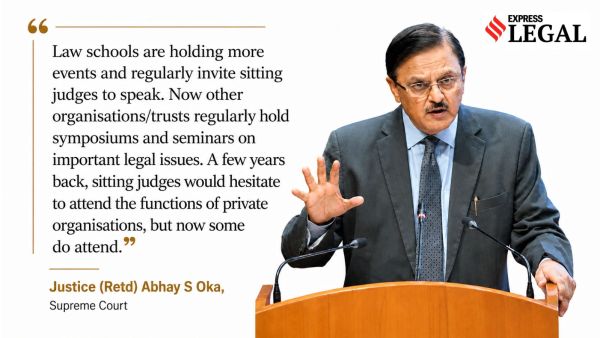
Justice Abhay S Oka, a retired Supreme Court judge known for raising environmental causes, including the pollution in Delhi-NCR, said the big difference now is the reach of social media. “I became a Judge of the Bombay High Court in 2003. Even then, sitting judges would address conferences and functions of the State Bar Council, Bar Associations, and law colleges. Local newspapers would carry reports too, but there was no social media. The law reporters stuck to reporting the court judgments and orders.”
“Moreover, the judges’ speeches were not uploaded on YouTube or other platforms as such platforms were not available at the time,” he pointed out, adding that in the last 10 to 15 years, several new national and private law schools have come up and sitting judges of the Supreme Court and high courts are associated with the national law schools.
The former top court judge feels that law schools are holding more events and regularly invite sitting judges to speak. “Now other organisations/trusts regularly hold symposiums and seminars on important legal issues. A few years back, sitting judges would hesitate to attend the functions of private organisations, but now some do attend,” he noted.
Interestingly, a year ago Justice Oka spoke at an event organised by the Supreme Court Bar Association (SCBA) on the topic of clean air and sustainability and said that apart from people taking up environmental issues being “ridiculed by the political class”, judges too had become targets for passing “strong orders” on such matters.
“Unfortunately, these activists who do this pro bono work. They take so much effort. They take so much risk by taking the environmental issues to the court. They’re ridiculed by the political class. They’re targeted by religious groups. This is the most unfortunate situation,” Justice Oka said in his speech in October, 2025.
He now thinks that the media is interested in publishing the speeches of judges and owing to the higher degree of public engagement on social media, their speeches go viral. “Even the apps of law reports report it. That is how video clips go viral. Therefore, both sitting and retired judges have to be cautious when they speak at such functions, as sometimes the reporting is not accurate,” he added.
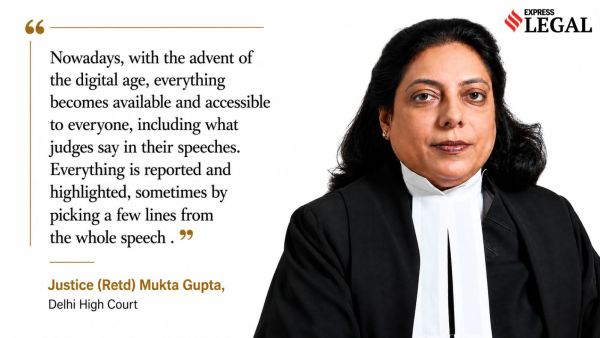
Everyone has the right to freedom of expression, including sitting judges, in a democratic country, said former Delhi High Court judge Justice (Retd) Mukta Gupta. “Nowadays, with the advent of the digital age, everything becomes available and accessible to everyone, including what judges say in their speeches. Everything is reported and highlighted, sometimes by picking a few lines from the whole speech.”
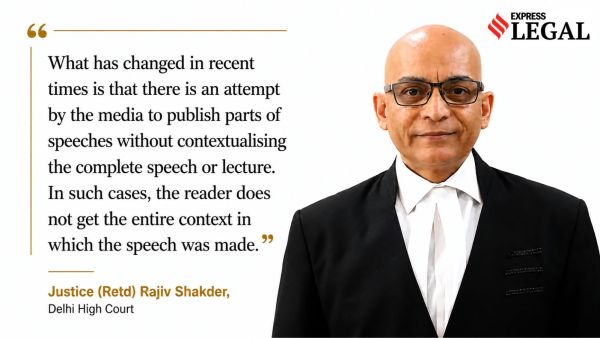
Former Delhi High Court judge Justice (Retd) Rajiv Shakdher said there is nothing new about sitting judges giving speeches or lectures. “What has changed in recent times is that there is an attempt by the media to publish parts of speeches without contextualising the complete speech or lecture. In such cases, the reader does not get the entire context in which the speech was made,” he said, surmising that media outlets, on account of competition, “are under pressure to report a story live and almost instantly.”
The profile of the media has changed and even the most conservative section of the print media has a digital format, said Justice Shakhder. “Therefore, we sometimes come across aberrations, which are more on account of failure on the part of the reporter to capture the context in which the speech or lecture was made,” he underlined.