


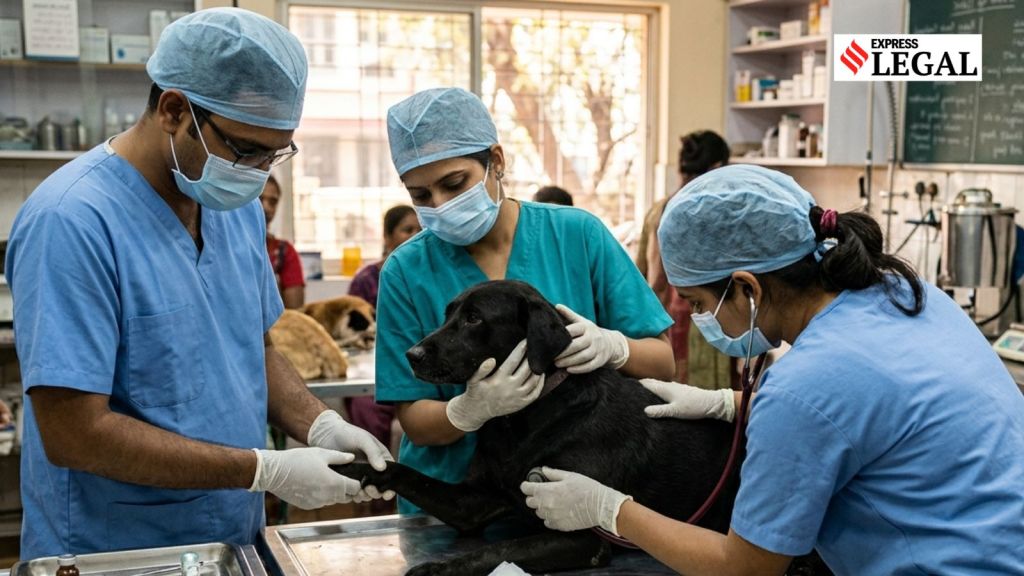
 Highlighting the growth of animal husbandry into an industry, the court emphasised that veterinarians interact with over 80 per cent of rural populations. (AI-generated image)
Calling veterinary doctors the world’s best physicians while quoting American humourist Will Rogers, the Madhya Pradesh High Court has upheld a ruling granting veterinary surgeons equal time-scale pay benefits on par with medical officers in human healthcare.
Time-scale pay is a salary system where an employee’s pay starts at a set minimum amount and automatically increases by regular, scheduled amounts (called increments) over time until it reaches a set maximum limit.
Dismissing the state’s plea, a bench of Justices Anand Pathak and B P Sharma said veterinary doctors have to go to the remotest of areas with adverse terrain and weather, to treat patients who can’t speak, and ruled that veterinarians perform demanding, highly skilled work treating voiceless animals, making discrimination in their pay progression unjustifiable.
The court quoted American humourist and social commentator Rogers as saying, “Personally, I have always felt that the best doctor in the world is the veterinarian. He can’t ask his patient what the matter is. He’s just got to know.”
“Human Doctors rely on patients explaining their symptoms, but that facility is not available to veterinarians. He has to heal the animal by deep intuition, incredible diagnostic skills, patience, and observation. Therefore, the job appears to be tough and requires special and robust skill sets,” the ruling observed.
 Justices Anand Pathak and B P Sharma observed that both veterinarians and doctors who treat humans act as ‘healers of society’.
Vishnu Kumar Gupta and other veterinary assistant surgeons had filed the petition before the high court seeking equal benefits under the time-scale of pay (higher pay scale/kramonnati) on par with dental surgeons and medical officers.
It was submitted that dental surgeons and medical officers receive time-scale pay benefits on completing five, 10, 15, and 30 years of service, whereas veterinary surgeons were only given the benefit after completing eight years of service. It was also claimed that there is discrimination between veterinary assistant surgeons vis-à-vis dental surgeons/medical officers, and they are not provided a similar benefit on par with the dental surgeon/medical officer.
A single bench of the court ruled in favour of the veterinary doctors, ordering the Department of Animal Husbandry and Dairy to grant them the time-scale pay benefits on par with dental doctors. Then, the state filed a petition challenging this order.
Representing the state, advocate Manikant Sharma submitted before the division bench that petitioners are qualified veterinary assistant surgeons working in the Animal Husbandry and Dairy Department, and they are governed by a different set of rules, whereas medical doctors and dental surgeons come under the Madhya Pradesh Public Health and Family Welfare Department and are governed by different rules. Therefore, the petitioners cannot claim parity with those employees.
The high court found that the state government already treats veterinary surgeons on par with medical and dental surgeons by giving them equivalent pay scales and benefits. Thus, they cannot be treated differently for higher time-scale pay benefits.
The court observed that both regular doctors and veterinarians act as “healers of society”; one treats human beings while the other treats voiceless animals, making the distinction between them unjustified. “Being the employer, the State cannot discriminate between two services rendering the same nature of job, although the targeted group may be different,” the order said.
Highlighting the growth of animal husbandry into an industry, the court emphasised that veterinarians interact with over 80 per cent of rural populations. “Therefore, their services cannot be discounted in any manner,” it added.