
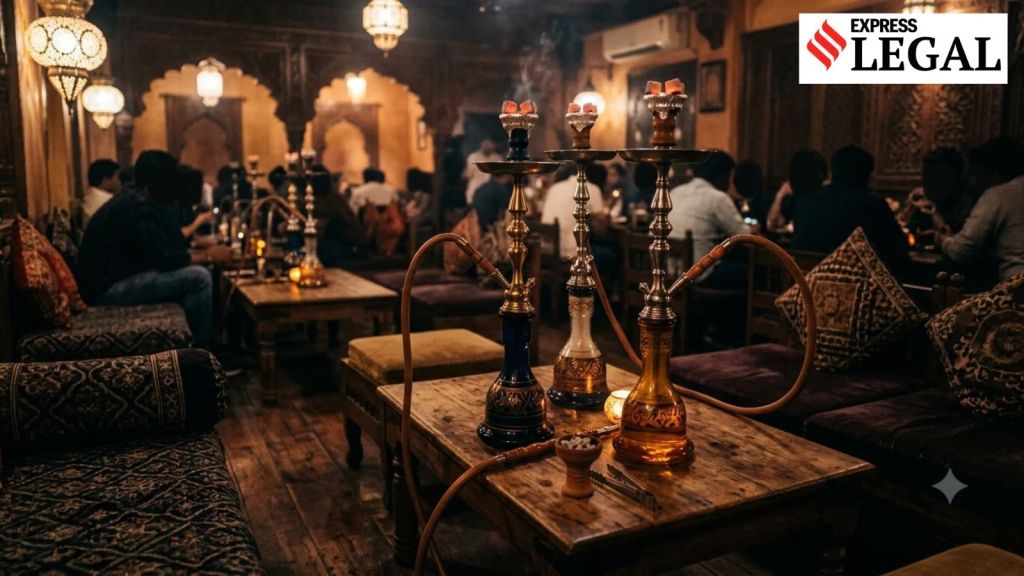
“The right of the non-smoker to breathe clean air in a public place is a fundamental right guaranteed under Article 21 of the Constitution of India, that cannot be abridged by commercial interest of an establishment having Right to Trade under Article 19(1)(g) of the Constitution of India,” the court said on September 29.
It held that operating hookah bars and rendering hookah services in restaurants in Uttar Pradesh amounted to a “flagrant violation” of Rule 4(3) of the Prohibition of Smoking in Public Places Rules, 2008, as amended in 2017, and was contrary to the scheme and object of the tobacco-control law.
The court expressed the expectation that the Uttar Pradesh government would take necessary steps to protect the health and welfare of citizens, “including issuing a notification, on similar lines with other States, imposing stringent punishment for service of hookah in all Designated Smoking Areas within the State.”
The court ultimately held that hookah bars cannot lawfully operate or render hookah services in designated smoking areas within public places in Uttar Pradesh and dismissed all the petitions.
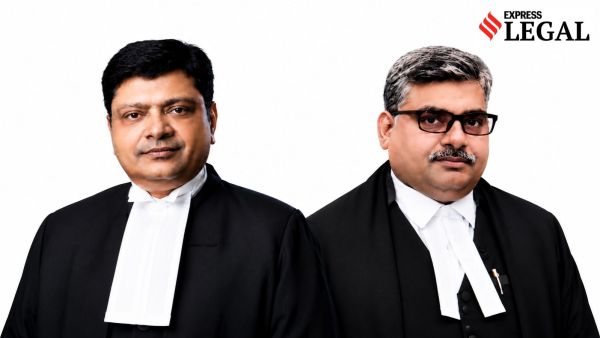
Justice Shekhar B Saraf and Justice Abdhesh Kumar Chaudhary said hookah service cannot be provided in designated smoking areas in UP. (Image enhanced using AI)
Judge’s personal warning on tobacco smoking
In its epilogue, the Allahabad High Court went beyond the legal question before it to highlight the health risks associated with hookah and tobacco smoking.
Story continues below this ad
“The Court… places on judicial record a fact of grave medical significance that a single session of hookah lasting approximately one hour involves an estimated 200 puffs and is equivalent in harm to smoking 100 cigarettes,” it said.
The court further said it is a myth that hookah is less harmful than cigarettes: “Hookah is as addictive as a cigarette, as harmful as a cigarette, and contains the same toxic chemicals as a cigarette. Moresoever, every packet of cigarettes carries a mandatory statutory health warning, a similar caution is required in case of hookah in order to fill a regulatory gap that demands urgent legislative attention.”
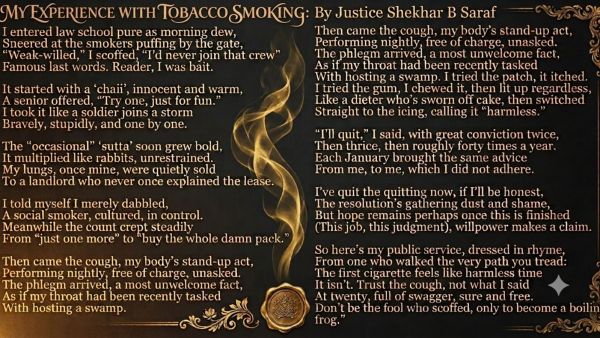
Justice Shekhar B Saraf then added a personal reflection titled “My experience with tobacco smoking”, writing that he had once believed he would never become a smoker but eventually took up the habit.
In a poem, he described how an “occasional” cigarette gradually turned into a recurring habit and how repeated attempts to quit followed. He ended with a warning aimed at young people, writing: “The first cigarette feels like harmless time / It isn’t.”
Story continues below this ad
Justice Abdhesh Kumar Chaudhary followed the poem with “I agree.”
Justice Shekhar B Saraf’s poem recounts his personal journey with tobacco smoking and warns young people against addiction. (Image enhanced using AI)
Dispute
The dispute arose after restrictions on hookah services in Uttar Pradesh during the Covid-19 pandemic.
In an order dated August 27, 2020, the High Court, in a suo motu PIL, issued strict directions to the UP Chief Secretary to not permit bars, restaurants and cafes to serve hookah until further orders due to alarmingly high transmission of coronavirus in the state. Subsequently, the Chief Secretary had issued a circular in September 2020 banning operation of all hookah bars.
The petitioners contended that the restrictions imposed during the pandemic were temporary and could not be treated as a permanent prohibition on hookah services.
Story continues below this ad
They argued that restaurants holding food-service licences should be permitted to maintain designated smoking areas and facilitate hookah use there. They also contended that the Food Safety and Standards Act dealt with food regulation and could not by itself be used to prohibit hookah services.
Another argument was that restaurants could avoid the prohibition by adopting a self-service model. Under this arrangement, they claimed, the establishment would prepare the hookah outside the designated smoking area, and customers would themselves use the apparatus inside it. The court rejected that distinction.
The first petition was filed in 2023, while the remaining 80 were filed in 2025 and 2026.
The petitioners’ counsel submitted that despite operating restaurants or hotels with valid food licences under the FSSA and having duly constructed designated smoking areas, the authorities were obstructing their hookah bar businesses.
Story continues below this ad
The court, however, held that the argument that a 2023 circular issued subsequent to the Covid lockdown implicitly recognised the legality of hookah bars is palpably incorrect, as the circular stated that it was mandatory for the establishments to ensure compliance with the COTPA and the amended Rules thereunder.
Hookah preparation itself amounts to service
The bench examined what constitutes a “service” under the amended rules and concluded that the expression has a broad commercial meaning. It said activities such as preparing, assembling, delivering, lighting, replenishing and maintaining a hookah for a customer for consideration amount to service. Therefore, providing hookah in a restaurant falls within the prohibition contained in amended Rule 4(3).
The court also rejected the argument that a hookah apparatus could simply be rented to a customer rather than provided as a service. Unlike a rented vehicle, where the person taking it on rent obtains possession and control and can use it independently, the court noted that a prepared hookah remains tied to the designated smoking area. It therefore held that providing the apparatus constitutes a service rather than a rental.
The proposed self-service model also did not convince the court. It held that the operation of a hookah intrinsically involves service requiring expertise and cannot realistically be converted into a purely self-service activity merely to avoid the statutory prohibition.
Story continues below this ad
A central part of the ruling was the court’s interpretation of the 2017 amendment to Rule 4(3). The court noted that the earlier wording referred to “no other service”, whereas the amendment substituted it with “no service”. According to the bench, this change made the prohibition absolute and unqualified.
The designated smoking area remains a limited statutory exception to the general prohibition on smoking in public places, the court said. It cannot be treated as an extension of the normal service area of a restaurant, hotel or similar establishment.
The court consequently held that services of any nature, including food, beverages, tobacco products, herbal products and hookah, cannot be provided within such an area.
Food department can’t license hookah bars
The court held that the Food Safety Department and Municipal Corporation does not have jurisdiction to issue licences specifically for regulating hookah bars in Uttar Pradesh. However, it said the enforcement provisions of COTPA give police authorities powers to ensure compliance, including search, seizure, confiscation and penalties where the statutory requirements are violated.
Story continues below this ad
The court concluded that operation of hookah bars and rendering of hookah services by restaurants in designated smoking areas within public places in Uttar Pradesh violates amended Rule 4(3) and the scheme and object of COTPA. It dismissed all the writ petitions. The registry was directed to send copies of the judgment to the Uttar Pradesh chief secretary and director general of police for information and necessary compliance.
The court, while concluding the case, also said it was necessary to record observations that had weighed on its judicial conscience. It noted that the WHO’s 2019 tobacco epidemic report rated India’s smoke-free policy as “merely moderate”.
It also pointed out that Gujarat, Punjab, Rajasthan, Maharashtra and Karnataka had amended COTPA to specifically ban hookah bars and increase penalties and fines for violations. The court further noted that India ratified the WHO Framework Convention on Tobacco Control on June 14, 2004, undertaking international obligations to ensure effective laws for smoke-free indoor public places, workplaces and public transport.




 Justice Shekhar B Saraf and Justice Abdhesh Kumar Chaudhary said hookah service cannot be provided in designated smoking areas in UP. (Image enhanced using AI)
 Justice Shekhar B Saraf’s poem recounts his personal journey with tobacco smoking and warns young people against addiction. (Image enhanced using AI)

