


 Ravi Kumar Diwakar questioned the legal force of administrative orders passed without jurisdiction and whether an officer can refuse to comply with them. (Image enhanced using AI)
Muzaffarnagar judge Ravi Kumar Diwakar, who has handed down 23 death sentences so far this year, has questioned the recall of 97 murder cases from his court, calling the administrative order passed by the District Judge “unlawful” and “without jurisdiction”.
On September 7, the judge had given his 23rd death penalty in 2026 and said he “would rather die” than be called a “coward” and give in to the diktats of mafias, strongmen, or criminals.
On September 17, Diwakar was deciding a narcotics case when he began penning his protest against the decision of the District Judge to recall the cases. He asked how the 97 serious cases, including murder cases, were removed from his docket through “nine similar orders” issued by the then Muzaffarnagar District Judge on August 18. He noted that the orders came just 13 days before the District Judge’s retirement.
“The provisions under CrPC and BNSS provide that the sessions judge cannot recall ‘part-heard’ files. Therefore, on August 18, 2026, the then District Judge, Muzaffarnagar, passed nine similar orders, recalling 97 part-heard murder cases from my court to his. The said orders were, in themselves, contrary to law, i.e., without jurisdiction, and the files were recalled merely 13 days before his retirement, without assigning any reason,” he said.
The 2015 narcotics case was filed for offences under the Narcotic Drugs and Psychotropic Substances (NDPS) Act. Judge Diwakar acquitted the accused, citing “prolonged litigation”, referring to the famous “tareekh pe tareekh” line from the 1993 Hindi blockbuster Damini starring actors Meenakshi Seshadri and Sunny Deol.
The judgment further asked if a judge is bound by an administrative order passed by a Sessions Judge or a District Judge which is “illegal” or “without jurisdiction”. “Another question that arises is: if an administrative order passed by a Sessions Judge or District Judge is contrary to the provisions or directions of law and is therefore “without jurisdiction”, can the concerned officer refuse to comply with it?” he said in the 35-page order written in Hindi.
“Power must be accompanied by responsibility and discretion. When checks on power cease to exist, a person begins to consider themselves above the law and morality. That is the moment when authority, instead of remaining a means of protection, becomes a means of oppression,” he added.
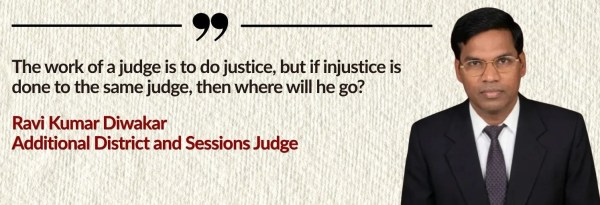
Diwakar went on to elaborate on the administrative control of a District Judge, saying, “The work of a judge is to do justice, but if injustice is done to the same judge, then where will he go?” How is a judicial officer required to follow an administrative direction that the officer considers contrary to law or without jurisdiction, he asked.
“If cases were subsequently decided by the district judge or another court after being moved under an administrative order that was legally invalid, would the decisions passed in those cases themselves be legally sustainable?” Diwakar raised the questions in the context of specific administrative orders, not a general declaration that judicial officers may disregard administrative directions when there is a disagreement.
Referring to the provisions of the Code of Criminal Procedure and the Bharatiya Nagarik Suraksha Sanhita, he said that a sessions judge cannot recall “part-heard” or partially heard matter files. “Therefore, on August 18, the then district judge, Muzaffarnagar, passed a total of nine similar orders, recalling 97 part-heard case files involving serious murder cases from my court to his own court. The said orders were, in themselves, contrary to law, i.e., without jurisdiction, and the files were recalled merely 13 days before his retirement, without assigning any reason,” he stressed.
Emphasising that the primary duty of a judge is to administer justice and discover the truth, he said, “A public servant should have the ability to call what is right, right, and what is wrong, wrong. This is because a public servant is not merely a public servant; rather, he or she is a part of, and represents, the system or institution to which they belong. Any system or institution can function and endure only when the public servants running it can call what is right, right, and what is wrong, wrong.”
In India, there is the rule of law, which means that no one is above the law, and this country will be run by the rule of law, rather than by the arbitrary conduct of any public servant, because they are not kings, he added.
The judge went ahead to comment on power and responsibility in a judicial context and said, “When a person acquires too much power, they often tend to misuse it for their own benefit. Power itself is neither good nor bad; its nature depends on how the person who possesses it chooses to use it.”
He continued, “Power must be accompanied by responsibility and discretion,” Diwakar observed. He said that when checks on authority disappear, there is a danger that a person may begin to regard themselves as above law and morality.”
Clarifying that power itself was not “inherently good or bad”, how it is exercised is what mattered. He quoted 19th-century English historian and politician Lord Acton as saying, “Power tends to corrupt, and absolute power corrupts absolutely”.
Diwakar acknowledged that the law separately gives a Sessions Judge the power to transfer criminal cases from one criminal court to another within the sessions division. He noted that the power to transfer a case does not necessarily end merely because its trial has commenced.
But, according to the legal principles discussed in the judgment, such a transfer power has to be exercised for the ends of justice and cannot be treated as an unrestricted administrative power. The judge therefore questioned the use of the word “recall” in the August 18 orders, particularly when, according to his judgment, the cases had already become part-heard. He also questioned why no reasons were recorded for moving the 97 serious cases.
97 murder cases pending before the UP judge were recently transferred via an administrative order passed by the Muzaffarnagar District and Sessions Judge on August 18. Despite the action, the judge gave the death penalty on September 7 in a dowry death case.
Diwakar joined the Uttar Pradesh judicial service as a civil judge in 2009 and has worked in several districts over the years, including Sultanpur, Budaun, Varanasi and Bareilly. He has been posted in Muzaffarnagar since November 2025. He became a familiar name beyond the courtroom in 2022, when, while serving as a civil judge in Varanasi, he ordered a videographic survey of the Gyanvapi mosque complex. Diwakar later said he received threatening calls and messages, including from international numbers, after the order.