4 min readNew DelhiSep 8, 2026 02:00 PM IST
For 21 years, a college laboratory attendant on contract kept showing up for work, with the promise of regularisation remaining just out of reach. The Orissa High Court has now described this prolonged uncertainty as a “Sword of Damocles”, set aside the rejection of his regularisation plea and given his long-pending hope a fresh lease of life by directing the Odisha Higher Education Department to reconsider his claim within three months.
Justice Murahari Sri Raman was hearing a petition filed by one Santosh Kumar Patra, a laboratory attendant at Shailabala Women’s Autonomous College, Cuttack, challenging the state government’s August 9, 2019 rejection of his plea for regularisation.

“The petitioner cannot be kept on the tenterhooks of employment for years together, by brushing aside and discarding his hopes and expectations for indefinite future with unresponsive indifference. This is nothing but a form of exploitation of the employees by not giving him the benefits of regularisation and by placing the Sword of Damocles over his head,” the court said on September 7.
The matter is related to Patra’s contractual service at the college and his claim that he deserved consideration for regularisation, particularly in view of the treatment given to another employee, one Anama Charan Nayak.
Justice Murahari Sri Raman noted that Patra had an unblemished record and served across different departments of the college for more than 20 years. (Image enhanced using AI)
More than two decades of contractual service
Patra claimed he was engaged from December 1, 2000, but records showed his service from September 1, 2005, when he joined as a peon at Rs 70 a day. He became an attendant in 2007 and a contractual laboratory attendant in 2010. He also worked in other departments, including admissions and examinations. His contract was repeatedly extended without objection. Taking 2005 as the starting point, the court said he had completed more than 21 years of service.
Patra sought regularisation in April 2017. The Odisha Administrative Tribunal directed the authorities to consider his plea in January 2018, but the higher education department rejected it on August 9, 2019.
The government said he was a temporary worker and not similarly placed to Anama Charan Nayak, who was appointed in 1988 on contract and later regularised. It also cited reservation requirements and his remuneration from the self-financing course.
The high court rejected the authorities’ reliance on reservation requirements introduced in 2013 and 2014. It said the college, as the appointing authority, was responsible for following the policy when Patra was engaged.
Story continues below this ad
After extending his service for more than 21 years, the authorities could not rely on later requirements to deny his regularisation claim. The court also noted that his extensions continued despite the later resolutions, with no objection to his work.
Rejection order unsustainable
The high court found that Patra was selected by the college and had the required qualification. It said the reservation law cited by the authorities did not apply when he was engaged.
It noted his unblemished record and more than 20 years of work across departments, saying his case could not be distinguished from Anama Charan Nayak’s on an “irrelevant basis and minuscule technicality”.
The court found the reasons for rejecting his claim in 2019 unsustainable, calling them “jejune grounds”. It set aside the rejection and ordered the higher education department to reconsider his regularisation claim within three months.





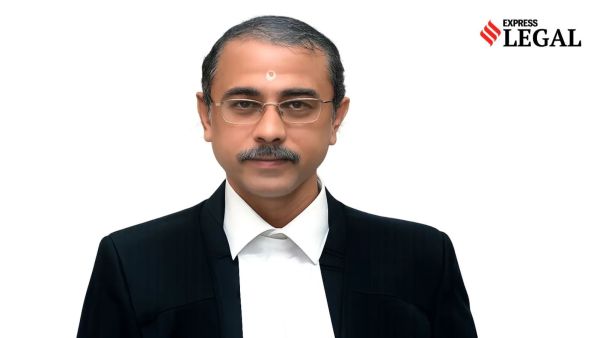 Justice Murahari Sri Raman noted that Patra had an unblemished record and served across different departments of the college for more than 20 years. (Image enhanced using AI)
