


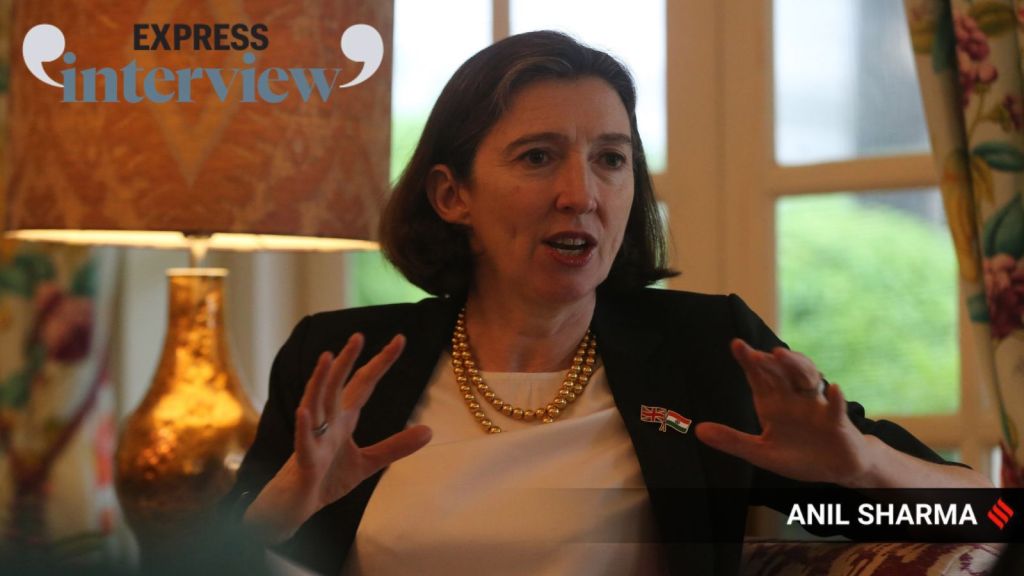
 British High Commissioner Lindy Cameron (Express photo by Anil Sharma)
Outgoing British High Commissioner Lindy Cameron is headed to London as the UK’s Permanent Under Secretary — equivalent to the rank of Foreign Secretary in India, the topmost diplomat’s job in the British Foreign Service. She leaves India over the weekend and will assume the new role next Monday. Cameron, who spent about two-and-a-half years in India, sat down with The Indian Express for a wide-ranging exclusive interview, in which she spoke about her professional and personal highlights — from the signing of the India-UK trade agreement to offering India to build world-class engines for fighter aircraft, the wars in Ukraine and West Asia, the protests in India, the issue of visas, among others. Edited excerpts:
What are your key achievements as the British High Commissioner to India?
I think, the top one has to be the trade deal, right? The Comprehensive Economic Trade Agreement, a really historic moment. It was a moment of just such extraordinary professional pride, a really career-defining moment to be standing in Chequers (the country residence of British PM), watching the two Prime Ministers, seeing the signing of the deal, knowing that this was something that was unequivocally going to benefit every single person in both of our nations, unrelentingly positive; that was the absolute high point for me.
 Lindy Cameron called the signing of the India-UK trade agreement, which she watched at Chequers, the “absolute high point” of her time in India. (Express Photo by Anil Sharma)
Then also Vision 2035, so taking that trade deal and then turning it into a wider and deeper relationship between the two countries, and really importantly seeing that as a future-facing relationship, so moving the relationship from where it was to thinking about the massive opportunities for the future, and I think those are probably the biggest things for me. But it’s been a hell of a two-and-a-half years, and it’s gone so quickly.
What were the biggest challenges in negotiating the FTA with India, any core memory or anecdote from the negotiating process?
So, I have to say, seeing Johnny Reynolds, our Trade Secretary, back with Commerce Minister Piyush Goyal this week was giving me flashbacks to various stages in the negotiation. I feel as if I have had a negotiating masterclass from Piyush Goyal over the last two and a half years, and genuinely, I’ve learned so much. He is incredibly impressive, but what it taught me was that it really was the relationships that built it. There were key moments, and I remember them very clearly, where they both said, “Okay, we won’t both get everything we want, but actually, the relationship is strong enough that we can make it work, and I think it’s that sense of how you get a mutually beneficial deal that is, frankly, enough for both sides. That’s how you find the landing zone for something like this. Nobody gets everything they want, but everybody gets most of what they want, and that was the outcome. And it really was relationship-driven. So, Johnny was remembering that when he came here first, he was in Opposition, and he told Piyush, “Look, we’re in Opposition now. If you can get the deal done, you should get it done. We’ll respect that… if you can’t get it done, we’ll do the deal.” And they both still tell that story to this day, and they both see that as the beginning of a journey that was then the relationship that landed that deal through what is now more than a year ago.
 Lindy Cameron said she is proudest of positioning Rolls-Royce as a candidate to build India’s future combat jet engine, with an offer that includes IP transfer. (Express Photo by Anil Sharma)
India and the UK are strategic partners. In the strategic domain, especially in defence and security areas, what was the highlight of your stint? And did your stint as head of the National Cyber Security Centre in London help and lead to any initiatives or progress in the cyber security domain?
So, defence and security is one of the five pillars of Vision 2035, along with technology as one of them, and that’s been really a key thread throughout. I joke that, on the cybersecurity side, of course, I knew people like Ajit Doval two years before I began as High Commissioner, when I was part of the team that was involved in the conversations that then led to the TSI, the Technology and Security initiative — another masterful negotiator, by the way, and somebody who I hugely respect. So, I think that’s what I brought on the cybersecurity side was an understanding of how thinking about future technology deeply permeated the thinking of both of our governments, and again, how thinking about the future world we wanted to shape and live in was part of what we needed to build a relationship around.
On defence and security, the proudest moment I have is seeing Rolls-Royce genuinely in a position to make an absolutely world-leading offer, not only the best time to first flight, but also really amazing IP (intellectual property) transfer as a potential candidate for building India’s future combat jet engine, but I am also really excited by the fact that it’s an offer to be part of India’s industrial future more widely. You know, they are making a big Make-in-India offer, that is very much about recognising that India will grow not just in defence and security, but actually the aerospace business will grow, the energy sector will grow, and being part of the indigenous journey to building power capability and engine capability is very exciting for them. How to position them to be there, that’s the thing I’m probably most proud of.
Coming to the Russia-Ukraine war, which has been going on for more than four-and-a-half years now, and after Russian President Putin’s visits to India, and EAM Jaishankar’s visit to Ukraine, there is talk of an Indian proposal in some kind of deal on the Black Sea. How do you view these developments?
It’s great that I think we all share, and particularly the UK and India share, a real desire to see this war brought to an end. It’s a huge, extraordinary suffering, and we really want it to end. It is, of course, for Ukraine to determine its position in any negotiations, and that’s very important. This is a symbol of India as a big global player. India is not only the biggest country in the world by population, but also an important and increasingly important player globally. And so, for me, this symbolises that move by India to be a player in a wider conversation, where, of course, India has an extraordinary and really diverse set of relationships to build on, some quite unique.
The war in West Asia has posed serious security, economic and energy security challenges to India. How can the UK cooperate with India to navigate these challenges?
We have huge shared interests here, whether that’s in energy security, whether it’s in energy costs, whether it’s in freedom of navigation, and I think this is really an area where we have an awful lot in common. So, thinking about what the path to peace and de-escalation is something that we are really keen to work very closely with India on. The Middle East is a complex area; it’s not straightforward, but it is really important that big countries like ours work on that together.
The issue of visas to the UK — the process, the numbers — is something that animates Indian conversations. During your time here, what has been the flow of Indian students, professionals, businesses and tourists to the UK, and how have you tried to ease the process?
I think we have a great story to tell. So, Indians are the biggest recipients of almost every visa category in the UK. Over 25% of UK visit visas were issued to Indians last year. That’s more than half a million visas. So, there is such fantastic mobility between our two countries. The story that I’ve tried to tell about this is that it is a story about mobility between two economic partners of the future, where actually this is not just about friends and families visiting. It’s not just about the amazing Indian tourists who go to all corners of the UK, Northern Ireland and Scotland, particularly excited about that, but it’s actually also about the kind of business mobility that the trade deal has improved for professional services like engineering or consultants, and indeed some of the specialist categories, yoga instructors as well. But actually, it’s a bigger story of two countries where I think we have got a great visa offer, and I’m very proud of UKVI. And frankly, no delays in getting them. You know, you can get an appointment whenever you want. So it’s a great service I’m proud of, and that makes it much easier to respond to all the questions. But also, it’s a great story about mobility between two future economic superpowers, and I think that’s a really exciting story to tell.
 Outgoing British High Commissioner Lindy Cameron, who spent about two and a half years in India, leaves over the weekend to take up the role of the UK’s Permanent Under Secretary. (Express Photo by Anil Sharma)
The UK has witnessed changes in its political leadership after two-and-a-half years of the Labour government. What does it mean for the India-UK relationship?
So, we have seen changes in UK politics, and that’s for politicians rather than me as a civil servant. But what’s been constant is the importance of India. I remember another event in February during the AI summit when we had David Lammy, who was then Deputy Prime Minister, and Rishi Sunak, the former Prime Minister from a different party, both on stage together, talking about AI. And it wasn’t just that AI had been important to both parties and both governments; it was also that India was important to both. And I think that remains the case. I was really lucky that our current Foreign Secretary Ed Miliband came here as Energy Secretary, and we had a great conversation. Many from our current government have been to India, whether with the same or different ministerial hats on. So, the importance of India and the importance of the UK-India strategic relationship remain really significant and really constant through any changes we’ve seen, and you’ve seen that again now in the latest changes. I think that nothing has changed, in a sense. We’re lucky because we have the Trade Secretary, in fact, back in his job, and he, as I said, he and Piyush Goyal were beyond excited to be back in the same place celebrating the deal that they have done together.
You have been in India for almost two-and-a-half years. Which have been your favourite experiences in these two years? What has been unaccomplished so far, and what would you like to do in the future?
Indeed. Oh, so I would say my professional highlight definitely was standing at Chequers (the country home of British PM) with the two Prime Ministers. Nothing will beat that probably in my whole career.
Personal highlights, it’s so hard to choose. I mean, how do you choose between standing at Kohima, which for us has got huge resonance as a battlefield, watching the Naga Hornbill Festival, as opposed to standing in Jaipur at the literature festival, or sipping a cup of coffee on the seafront in Pondicherry, or wandering around the extraordinary shared history in Lucknow that we have. I feel like I have scratched the surface, and I have an incredibly long list of places I haven’t made it to. Probably, the biggest regret is that I haven’t spent enough time in the mountains. So actually, I remember flying to Bhutan during my time here on a glorious sunny day, just watching the entire ridgeline of the Himalayas laid out before me, and thinking there you could spend a lifetime. So, when I’m back as a private citizen and as a tourist, I shall be off trekking in the mountains.
And, any sore points?
Sore points. To be honest, one of the great things about this relationship, and it’s one of the things I’m probably most proud of, is that we have a relationship of depth and trust that means that the sore points are things we can discuss privately. We are celebrating public success this week. Three ministers. It was quite a visit. This is partly why I look a little tired. Three secretaries of state, seven mayors, all here to celebrate the comprehensive economic trade agreement, but I think that’s public success. We have tough conversations, but we have them in private, and we have them with friends. And I’m seeing a number of these people for farewell calls today, and I think that that’s one of the things we’ve been reflecting on is how we do that.
Both India and the UK are democratic societies. You also have protests, democratic freedom of expression. In India, we are seeing an increase in protests. How do you view this political situation from a shared value perspective?
Yeah, so I think that firstly, I would say we completely support the right to peaceful protests. It’s an important part of our values. Policing is a matter for the Indian government, and it’s not for me to comment on. I think that these protests have been very widely covered globally, including in the UK, and that’s partly because India is the world’s largest democracy, and with that comes a level of interest in what’s happening in the world’s largest democracy. So there’s been a lot of interest in that, and I’ve been asked a lot of questions about it. But as I say, we are big believers in the right to peaceful protest. It’s something that matters to us in the UK.
As you leave for London to occupy the Permanent Under Secretary’s job, what are the key learnings from India that you will take to the topmost diplomat’s job in the UK? And as a friend of India, what does it mean for the future of India-UK ties?
So I’ve been reflecting on this in some of my farewell calls, and one of the friends that I was talking to was reflecting on the fact that I will take with me an understanding of India’s worldview. I think when you sit in Delhi, you sit in a different geography. You see the world from a different perspective. You see the world with a different history. You see the world with a different scale, actually, and that is something I will take with me to London. It’s probably part of why I got the job, in all honesty. So I think that this relationship really matters for the future, and understanding India is something that will permeate. I think every part of the job that I go and do, I ask for advice from colleagues as I go into it because I know it will be a big job, and of course the world is a complicated place at the moment. So it’ll bring many challenges, but many opportunities as well. And you can rest assured that I will be back, both I’m sure in a professional capacity and also in a personal capacity, many times in the years to come. And I’m really looking forward to it.