


Journalism of Courage
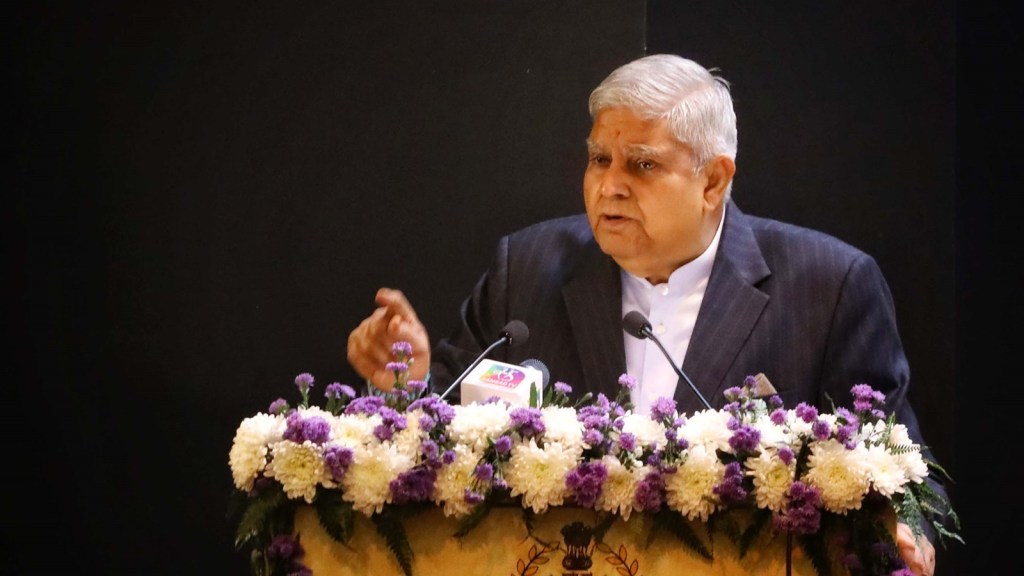 Vice President Jagdeep Dhankhar. (Source: Express Archives)
In the wake of the Supreme Court ruling that sets a three-month timeline for the President to decide on Bills referred by Governors of states, Vice President Jagdeep Dhankhar said Thursday that India cannot have a situation where the judiciary directs the President.
“So, we have judges who will legislate, who will perform executive functions, who will act as super Parliament, and absolutely have no accountability because the law of the land does not apply to them,” Dhankhar said while addressing the sixth batch of Rajya Sabha interns at the Vice President’s Enclave.
The Supreme Court earlier this month declared as illegal and erroneous the action of Tamil Nadu Governor R N Ravi in reserving 10 Bills for consideration of the President in November 2023 after they had already been reconsidered by the state Assembly. In the judgement, the apex court, for the first time, prescribed that the President should decide on the Bills reserved for consideration by the Governor within three months from the date on which such reference is received. It said that “in case of any delay beyond this period, appropriate reasons would have to be recorded and conveyed” to the state concerned.
Referring to the Supreme Court ruling, Dhankhar said his worries are at the “very highest level” and asked, “There is a directive to the President by a recent judgement. Where are we heading? What is happening in the country?”
VIDEO | Vice-President of India Jagdeep Dhankhar (@VPIndia) says, “We cannot have a situation where you direct the President of India and on what basis? The only right you have under the Constitution is to interpret the Constitution under Article 145(3). There it has to be five… pic.twitter.com/b6mA4XPfC0
— Press Trust of India (@PTI_News) April 17, 2025
“I never thought in my life I will have the occasion to see it. The President of India is a very elevated position. The President takes oath to preserve, protect and defend the Constitution. This oath is taken only by the President and her appointees, the Governors…” he said.
“We have to be extremely sensitive. It is not a question of someone filing a review or not. We never bargained for democracy for this day. The President being called upon to decide in a time-bound manner, and if not, it becomes law,” said Dhankhar.
“We cannot have a situation where you direct the President of India, and on what basis?” he asked.
Dhankhar also said Article 142 of the Constitution, which grants the Supreme Court the power to pass any order necessary to ensure “complete justice” in any case pending before it, “has become a nuclear missile against democratic forces, available to the judiciary 24×7”.
On the matter of partly burnt sacks of cash being recovered from the residence of Justice Yashwant Varma last month, Dhankhar said, “… In a democratic nation, purity of its criminal justice system defines its direction. Investigation is required… No investigation under law is in progress at the moment. Because for a criminal investigation, the initiation has to be by an FIR, First Information Report. It is not there.”
He asked while the Constitution accords immunity from prosecution only to the President and Governors, how a category beyond law secured this immunity, referring to the Justice Varma incident.
“The ill effects of this are being felt in the mind of one and all. Every Indian, young and old, is deeply concerned. If the event had taken place at his house, the speed would have been an electronic rocket. Now, it is not even a cattle cart,” he said.
“There is a committee of three judges investigating the matter, but investigation is the domain of the executive; investigation is not the domain of the judiciary. Is the committee under the Constitution of India? No. Is this committee of three judges having any sanction under any law emanating from Parliament? No. And what can the committee do? Committee can at the most make a recommendation. Recommendation to whom? And for what?” he asked.
Referring to the independence of the judiciary, Dhankhar said, “This independence is not a protection, this independence is not some kind of impregnable cover against inquiry, investigation, probe. Institutions thrive with transparency, with there being probe. The surest way to degenerate an institution or an individual is to give total guarantee there will be no inquiry, no scrutiny, no probe.”