Ruchi Ghanashyam – the first Indian woman diplomat to be stationed in Islamabad – was heading towards the home of former Pakistani diplomat and author Husain Haqqani, when she realised her car was being tailed.
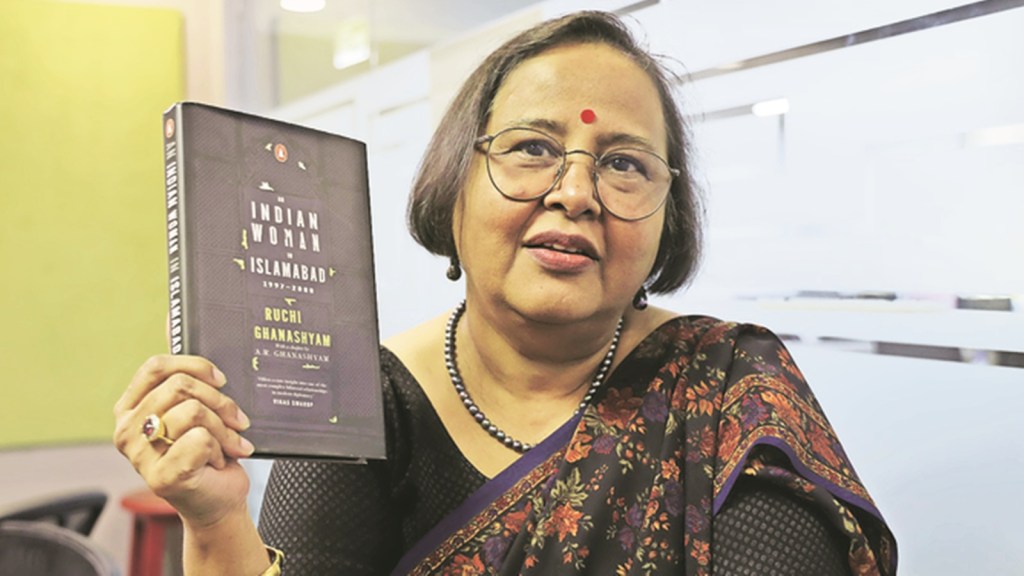
Recalling one of several such incidents in her new book, ‘An Indian Woman in Islamabad 1997-2000’ (Penguin Random House India), Ghanashyam — who had served in Syria, Nepal, South Africa, and the UK during her distinguished career of 38 years — remembers telling Haqqani, “… I was a more expensive guest than he had bargained for, ‘I brought seven guests, apart from myself!’.”
The experience of being constantly shadowed and particularly during her drive to Haqqani’s home by “five of them in a car and two on a motorcycle”, is delineated in the chapter “The Constant Shadows”. “It was a visit to Karachi that probably represents the pinnacle of tailing,” Ghanashyam writes. “As he received me, Husain instructed his staff to offer tea to the agents who had accompanied me,” she said in her book.
She also says in the book that “the presence of agents came in handy at times”. One evening, while going to a new pizza outlet in Lahore with her family without a GPS, it was the agents following them who came up to them and asked them where they wanted to go. They followed the agents to the restaurant. “Normally, whenever we went somewhere, they (Pakistani agents) would wait outside, and when we would finish our work, they would follow again. They would have listened to your conversation, so they would have known whom you met,” Ghanashyam, 64, who retired in 2020, tells The Indian Express.
Ghanashyam, along with her husband AR Ghanashyam, was posted at the Indian High Commission during the Kargil conflict. “Pakistani briefings initially described the infiltration as a limited probe, meaning a small-scale incursion to learn about occupied/unoccupied areas. Even as intrusions in Kargil were far too extensive to be described as a limited probe,” she says in the chapter ‘LoC heats up conflict in Kargil.’
When IC 814 flight was hijacked in 1999, AR Ghanashyam, then commercial counsellor at the Indian High Commission in Islamabad, was sent to Kandahar to establish direct contact with the hijackers. In the chapter “IC 814 hijacking: The perspective from Islamabad’, she writes about how the Pakistani establishment was peeved at her husband’s deputation to Kandahar, even claiming that he belonged to the Research and Analysis Wing (R&AW).
Later, as a Pakistani “friend” cornered her one evening, asking her if her husband was “the station chief” in Islamabad, she reveals in the book how she shut that person up with: “When it comes to Pakistan, we have a billion agents in India. All of us are R&AW agents!” That, she says in the book, was the end of the probing.
The author was working on the Pakistan desk in South Block when the 2001 Parliament attack took place. “When it happened, we decided to cut down the strength of the Mission. The families came back. Similarly, the Pakistan High Commission strength in Delhi was also cut down,” she tells The Indian Express.
“But when our High Commissioner’s wife came back from Islamabad, she told me she had a packet for me — it was a gift from my tailor in Islamabad,” she recalls, adding how the tailor even made a trunk call from Islamabad to ask if she liked it or not.
Explaining the ties between India and Pakistan, she said, “The ties operate at two different levels. It’s as if the official relationship is one world in which you live, but at the same time the personal level, that’s another world in which you are living.”




 Share


