Journalism of Courage



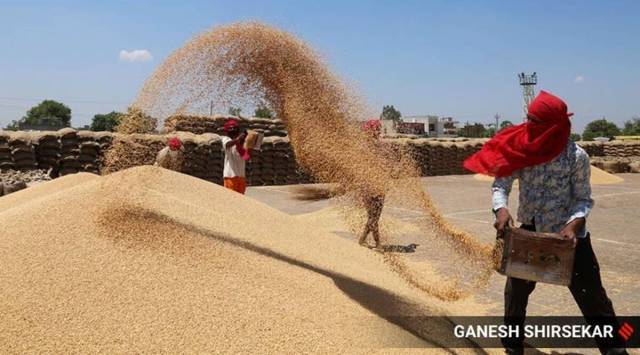 India exported wheat to 44 countries in April — the most (3.35 lmt) to Bangladesh and the least to the United Kingdom (2,000 metric tonnes). (File Photo)
In the first five months of this financial year — April to August — India exported double the quantity of wheat compared with the same period in 2021-22, official data show. This is in spite of a slowing of exports after the sudden ban announced by the government in mid-May.
India exported 43.50 lakh metric tonnes (lmt) of wheat during April-August 2022-23, which was 116.7 per cent more than the corresponding months last year, according to Department of Commerce data.
Exports were boosted by the Russian invasion of Ukraine in late February, which led to a major spike in demand for Indian wheat. Exports in April touched 14.71 lmt, more than 500 per cent higher that the 2.42 lmt exported in April last year. After the ban announced on May 13, exports for that month fell to 10.79 lmt, which, however, was still 164 per cent higher than the 4.08 lmt exported in May 2021.
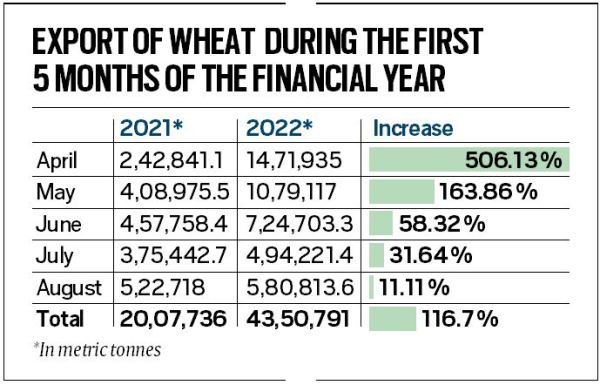
Exports have fallen thereafter — 7.24 lmt in June, 4.94 lmt in July, and 5.80 lmt in August compared with 4.57 lmt, 3.75 lmt, and 5.22 lmt in June, July and August 2021 respectively.
India exported wheat to 44 countries in April — the most (3.35 lmt) to Bangladesh and the least to the United Kingdom (2,000 metric tonnes). The number of national export destinations fell to 31 in May (Bangladesh was again on top), and sharply thereafter following the ban.
India exported wheat to 11 countries in June 2022, only five countries in July (Indonesia, Bangladesh, Korea, the UAE, and Angola), and eight in August (Bangladesh, the UAE, Indonesia, Sri Lanka, Afghanistan, Malaysia, Taiwan, and Bhutan).
Indonesia emerged as the top buyer of Indian wheat in the months after the ban. Of the 18 lmt of wheat exports in this period, about 7 lmt went to Indonesia. In the five-month period from April to August, Indonesia has been the No. 2 export destination for Indian wheat after Bangladesh (8.06 lmt and 11.12 lmt respectively).
The export of atta (wheat or meslin flour) too has more than doubled in the first five months of the current financial year — 4.49 lmt compared with 1.64 lmt during April-August 2021. Somalia, the UAE, Sri Lanka, Madagascar, and Djibouti were the top 5 buyers of Indian flour during April-August 2022.
The ban on wheat exports came amid a lower wheat output of 106 million tonnes, lower procurement (18.7 million tonnes compared to 43.3 million tonnes last year), and rising domestic prices. However, two kinds of shipments were allowed: exports based on permission granted by the Centre to other countries “to meet their food security needs” and “on the request of their governments”; and contracted exports against which irrevocable letters of credit had already been issued.
Prices of wheat and wheat flour in the domestic market have increased significantly of late. Price data on the Department of Consumer Affairs website show the all-India daily average retail price of wheat flour at Rs 36.23 per kg on October 15, which was 18 per cent higher than the price a year ago (Rs 30.7 per kg).

 3 min read