7 min read
Stay updated with the latest - Click here to follow us on Instagram

Journalism of Courage



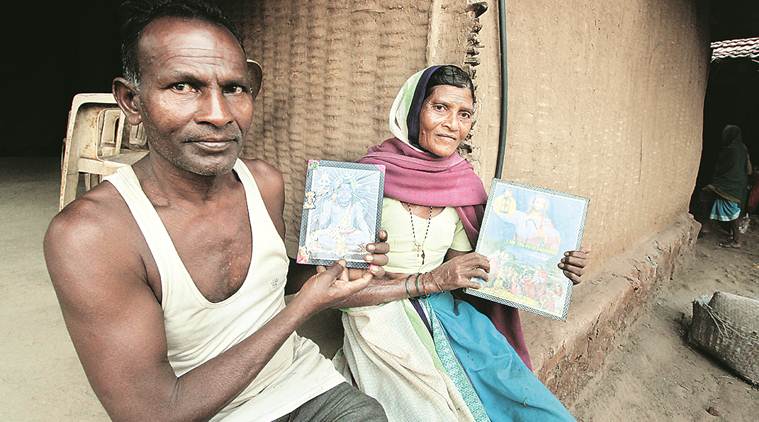 Rumshi Jadav and his wife Devku Jadhav show portraits of gods of different faiths followed in their household in Umbarpada village of Dang. (Photo Courtesy: Javed Raja)
On Christmas, the church with a thatched roof in Umbarpada was all decked up with shiny buntings, lights and flowers. Devku Jadav, 52, woke up early for the mass along with other Christians of the village. Later, her husband Rumshi (54) and their children joined in the singing and drama performances in this tribal hamlet inside the Dang forest, with no mobile phone network.
Devku converted to Christianity six years ago. Their mud house adjacent to the village road that divides the hamlet into two has walls adorned with pictures of Jesus Christ and Lord Shiva.
Farming, herding cattle into the forest for grazing, extracting livestock produce and then retiring for the day at sunset on the Saputara hills is the daily routine of the Jadhav household. The homogeneity is only contradicted by the different faiths that they follow. Rumshi is a Hindu, while brother Jamal, 50 who lives nextdoor, is a Christian.
Dang is Gujarat’s 100 per cent tribal district that shares a border with Maharashtra. Of the 1,100-1,200 residents of Umbarpada, over 80% are Christians, many families following two faiths. Rumshi says Devku converted from Hinduism to Christianity six years ago, while his brother converted a decade ago.
“My wife Devku wasn’t keeping well for a long time. It was then that she got in touch with a local preacher and adopted Christianity. Since then, she has found peace with herself and it makes me happy to see her content.” Their seven children — five of them girls, follow Hinduism “as of now”, he says adding that he would have no problem if they changed their mind in the future.
Jamal says he turned to Christianity when he was anxious about his son’s deteriorating health, a decade ago. “Despite frequent hospital visits, he wasn’t getting any better. I had taken a vow for his health and turned to Christianity later. I have only found peace since then,” said Jamal.
However, the shadow of the anti-Christian riots of 1998 looms large on this district. Dang witnessed Gujarat’s first anti-Christian riots where churches were attacked and burned by agitating mobs from the saffron groups angry to avenge the alleged conversion programmes by missionaries.
The Vishwa Hindu Parishad (VHP) and the controversial Swami Aseemanand ran “ghar wapsi” programs for its tribals, seeking to “reconvert” them. Accused in the Ajmer Dargah blast of 2007, Aseemanand who is now acquitted, founded Shabri Dham in Subir Taluka of Dang, and organised a massive Shabri Kumbh Mela in 2006, which was attended in huge numbers by workers from the RSS, VHP, Bajrang Dal and the BJP, including the stalwarts, which fanned tension between the communities. Shabri dham is listed as a pilgrimage destination on the official Gujarat Tourism website as the place where Lord Ram is believed to have eaten berries from the hands of Shabri when looking for Sita.
According to Census 2011, of the total 2,28, 291 population, spread across 308 villages and three towns, Scheduled Tribes constituted 94.65 per cent (Hindus were 2,03,545, Muslims 3,593 and Christians 20,029). In comparison, the 2001 census showed the Hindus at 1,65,436 of the total 1,86,729, Muslims at 2,792 and Christians 17,760. Bhil, Varli, Kunbi and Kotwaliya are the main tribes residing here.
Dang Collector NK Damor said that the local administration does not keep track of the population demograph. “Census 2021 is coming and then a clear picture could emerge of the religious demography of Dang. Even the three talukas — Subir, Ahwa and Waghai — have mixed population living together,” said Damor.
According to an estimate provided by a local Christian leader, a total of 16 missionary bodies are active in villages of Dang, including the Church of North India (CNI), New Jerusalem Church, Roman Catholic and Pentecostal Church. According to a study by Dr Sitaram Deshmukh, associate professor in Gujarat Vidyapith, in 2017, Dang had 408 primary schools, many founded and run by missionaries.
Both Hindu and Christian bodies have built temples and churches in several villages of Dang where there is mixed population. Recently, tension escalated when a fringe group, Rashtriya Janjati Sangh, affiliated to the RSS, gave a rally call in Ahwa town to identify those tribals who converted to Christianity, as “Christians”, ahead of the upcoming Census survey in 2021.
 At a church in Umbarpada village in Dang district. (Photo Courtesy: Javed Raja)
Speaking to The Indian Express, Dhanrajsinh Suryavanshi, one of the tribal kings and a BJP member, who gave calls for a rally on December 16, said, “We have just one demand that those who are Hindu must write ST Hindu on their school leaving certificates (LC), those who are Muslims must write ST Muslim and those who are Christians must write ST Christian on their LCs, ahead of the census survey.”
There are five tribal kings in Dang who together form a Darbar of the five erstwhile states — Godhvi, Daher, Amalaa, Pimpri and Vasuna. Every year, the five kings are honoured during a Darbar ceremony and they hold a special place in the tribal culture of Dang.
“The rally was called to fan tension between the communities and send a message to the ST Christians that once their religious status is changed in their school leaving certificates, they will lose all benefits of reservation provided to them by the Indian Constitution,” said Suryakant Gavit, a local activist and Christian leader. However, the rally was not permitted fear of increased tension between communities.
“Police and administration officials spoke to the rally organisers and ensured that no such programme is carried out in Dang. We have provided ample police protection to the marginalised communities in the district,” said Damor.
Ahead of every Christmas, there is tension in Dang but its tribals celebrate their culture of co-existence. In the Sakarpatal village market, 62-year-old Jaanu Bhoye, sits on a wooden bench outside his tea shop, dressed in a white kurta and shorts and has a ‘U’ shaped vermillion mark on his forehead. Hundred metres from the shop is another tea stall, whose owner is 60-year-old Ganpat Bhoye, Jaanu’s younger brother who sports the tattoo of a Christian cross on his forehead. Converted to Christianity 30 years ago, Jaanu and Ganpat are neighbours and say that their kids grew up together though they belong to different faiths. Locals believe that the ‘Adi’ (indigenous) culture overcomes any other cultural invasion attempt.
“We follow the principle of sarva dharma samman first and this is the reason why the culture of harmony and mutual respect has thrived in Dang even though the majority population follows Hinduism. Maximum cases of such inter mixed families can been seen in Subir Taluka,” said Mangal Gavit, Congress MLA from Dang.
“Jiski jaisi marzi (to each his own),” says 65-year-old Parshya Chaudhary, a tribal Hindu from Susarda village in Dang. Of Chaudhary’s nine brothers three are Christians. Away from the influence of social media, the district celebrates its second highest sex ratio in Gujarat at 1006, and a literacy rate of 75.16%.
Stay updated with the latest - Click here to follow us on Instagram