
Tension between Executive, Judiciary: The current conflict — and its fraught resolution
With a narrow majority, the SC, in its judgment of April 1973, upheld Parliament’s power to amend the Constitution but imposed fetters against amending its “basic structure”
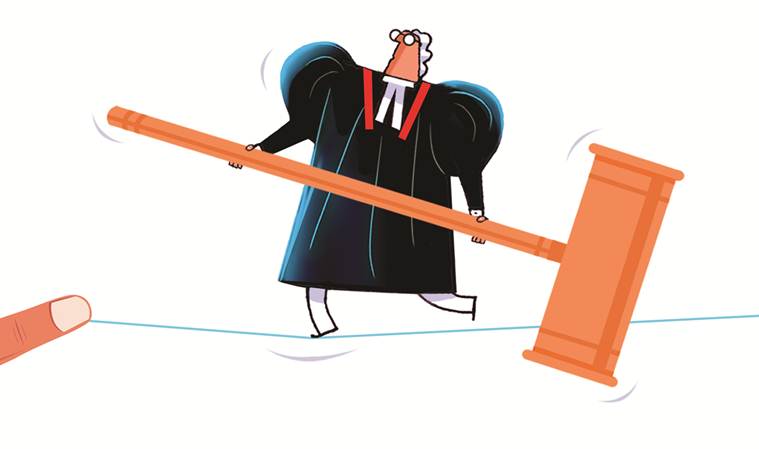 In 2015, the Supreme Court struck down the NJAC legislation as unconstitutional, paving the way for the latest round of confrontation. (Illustration: C R Sasikumar)
The tension between the Executive and Judiciary isn’t new. What’s different about this latest round is the unusual mix of factors: the political establishment’s attempt to clip the Judiciary’s wings stalled, a Supreme Court publicly divided and a Chief Justice facing an impeachment notice. Ravish Tiwari tracks this strain over the years to explain the current conflict — and its fraught resolution.
On July 29, 1947, the Constituent Assembly was gripped by a question: should the power to remove superior judges be vested in the President or Parliament? In the end, the view of Sir Alladi Krishnaswami Ayyar, former Advocate General of Madras State, prevailed and the members decided that both Houses of Parliament, while acting on an impeachment notice, would exercise this power, if at all. For, few members believed that this provision would ever be used.

“Whatever procedure you prescribe for the removal of Judges for proved misconduct or misbehaviour, that procedure is likely to be used only in the rarest of contingencies and very probably will not be used within my life time or even the life time of those who are much younger in this House than I am,” Sir N Gopalaswami Ayyangar had said in his concluding arguments that day, before the draft proposed by Ayyar was adopted.
Otherwise prescient, the wise men and women of the Constituent Assembly didn’t anticipate what was to follow.
Seventy years later, that very provision is at the heart of a tussle between the Opposition and the ruling party members. While the Congress-led Opposition members of the Rajya Sabha have declared that they would challenge Rajya Sabha chairman Venkaiah Naidu’s ruling dismissing their notice for impeachment of Chief Justice of India (CJI) Dipak Misra, the ruling combine members have hailed the decision as sound course of action.
Days after Naidu’s ruling, another row blew in the face of Judiciary and Executive relations, when, on April 26, Law Minister Ravi Shankar Prasad wrote to CJI Misra, segregating the Supreme Court Collegium’s recommendation for appointing two judges to the apex court. While the government returned for reconsideration the collegium’s recommendation to elevate Uttarakhand Chief Justice K M Joseph to the Supreme Court, it notified the appointment of senior advocate Indu Malhotra as a judge of the apex court.
Here again, the ruling and Opposition parties are divided over the course of events, with the spotlight now on the Judiciary’s place in the delicately stitched constitutional space that it shares with the political class comprising the Executive and the legislature.
 Venkaiah Naidu’s ruling dismissed Opposition notice for impeachment of Chief Justice of India (CJI) Dipak Misra.
This space has been created and shaped by the Judiciary’s evolving relationship with the Executive over three distinct eras.
1947-1964: Retreat or review
Notwithstanding Ayyangar’s belief that the provision for removal of judges will rarely be used, within a year, even before the Constitution was ready, the judiciary found itself staring at the removal of a high court judge.
An academic paper on ‘The Evolution of Judicial Accountability in India’ published in the Journal of Public Affairs and Change by Bhairav Acharya, lawyer and policy specialist, recounts the removal of Allahabad HC judge Justice Shiv Prasad Sinha in July 1948 at the request of the erstwhile United Provinces Government. Since the Constitution was far from final, Sinha was removed under Section 220(2) of the Government of India Act, 1935, after an inquiry by the then Federal Court upheld one of the five charges against him.
If that’s the note on which the Judiciary started, after the Constitution came into force, the first removal pitch was made in 1970 against Justice J C Shah. The petition was rejected by the Lok Sabha Speaker under the Judges (Inquiry) Act, 1968.
The intervening two decades witnessed a phase where the political class asserted its supremacy against the Judiciary’s power of judicial review. In fact, the first situation arose within months of the Constitution coming into force on January 26, 1950.
Communist leader A K Gopalan challenged his detention without trial since 1947 in Madras Jail under the Preventive Detention Act, 1950. The Act was challenged on the grounds of failing to meet provisions of Article 21 that guarantees the protection of life and personal liberty. The case was heard by a six-member bench which rendered separate judgments. However, a unanimous feature was that they struck down Section 14 of the Act — which prevented even courts from accessing material which formed the basis of the detention orders — as unconstitutional. The government responded by amending the Act to delete the said section.
 The Executive’s assertion again reached the Supreme Court in a case now famously known as Kesavananda Bharati case.
This tussle between the Judiciary and the political class came to a head when legislation on agrarian reforms and abolition of the zamindari system across different states came up for challenge under Article 31 that provided guarantees for right to property. The landed class objected to the reform legislation undertaken by several provincial Congress governments to further the socialist vision of prime minister Jawaharlal Nehru.
The most famous of these litigation was Kameshwar Singh vs State of Bihar, in which the Patna HC in March 1951 had ruled that the Bihar Land Reforms Act was unconstitutional and in violation of Article 14 since it discriminated in providing compensation.
Sensing that it may cast a shadow on its agrarian reforms, in the summer of 1951 the Congress government moved the Constitution (First Amendment) Bill in Parliament without even waiting for the Supreme Court ruling on the appeal in the case. The Amendment introduced blanket immunity for the land reform legislation against any appeal on grounds of infringement of fundamental rights. Going a step further, the amendment created the Ninth Schedule of the Constitution to ring-fence 13 enactments, including the Bihar Land Reforms Act, from judicial review.
The invention of the Ninth Schedule led to the shielding of more legislation from the purview of judicial review — by 1964, the number of such laws across the country rose to 64. The number has risen to 284 different laws in this Schedule.
Underlining the fault line that led to the Ninth Schedule, PDT Achary, former Secretary General of the Lok Sabha, says, “In the beginning, the confrontation between the Judiciary and the political class arose on the issue of right to property. Such a confrontation was obvious considering this was a government professing socialist path.”
Thus, the political class asserted its supremacy through amendments, ostensibly to further the socio-political objective framed by the government, which then comprised many of the framers of the Constitution.
1965-1993: Full-blown clash
The power of the political class to bring in amendments is likely to have generated fears of the Constitution being overridden. The Supreme Court had to assert its position.
It did so in a case challenging the Punjab Security and Land Tenures Act, which was given immunity from judicial review by being put under the Ninth Schedule after the Constitution (Seventeenth Amendment) Act, 1964.
Known as the Golaknath Case, the 11-judge SC bench headed by Chief Justice K Subba Rao with a majority of 6:5 restrained Parliament’s power to curtail fundamental rights.
The fetters imposed by the Golaknath case is believed to have left the socialist leaning Indira Gandhi government disappointed. But, the verdict had come close to the 1967 general elections, in which Indira Gandhi had returned to power with 284 seats in the Lok Sabha, its worse performance until then. A weakened government pursued populist policies such as bank nationalisation and abolition of privy purses, which suffered setbacks in the Supreme Court.
However, in the 1971 general elections, the Indira-led Congress returned to power with an enhanced mandate of 350 seats. It now had the electoral strength for its fight against the judicial setback. The Executive asserted its supremacy over the Judiciary by bringing in another amendment to the Constitution.
“The result of the (SC) judgment (in the Golaknath case) is that Parliament is considered to have no power to take away or curtail any of the fundamental rights guaranteed by Part III of the Constitution even if it becomes necessary to do so for giving effect to the Directive Principles of State Policy and for the attainment of the objectives set out in the Preamble to the Constitution. It is, therefore, considered necessary to provide expressly that Parliament has power to amend any provision of the Constitution so as to include the provisions of Part III within the scope of the amending power,” read the Statement of Objects and Reasons appended to the Constitution (Twenty-fourth Amendment) Bill, 1971.
The Executive’s assertion again reached the Supreme Court in a case now famously known as Kesavananda Bharati case. Since, the 24th Constitution Amendment had annulled the force of the Golaknath verdict by an 11-judge bench, the challenge to this legislation was to be heard by a 13-judge bench headed by Chief Justice S M Sikri. The government acted quickly to appoint judges to suit its political commitments, say experts.
“The reason for this was that the Kesavananda case, which would reconsider Golaknath restrictions on amending power, was on the anvil. Because the latter was decided by an 11-judge bench, 13 would be needed for the Kesavananda case. Conveniently for the government, which was aware that several of the sitting judges did not subscribe to its aims, these vacancies provided it with an opportunity to shift the ideological composition of SCI,” wrote George H Gadbois in his book, Judges of Supreme Court of India, referring to nine new appointments that happened between July 1971 and October 1972.
The arguments in the Kesavananda case began on October 31, 1972. Gadbois refers to writings of former SC Judge Jaganmohan Reddy to point out that of the new judges, two were nominees of Law Minister H R Gokhale, one of minister Mohan Kumarmangalam, two that of Sidhartha Shankar Ray and two of prime minister Indira Gandhi.
With a narrow majority of 7:6, the Supreme Court, in its judgment of April 1973, upheld Parliament’s power to amend the Constitution but imposed fetters against amending its “basic structure”. This exposition of the “basic structure” principle has since then emerged as one of the most potent tools against the unbridled power of the Executive.
“When such a stage was reached that any part of the Constitution could get amended guided by political consideration, the Supreme Court stepped in. I feel the Supreme Court did yeomen service to the nation by discovering the ‘basic structure’,” says Achary.
The judgment was considered a setback and the political executive hit back by appointing A N Ray as the next Chief Justice of India after Sikri, superseding three other judges — Justices J M Shelat, AN Grover and K S Hegde. The three judges resigned immediately.
This confrontation between the Judiciary and the Executive worsened when Allahabad HC judge Justice Jagmohan Lal Sinha, acting on a petition filed by Raj Narain, set aside Indira Gandhi’s election to the Lok Sabha from Rae Bareli. Gandhi reacted to the judgment of June 12, 1975 by imposing Emergency.
In another case, popularly known as ADM Jabalpur Case, the Supreme Court, in a 4:1 judgment, upheld governments’ unrestricted use of powers during Emergency. While Justices A N Ray, P N Bhagwati, Y V Chandrachud and M H Beg were part of the majority ruling, the lone dissenter, Justice K R Khanna, was superseded by Justice M H Beg to be Chief Justice in 1976.
Even the Janata Party government faced the ire of the Supreme Court in Maneka Gandhi vs Union of India case in 1978. The Janata Party administration had impounded her passport on the grounds of “in public interest”, which was challenged. The majority ruling of the Supreme Court declared that the right to travel abroad was part of right of personal liberty under Article 21 and government can’t arbitrarily impound the passport as it violated right to equality under Article 14.
The case pertains to the legal challenge against the implementation of Law Minister P Shiv Shankar’s March 1981 circular that sought Executive discretion in transfer of judges “to further national integration and to combat narrow parochial tendencies.”
 Chief Justice of India Justice Dipak Misra (Express Photo by Tashi Tobgyal/Files)
Adjudicating on this batch of petitions, in December 1981, Justice P N Bhagwati declared that the “primacy” of the CJI’s recommendation on judicial appointments and transfers can be refused for “cogent reasons”.
This, in a way, bolstered the hands of the Executive in judicial appointments for over a decade till the primacy of the CJI was restored in the years that followed.
1993-2018: Judiciary asserts
The tide slowly turned in favour of the Judiciary with the advent in the late 80s ofcoalition governments.
Given the rising impatience over charges of arbitrariness in judicial appointments, the VP Singh government introduced the Constitution (Sixty-seventh Amendment) Bill, 1990 for constituting the National Judicial Commission for appointments in the higher judiciary. However, it lapsed with the dissolution of the Lok Sabha in 1991.
In 1993, the Supreme Court wrested control of appointments through its judgment in the Supreme Court Advocates-on-Record Association vs Union of India (The Second Judges Case) that crafted a completely new process of judicial appointments.
“The role of the CJI is primal in nature because this being a topic within the judicial family, the Executive cannot have an equal say in the matter,” said the verdict delivered by a nine-judge bench with the condition that the CJI should consult the two most senior judges on matters of appointment.
The judgment, however, did not spell out the modalities of the consultation, inviting criticism from the Executive and resulting in a presidential reference in 1998 from then president K R Narayanan.
In it advisory opinion in Special Reference No. 1 of 1998 (The Third Judges Case), the Supreme Court unanimously set down the modalities of the consultative process, where the CJI would have to consult his four senior-most colleagues for Supreme Court appointments and his two senior-most colleagues for High Court appointments, thus paving the way for the present collegium system.
With the collegium freeing the Judiciary from the Executive’s alleged interference, the Supreme Court went on to pronounce several key verdicts — from the S R Bommai judgment to the 2G verdict— many of which went against the Executive of the day.
This got the political class to search for ways to ensure ‘judicial accountability’. While the previous NDA regime came up with the Constitution (98th Amendment) Bill, 2003, for setting up the National Judicial Commission for judicial appointments, the UPA moved the Judicial Standards and Accountability Bill and the Constitution (120th Amendment) Bill to provide for a new mechanism. But they could not get these enacted.
That changed in 2014. Unhindered by compulsions of coalition politics, the majority government under Narendra Modi sought more accountability from the Judiciary. It moved the Constitution Amendment legislation to scrap the two-decade-old collegium system and provide for the National Judicial Appointments Commission (NJAC).
“If it is challenged, then we will see it. Why Parliament must be wary of using its powers? Parliament must have full trust in the ability of Parliament to pass the law,” Law Minister Ravi Shankar Prasad had asserted when both the laws were passed in August 2014.
In 2015, the Supreme Court struck down the NJAC legislation as unconstitutional, paving the way for the latest round of confrontation. With the Memorandum of Procedure (MoP) for judicial appointments still stuck, almost every appointment is fraught with tension.
This, along with a string of other factors — the CJI facing an impeachment motion, the lack of cohesion among senior Supreme Court judges, and the Executive asserting itself — make for an unprecedented situation.
“All these episodes have a lesson. Confrontation with Judiciary doesn’t help us at all. In fact, confrontation with Judiciary is a lose-lose situation for the Executive,” says senior advocate Arvind Datar.
With four of the five most senior SC judges retiring by the end of the year and the NDA government too entering its last lap as it heads into an election year, what shape this current crisis takes will depend on the leadership that 2019 throws up.
The way forward
Retired judges and legal experts talk to Kaunain Sheriff M on possible solutions to the current impasse.
R M Lodha, former CJI
MoP
“The first step forward is finalisation of the MoP. This has been hanging for more than two years. The drafts have been exchanged a number of times.”
Segregation of names recommended by collegium
“MoP must have a specific provision where government cannot segregate names unilaterally. It must be brought to the notice of the Chief Justice. And the Chief Justice, in consultation with the collegium, should take a call… To ensure that primacy of Judiciary remains intact, selective segregation is not allowed to be done.”
Stay insulated
“Political parties will always play their politics, but Judiciary should not engage in their game plan. Judiciary should remain unconcerned and unconnected with political issues and dimensions.”
A former CJI
Body for appointments
“There exists a problem within the Judiciary… in the name of independence, Judiciary cannot appoint judges solely by itself. There are countries where indirectly the society has some role to play in the appointment of judges. But the Supreme Court struck down NJAC, stating only Judiciary can appoint judges… A probable solution could be formation of a judicial appointments commissions… If there is so much confrontation, why has the MoP not been finalised?
K Parasaran, former Attorney General in governments headed by Indira and Rajiv Gandhi
Joint deliberation
“I feel there should be joint deliberation by the government and Judiciary on appointments. If they had taken that view, with overriding cover in the court, all this controversy would have not happened. This is purely my personal view.”
 Share


