Journalism of Courage



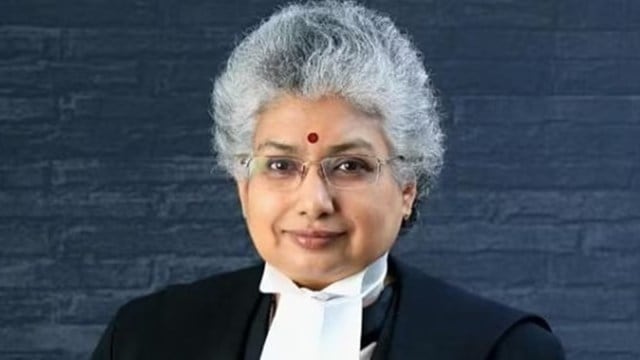 Justice B V Nagarathna, who gave a dissenting opinion on demonetisation in a judgement in January last year, spoke about how she was moved by the plight of people due to the move. (File)
Observing that there is a recent trend of Governors getting involved in litigation for not assenting to Bills sent for approval by state governments, Supreme Court Judge B V Nagarathna Saturday said they should act in accordance with the Constitution.
“This is not a healthy trend under the Constitution to bring what the Governor does before constitutional courts for consideration. Though it is called a gubernatorial post, it is a serious constitutional post, and Governors must act as per the Constitution so this kind of litigation reduces. It is quite embarrassing for Governors to be told to do or not do a thing. The time has come where they would be now told, I suppose, to do their duties as per the Constitution,” she observed.
She was speaking during the introductory session of the Courts and the Constitution Conference organised by NALSAR University of Law, Hyderabad.
Justice Nagarathna’s observations come against the backdrop of the SC expressing concerns over the acts of Governors of Tamil Nadu, Kerala, Telangana and Punjab. The former Governor of Telangana, Dr Tamilisai Soundararajan, was also accused by the previous BRS government of refusing to approve and sign on several Bills sent by the government.
Justice Nagarathna, who gave a dissenting opinion on demonetisation in a judgement in January last year, also spoke about how she was moved by the plight of people due to the move. She said was happy to be a part of the Bench that heard the case.
“We all know what happened on November 8, 2016. 86% of the currency was 500 and 1,000 notes, which I think the central government lost sight of. Imagine a labourer who had to get his notes exchanged for daily essentials. 98% of the currency came back, so where are we in black money eradication? So I thought it was a good way of converting black money into white money, of unaccounted cash entering the system. What happened with regard to income tax proceedings thereafter, we do not know. So this common man’s predicament really stirred me and I had to dissent,” she said.
Speaking about cases of medical termination of pregnancy, Justice Nagarathna said that the SC’s opinion vacillated on reproductive rights. “There was a debate with regard to pro-life and pro-choice. I would not like to speak much about it, but I will only say we should not polarise the debate like this. Ultimately it depends on the facts of the case, why has the lady come to court, beyond the time? It is a very difficult decision for a woman to terminate a pregnancy. She has to be psychologically ready… it is not an issue of abortion rights.”
Retired Supreme Court of India judge Justice S Ravindra Bhat, Telangana High Court Chief Justice Alok Aradhe, Supreme Court of Nepal Judge Sapana Malla, and Pakistani Supreme Court Judge Syed Mansoor Ali Shah also spoke at the event.
Justice Bhat said that the Supreme Court’s judgement upholding the abrogation of Article 370 of the Constitution did not address a key issue concerning federalism. He made the remarks while speaking about key judgments delivered by the top court in recent times.
“The other important judgement which has long-term implications is the one on abrogation of Article 370. The SC spoke in unison through three judgments but left unanswered an important issue on federalism,” he said. Justice Bhat also referred to other judgements like the one on electoral bonds, and appointment of election commissioners.
“This trend of examining and revisiting our norms, which were long held to be dearly held values, is not necessarily disheartening but is to be seen as the court probing and considering the changes which are necessary to be made, to make the Constitution responsive, efficient and relevant in the 21st century,” Justice Bhat observed.

 4 min read