Journalism of Courage
 6 min read


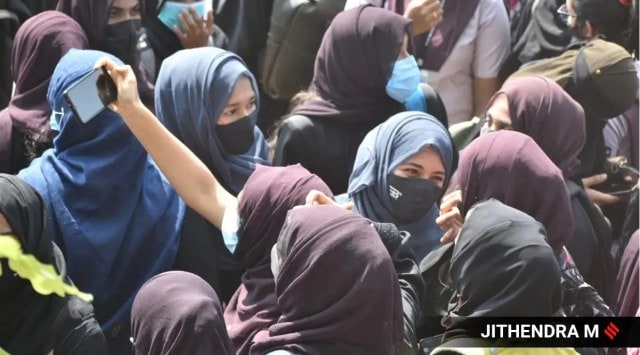 Students wearing hijab protest at MGM College in Udupi, February 8, 2022. (Express Photo: Jithendra M)
ON THE day the Karnataka High Court put its observations on the hijab issue in its interim order, reiterating its call for classes to reopen and students to attend without wearing any religious dress, the Supreme Court declined to grant urgent listing for an appeal against the interim order and asked the petitioners not to “spread” the controversy to “larger levels”.
On Friday, responding to Senior Advocate Devadatt Kamat, who requested that a Special Leave Petition filed against the High Court’s interim order be taken up urgently, Chief Justice of India N V Ramana said: “I don’t want to express anything. Don’t spread these things to larger levels…We also know what is happening there in the state as well as in the hearings also. And you also have to think over whether it’s proper to bring those things to Delhi, national level issues and all that.”
Solicitor General Tushar Mehta, appearing for Karnataka, said: “Exactly, that’s our purpose…Let us not make it political, let us not make it communal. Let the High Court decide the Constitutional plea.”
Kamat is representing students from Udupi against the hijab ban before a full bench of the Karnataka High Court, which is scheduled to take up the matter again on Monday for a full hearing on the legal issues raised.
The Supreme Court proceedings took place before the High Court’s interim order was uploaded. However, Kamat urged the apex court to take up the matter since it involved legal issues that it must examine. “Definitely, we will examine. Definitely, if there is something wrong, we will definitely protect. We have to protect the Constitutional rights of everyone,” the CJI said.
As Kamat sought to explain the issue involved, the CJI told him that there is “no need to go into the merits”. “Let us see. At the appropriate time, definitely we will interfere. Let us see when we have to,” the CJI said.
Kamat urged the bench to list the SLP for hearing on Monday but CJI Ramana reiterated: “We will take up at appropriate time. Leave it to us.”
Earlier, after pointing to the SLP, Kamat said: “I would say it’s rather strange. The High Court says none of the students should disclose any religious identity when they go to school or college. This has far-reaching implications not only for the Muslim community, but also other faiths. For example, Sikhs wear turbans when they go to schools or colleges. The High Court, by an ad-interim order and in the midst of arguments, says that we direct that all the students should go without disclosing any of their religious identity. Our respectful submission is this in effect is a complete suspension of Article 25 (freedom of religion) as far as our clients are concerned. So Lordships may kindly hear us as to what is the interim arrangement.”
At this point, the SG said that “the order has not yet come out”, prompting the CJI to say “wait, let us see”. Kamat contended that the matter “has far reaching implications” and said “all the colleges have been closed” and that “whatever interim arrangement your Lordships decide will be acceptable to everyone”.
The CJI reiterated that the Supreme Court will take up the matter “at an appropriate time”.
In the Karnataka High Court, a day after it concluded the previous hearing by expressing its intent to pass an interim order, a full bench said it was “pained” over the agitations for and against the hijab ban and said the “right to freedom of religion was not absolute”.
In the seven-page interim order, the full bench comprising Chief Justice Ritu Raj Awasthi, Justice Krishna S Dixit and Justice J M Khazi stated: “The interest of students would be better served by their returning to the classes than by the continuation of agitations and consequent closure of institutions. The academic year is coming to an end shortly.”
It said: “Elongation of academic terms would be detrimental to the educational career of students especially when the timelines for admission to higher studies/ courses are mandatory… In the above circumstances, we request the state government, and all other stakeholders to reopen the educational institutions and allow the students to return to the classes at the earliest.”
The full bench said that pending consideration of the petitions, “we restrain all the students regardless of their religion or faith from wearing saffron shawls (bhagwa) scarfs, hijab, religious flags or the like, within the classroom, until further orders”.
It said the order “is confined to…institutions wherein the College Development Committees have prescribed the student dress code/uniform.”
Referring to protests over the issue, the High Court said: “Firstly, we are pained by the ongoing agitations and closure of educational institutions since the past few days, especially when this court is seized of this matter and important issues of Constitutional significance and of personal law are being seriously debated.”
It said: “It hardly needs to be mentioned that ours is a country of plural cultures, religions and languages. Being a secular state, it does not identify itself with any religion as its own. Every citizen has the right to profess and practice any faith of choice is true.”
It also said the right to freedom of religion was not absolute. “However, such a right not being absolute is susceptible to reasonable restrictions as provided by the Constitution of India. Whether wearing of hijab in the classroom is part of the essential religious practice of Islam in the light of Constitutional guarantees, needs a deeper examination,” the High Court said.
“Ours being a civilized society, no person in the name of religion, culture or the like can be permitted to do any act that disturbs public peace and tranquility. Endless agitations and closure of educational institutions indefinitely are not happy things to happen. The hearing of these matters on an urgent basis is continuing,” the full bench said.