


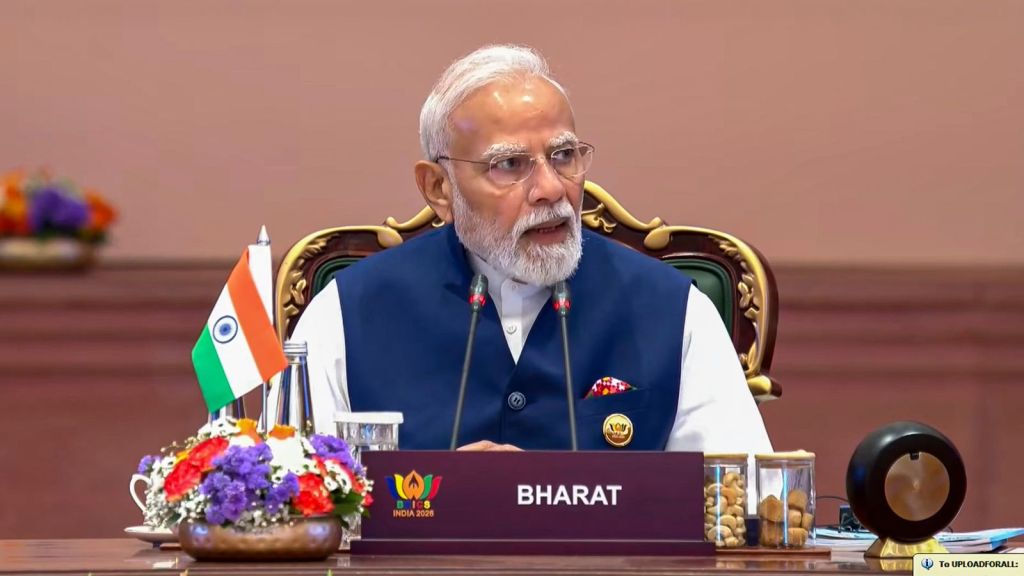
 Prime Minister Narendra Modi on the second day of the BRICS Summit 2026, at Bharat Mandapam in New Delhi. (@NarendraModi/YT via PTI Photo)
On a day when Prime Minister Narendra Modi warned that “the weaponisation of technology and critical minerals” could hinder progress and underlined the need for “inclusivity”, Chinese President Xi Jinping on Sunday announced that Beijing would lead the creation of an open-source AI ecosystem for BRICS member nations.
Modi’s remarks are seen as an oblique reference to Beijing’s control over the critical mineral supply chain and the US-China leverage battle over access to technology. He was speaking at the concluding session of the two-day BRICS Summit, with Xi, Russian President Vladimir Putin and Iranian President Masoud Pezeshkian, among other leaders, in attendance.
Xi, who spoke after Modi, made the announcement as part of a five-point initiative to boost cooperation in technology, manufacturing and trade, even as he called on the bloc to focus on building a large integrated market comprising emerging economies. This is seen as an effort to position Beijing as a central technology partner for BRICS amid its growing AI competition with the US.
In a statement, the Chinese Foreign Ministry said Xi called upon BRICS leaders to work towards writing a “new chapter of strength through unity for the Global South”, and asserted that the logic that “might makes right” should have been discarded long ago.
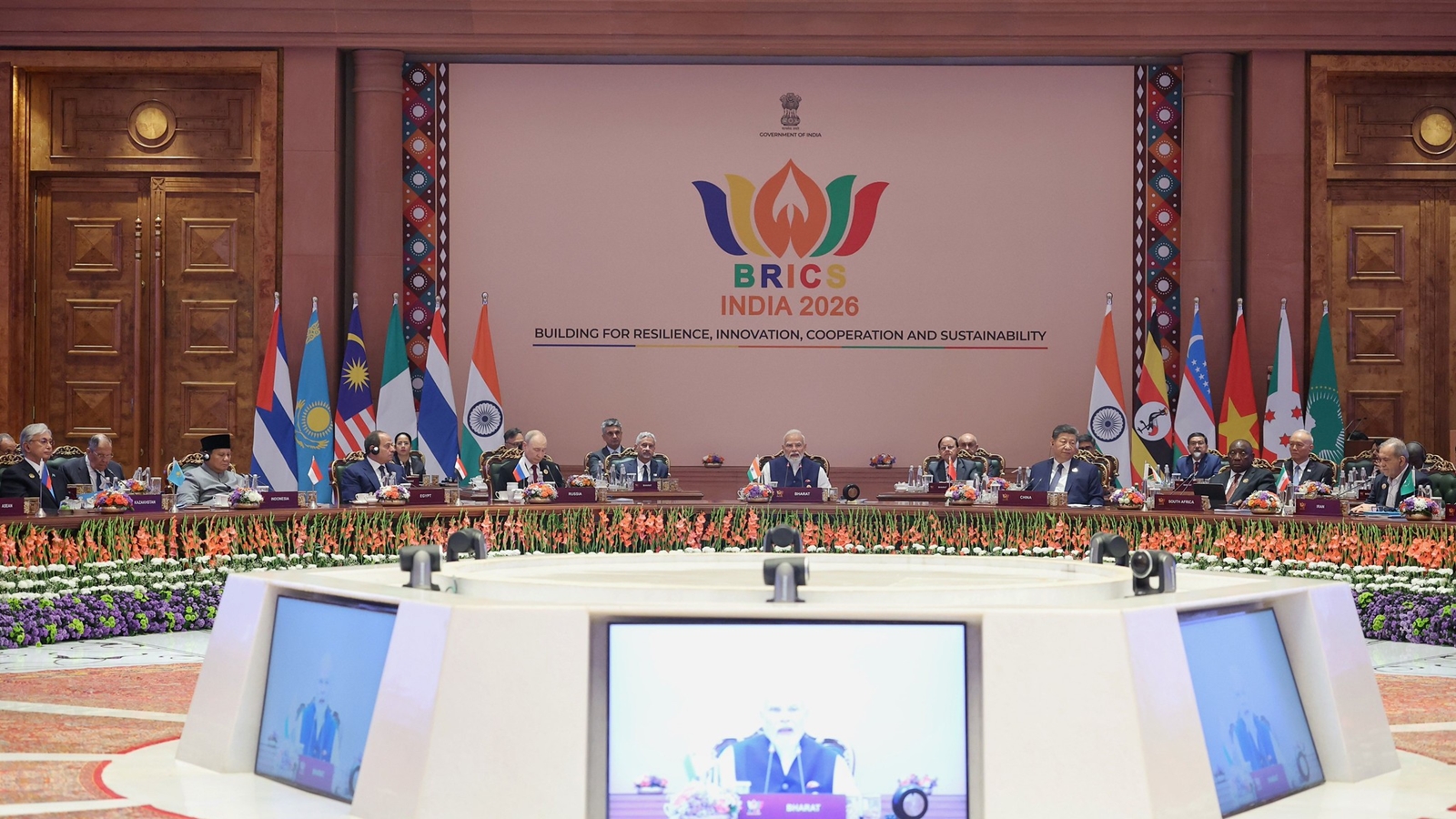 Prime Minister Narendra Modi addresses a session on the second day of the BRICS Summit in New Delhi, Sunday. On the right are Chinese President Xi Jinping, South African President Cyril Ramaphosa and Iranian President Masoud Pezeshkian; on the left are Russian President Vladimir Putin, Egypt’s President Abdel Fattah El-Sisi, Indonesian President Prabowo Subianto and Kazakhstan President Kassym-Jomart Tokayev. (Image source: MEA)
Putin, in his address, urged the Global South countries to “jointly advance better (global) governance structure and tackle both traditional and non-traditional security threats.”
Addressing the BRICS leaders’ outreach summit, attended by the grouping’s full member countries as well as its partner countries, Modi said the trust of Global South countries in BRICS has grown because their voices are heard and their experiences are respected.
He said that with rising global tensions impacting lives, the emphasis is on enhancing resilience within the bloc. In this context, he announced a slew of initiatives — BRICS Integrated Early Warning System for prevention of and response to infectious diseases, BRICS Logistics Supply Chain Cooperation Framework, BRICS Incubator Network, Startup Innovation Fund, BRICS MSME Cooperation Portal, Digital Centre of Excellence for Smart Grids and Energy Storage, Urban Mobility Hub, and Centres of Excellence for Agro-Ecology and Regenerative Agriculture.
“The BRICS Network on Digital Agriculture will create new opportunities for farmers. Through this initiative, AI, geospatial technology, and Digital Public Infrastructure will be connected to the real needs of farmers. The weaponisation of technology and critical minerals can hinder our shared progress. Therefore, we have emphasised inclusivity in the adoption of technology,” he said.
“I can say from personal experience that the trust of Global South nations in BRICS has grown, because within BRICS, their voices are heard. Their experiences are respected. And solutions are created with them, not merely for them,” he said.
Framing the global situation, he said: “Tensions across the world are constantly rising, having a significant negative and far-reaching impact on the lives of ordinary people… Pandemics, climate disasters, and supply-chain disruptions have demonstrated that in today’s interconnected world, no crisis remains confined to a single region. That is why we have placed special emphasis on enhancing resilience within the BRICS group. Identifying challenges in time, preparing for them, and taking immediate action are equally essential,” he said.
“With this mindset, a consensus has been reached on a BRICS Integrated Early Warning System for the prevention of and response to infectious diseases. Guidelines for Early Warning Data Integration regarding disaster management have been formulated. The BRICS Logistics Supply Chain Cooperation Framework will help make our supply chains more reliable and resilient,” he said.
“Today, this hall brings together diverse continents, cultures and developmental journeys. This stands as a testament to the growing strength, appeal, and unprecedented trust associated with BRICS… The strength of BRICS lies in our diversity and cooperation,” he said.
“Under India’s chairmanship, we have focused all our efforts on four pillars: Resilience, Innovation, Cooperation and Sustainability. I am pleased that, with your cooperation and support, we have been able to transform our shared vision into a win-win collaboration,” Modi said.
“By advancing along these four pillars, we have endeavored to foster inclusive global growth through BRICS. This is because we believe that the benefits of solutions developed within BRICS should not be limited to the bloc alone; they should be made adaptable and accessible to meet the needs of the Global South,” he said.
Under the pillar of innovation, he said the BRICS Incubator Network would connect start-ups and incubators. “We have proposed a BRICS Startup Innovation Fund to promote innovative and scalable solutions,” Modi said.
Underlining that India has advanced the spirit of friendship, partnership, and cooperation through the BRICS platform, Modi said, “We have endeavored to ensure that BRICS cooperation is not limited to governments alone; we want our entrepreneurs, farmers, researchers, women, youth, and ordinary citizens to become active participants as well.”
Xi’s 5-point plan
Elaborating on the open-source AI proposal, Xi, in his address, said: “China will be a pioneer in establishing a BRICS AI open-source community, support cooperation in developing and applying large language models, hold specialised AI seminars and training courses, and build an open ecosystem for AI.”
China has partnered with around 30 countries to establish the World AI Cooperation Organisation. Beijing is focusing on establishing a cost-effective international AI ecosystem based on open models, unlike major US developers such as OpenAI and Anthropic, which rely on closed frameworks.
The five-point initiative, Xi said, is aimed at boosting cooperation in manufacturing, trade and technology across member states. The initiative focuses on establishing an inclusive artificial intelligence framework, facilitating trade and investment, deepening digital industry ties, advancing “intelligent manufacturing,” and launching a joint science and technology development initiative.
In his remarks, Xi said that BRICS should leverage its close ties with emerging markets and the Global South to safeguard supply chains and build a large integrated market.
The Chinese Foreign Ministry statement quoted Xi as saying in his address that “a world without rules is like a crossroads without traffic lights, where chaos and disorder are all but guaranteed. Fairness and justice is a universal aspiration, and international rules must be written by all countries”.
“The world is currently undergoing profound changes, a phenomenon unseen in a century, with the Global South rising collectively and becoming a key driving force for multipolarity. At the same time, the international situation is complex and volatile, with various risks and challenges emerging one after another. To stabilise and improve the world, the BRICS countries must seize the initiative in history, unite with the vast majority of the Global South countries, play a positive, stabilising, and benevolent role in international affairs, and enhance the common well-being of humanity,” he said, according to the statement.
“Xi Jinping emphasised that the Global South should jointly uphold the rule of international law, safeguard the basic norms of international relations such as sovereign equality, non-interference in internal affairs, and peaceful settlement of disputes, and ensure the equal application of international law and rules without double standards… accelerate the formation of a broadly consensus-based global artificial intelligence governance framework, allowing emerging technologies to illuminate the path to common prosperity,” the statement said.
Also addressing the session, Putin said: “As global challenges keep surfacing, we should adopt a holistic approach to address both the symptoms and root causes. Global South countries should jointly advance better (global) governance structure and tackle both traditional and non-traditional security threats.”
“Many around the world find our core values and ideals appealing, including our commitment to charting an independent course and a desire to resolve problems collectively, guided by international law and the key provisions of the UN Charter,” he said.
South Africa President Cyril Ramaphosa, Egypt President Abdel Fattah el-Sisi, Indonesia President Prabowo Subianto, Ethiopia Prime Minister Abiy Ahmed, foreign ministers from Brazil and Saudi Arabia, leaders or representatives of BRICS partner countries and guest countries, and heads of international organisations like UN Secretary-General António Guterres were among those who attended the outreach summit on Sunday.
"Under India's presidency, we have focused all our efforts on four pillars: resilience, innovation, cooperation, and sustainability. I am pleased that, with your cooperation and support, we have been able to transform our shared vision into a win-win collaboration."
"Today, the number of tensions in the world is continuously increasing, and they are having a very negative and widespread impact on the lives of ordinary people. Pandemics, climate disasters and supply chain disruptions have shown that in today's interconnected world, no crisis remains confined to one region."
"Therefore, we have placed special emphasis on strengthening resilience within the BRICS group. It is equally important to identify challenges in time, prepare for them and take immediate action. With this approach, an integrated BRICS early warning system has been agreed upon for the prevention of and response to infectious diseases. For disaster management, early warning data integration guidelines have been prepared. The BRICS Logistics Supply Chain Cooperation Framework will help make our supply chains more reliable and resilient."
"Under innovation, the BRICS Incubator Network will connect our startups and incubators. To promote innovative and scalable solutions, we have proposed the BRICS Startup Innovation Fund. The BRICS Network on Digital Agriculture will create new opportunities for farmers. Through this network, AI, geospatial technology and digital public infrastructure will be aligned with the actual needs of farmers. The weaponisation of technology and critical minerals can hinder our shared progress. Therefore, we have emphasised inclusivity in the adoption of technology."
"India has used the BRICS platform to advance friendship, participation and cooperation. Our effort has been to ensure that BRICS cooperation does not remain limited to governments alone. Our entrepreneurs, farmers, researchers, women, youth and ordinary citizens should also become active participants in it. Through BRICS Connect, we have promoted skills, women's participation in the workforce, social security and capacity building. To connect small entrepreneurs with knowledge, finance and new markets, we have initiated the BRICS MSME Cooperation Portal. The BRICS Urban Mobility Hub has been established to facilitate the sharing of best practices among our cities."
"We have emphasised the need to maintain a balance between human development and the environment. This is the foundation of sustainability. It is also our responsibility towards future generations. In this direction, we have made progress on several initiatives. We have established the BRICS Digital Centre of Excellence for Smart Grids & Energy Storage. This will help make our clean energy systems more reliable, efficient and accessible. The Centres of Excellence on Agroecology and Regenerative Agriculture will connect traditional knowledge with modern science. The principles developed for community-based climate adaptation will make indigenous knowledge an important foundation for climate action."