Over 1,000 workers and railway officials worked on a war footing through Saturday night with heavy machinery, including seven pocketing machines, a 140-tonne railway crane, and four road cranes, for the restoration of train services as relief and rescue operations ended at the site of the horrific train accident near Balasore in Odisha.
As many as 288 bodies have been found and over 1,100 people have been rescued after the Chennai-bound Coromandel Express, the SMVT Bengaluru-Howrah Express, and a goods train collided near the Bahanaga Bazar station around 7 pm Friday—in the worst train tragedy in the country in two decades.
According to Railways Minister Ashwini Vaishnaw, who was present at the spot Saturday night, the restoration of services is expected by “Tuesday night or maximum latest by Wednesday morning”.
As relief and rescue ended, work on restoration continued throughout Saturday night using lights through generators with work on track linking also being initiated.
“Around 1,000+ labours, 7 Poclain machines, 2 ARTs (accident relief trains) at the site and more available, 1,140-ton railway crane working, 3 road cranes at site + 1 moving to the site,” stated a release from CPRO, South Eastern Railway, late Saturday.
Railway authorities used loudspeakers to alert local residents and people about the restoration work with a large contingent of Railway police deployed at the Odisha train accident site.
By Sunday morning, all 21 bogies which derailed after the trains collided at the Bahanaga Bazar Station were cleared, and fresh tracks were placed. Men were seen laying and linking tracks and some atop a railway inspection car worked on the fresh tracks to repair overhead wires. Damaged bogies were seen laid off the tracks.
“Three goods wagons and work on locomotive grounding is going on. Track linking and OHE work is going on parallel,” said a press release by South Eastern Railway Sunday.
At the Bahagana market, the police were at work to keep the crowd away from the accident site. Rows of vehicles, including cars, earthmovers, jeeps and buses were parked on both sides of the road leading to the accident site.
NDRF personnel were seen packing their belongings, generators and equipment, in what indicated the winding up of the rescue operations.

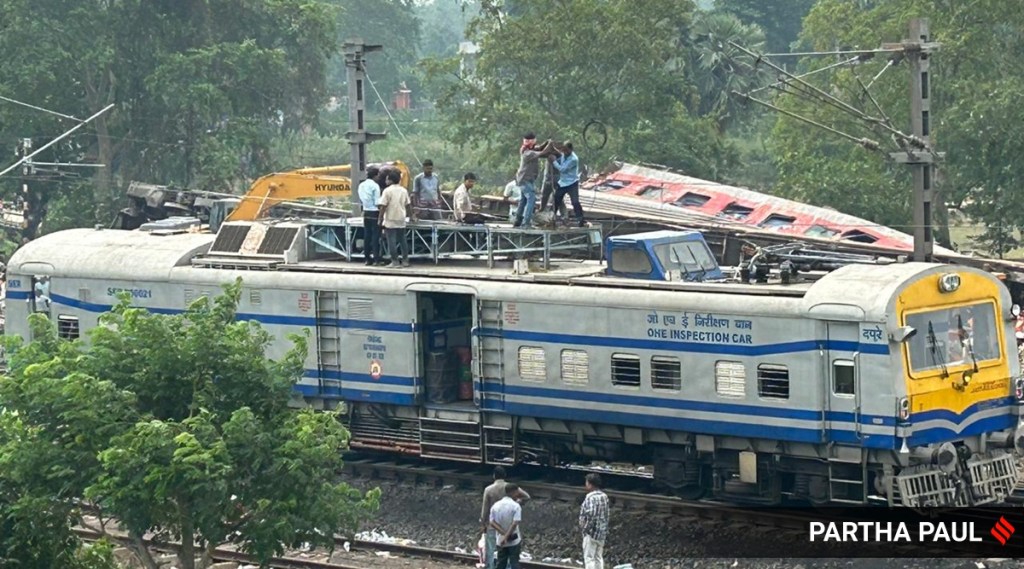

 Work on restoration continued throughout Saturday night using lights through generators. (Express photo by Partha Paul)

 Share


