


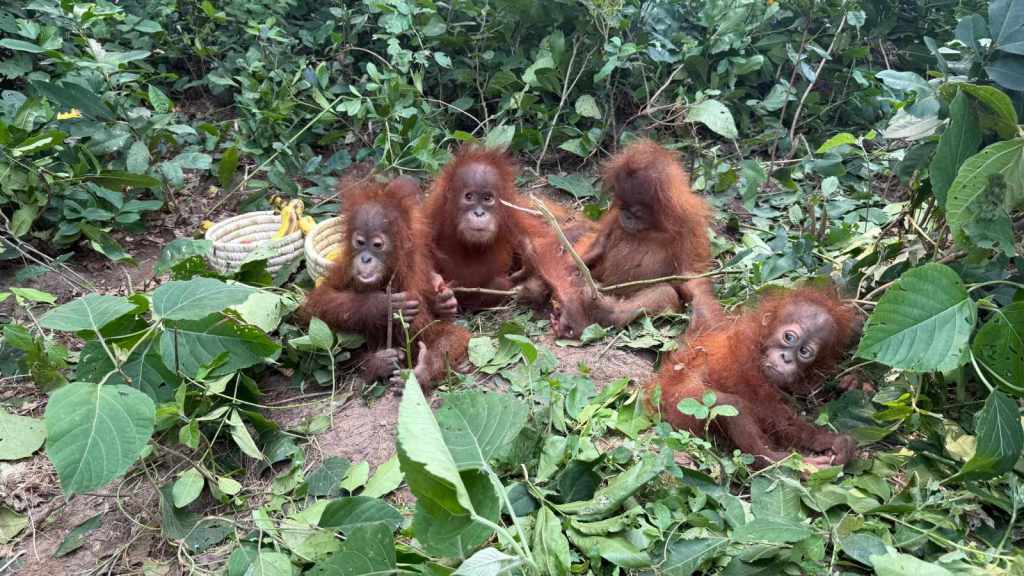
 The orangutans were spotted near the Badapai village forest in Bhograi area of the coastal district around 6 am.
Local residents roaming about a forest area near a village in Odisha’s Balasore district had an unusual sighting on Tuesday — five tiny orangutans.
UPDATE | As 5 orangutans find new home in Odisha, a probe into how they landed there
As the news of the rare visitors spread rapidly, thousands of onlookers gathered within an hour, forcing the forest department to step in and rescue the wild animals.
Unusual sighting in an Odisha forest: 5 baby orangutans
“We have rescued 5 baby orangutans and brought them to the forest office. 4 of the 5 babies are healthy. Veterinary doctors are examining and treating them”: Balasore Divisional Forest Officer Pratik Prakash Indalkar told… pic.twitter.com/P2emXEKOGI
— The Indian Express (@IndianExpress) September 8, 2026
The orangutans were spotted near the Badapai village forest in Bhograi area of the coastal district around 6 am.
“We have rescued five baby orangutans and brought them to the forest office. Four of the five babies are healthy and eating food and drinking ORS. Veterinary doctors are examining and treating them and they are under the care and observation of the forest officials,” Balasore Divisional Forest Officer (DFO) Pratik Prakash Indalkar told The Indian Express.
Though the exact age of the orangutans is not known, forest department officials said from their size — measuring 1-to 1.5 feet in height, they are likely to be juveniles.
While the forest department is yet to ascertain how the apes ended up in Odisha forests, which is not a natural habitation for them, senior officials suspect that they may have been brought into the state as part of an international wildlife-smuggling racket.
Orangutans spend nearly all of their lives above the forest floor, using extraordinary arm strength and grip to move hand over hand through the canopy rather than leaping like monkeys.
|
1–1.5 ft
Height of a juvenile, like the five found in Odisha
|
2.2 m
Arm span of an adult male, nearly twice their standing height
|
40 yrs
Average lifespan in the wild
|
55 yrs
Maximum lifespan reached in captivity
|
Wild orangutans exist only in the rainforests of Borneo and Sumatra in Southeast Asia. There is no natural land corridor connecting these islands to India — which is why officials say the Odisha sighting could not have been a natural migration.
|
Sumatra & Borneo
The only two places wild orangutans exist — both in Southeast Asia
|
Balasore, Odisha
Where the five juveniles were found — roughly 2,700 km away
|
The Balasore DFO's view
"Chances of natural migration is less as there is no corridor link. It must be a human-induced act."
|
Orangutans are Asia’s only great apes and hold the title of the largest tree-dwelling (arboreal) mammals on earth. Native only to the rainforests of Borneo and Sumatra, these highly intelligent primates are currently facing a severe survival crisis, with all three species classified as Critically Endangered on the IUCN Red List.
“Chances of their natural migration to the Balasore forest is less as there is no corridor link. It must be a human-induced act. We have launched an investigation through field officials to ascertain how the primates arrived in the Odisha jungle,” said the Balasore DFO.
A formal complaint has also been lodged under the relevant provisions of wildlife laws while the forest department is also taking help of the police to find out involvement of any individual or racket.
The Wildlife Crime Control Bureau (WCCB), a multi-disciplinary agency by the Centre, would probe into the matter as the state government suspects involvement of international smuggling racket, said Odisha’s forest and environment minister Ganesh Ram Singh Khuntia.
Besides, the forest department has launched a combing operation in the nearby forest areas to find out if any other wild animals are present there or if there is any sign of evidence of their smuggling. “The details, as to whether there is involvement of any individual or a racket, would only be known after a thorough investigation,” said an official.
| Arboreal | The largest tree-dwelling mammal species on Earth |
| Great ape | Asia's only great ape — close relatives of chimpanzees and gorillas |
| Highly intelligent | Known for tool use, problem-solving, and complex social learning |
| Reddish coat | Shaggy, reddish-brown hair distinguishes them from other apes |
Habitat loss, poaching, and illegal trafficking have pushed every orangutan species to the brink. The IUCN Red List places all three in its highest risk category before extinction in the wild.
| Least concern | Vulnerable | Endangered | Critically endangered |
|
Bornean orangutan
Found across Borneo; the most numerous of the three species, still in steep decline
|
Sumatran orangutan
Restricted to northern Sumatra; among the rarest great apes on the planet
|
Tapanuli orangutan
Identified only in 2017; fewer than 800 individuals remain in one forest patch
|
| Source: The Indian Express reporting on the Balasore, Odisha orangutan rescue | IUCN Red List · Wildlife Crime Control Bureau |
Cases of orangutan trafficking involve a multi-million-dollar criminal industry, said officials.
Forest officials said the orangutans will most likely be brought to the Nandankanan Zoological Park in Bhubaneswar after following necessary procedures.
A team from the Nandankanan Zoo has left for Balasore to coordinate the shifting of the wild animals. “Once shifted, they will be put in quarantine for some days at the zoo,” said Principal Chief Conservator of Forests, Wildlife, PK Jha.
Nandankanan had an orangutan — Binny — which died in February 2019, at the age of 41 of respiratory issues. It was then the country’s only Orangutan, which was brought here from Pune in 2003. Prior to Pune, it was brought from Singapore.
Orangutans live an average of up to 40 years in the wild while they can reach up to over 50 to 55 years in captivity, according to forest officials.