


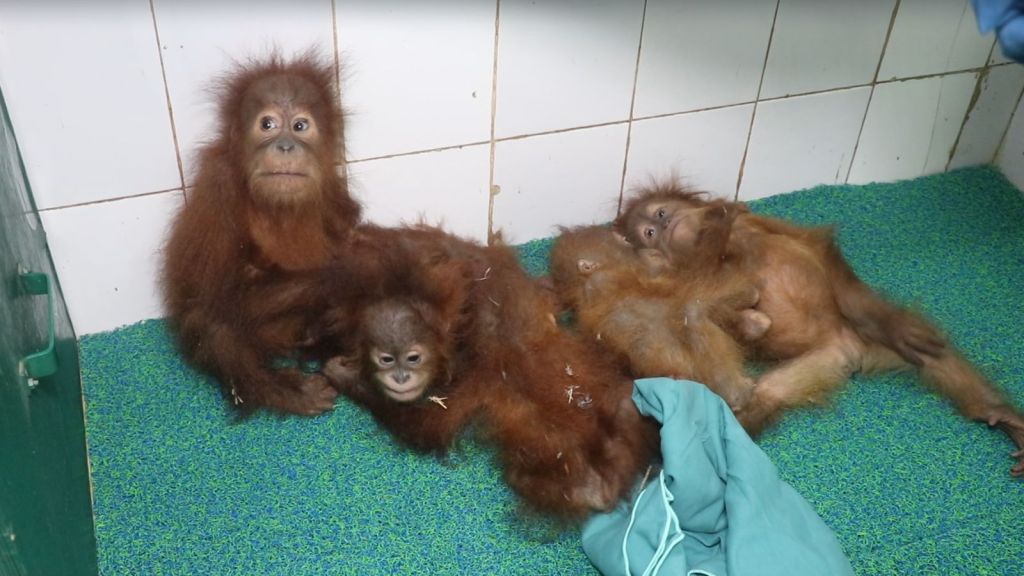
 Baby orangutans at Nandankanan Zoo in Bhubaneswar. (Special arrangement)
A temperature-controlled quarantine facility, round-the-clock monitoring, bananas and apples every two hours, and plenty of toys and slings – the Nandankanan Zoo in Bhubaneswar is leaving no stone unturned to care for five unexpected guests.
On Tuesday, five baby orangutans were rescued from a forest in the state’s Balasore district, raising concerns that a global smuggling ring may be involved since the animals are not native to the country.
Unusual sighting in an Odisha forest: 5 baby orangutans
“We have rescued 5 baby orangutans and brought them to the forest office. 4 of the 5 babies are healthy. Veterinary doctors are examining and treating them”: Balasore Divisional Forest Officer Pratik Prakash Indalkar told… pic.twitter.com/P2emXEKOGI
— The Indian Express (@IndianExpress) September 8, 2026
Later that evening, the five were brought to Nandankanan Zoological Park. Pradeep Mirase, the zoo’s deputy director, said the animals – three males and two females – underwent health check-ups and were taken to a quarantine centre.
As 5 orangutans find new home in Odisha, a probe into how they landed there https://t.co/tMfYYHqoi9 pic.twitter.com/1FV2QejMHc
— The Indian Express (@IndianExpress) September 9, 2026
“Three animal keepers and a special veterinary team have been assigned to take care of them, and we are also monitoring them through CCTV. As one of them had a fever, authorities administered medication. They are stable now. Our focus is to stabilise them, following which we would conduct some tests,” Mirase told The Indian Express.
Ensuring the right nourishment for the new guests is another priority for zoo authorities. A special diet chart has been prepared in consultation with Mysore Zoo – home to three orangutans and with valuable experience caring for the species.
“They are being fed every two hours as per a diet chart. As two of them are very young, the animal keepers are feeding them mashed potatoes and mashed apples. The others are eating bananas and apples. We are also feeding them milk,” said a senior zoo official.
| Frugivorous | Fruit can make up to 90% of intake during peak fruiting seasons, especially figs and durian |
| Opportunistic | Supplements fruit with leaves, shoots, bark, and honey when fruit is scarce |
| Occasional protein | Insects, termites, bird eggs, and rarely small vertebrates round out the diet |
| Tool-assisted foraging | Uses sticks to extract insects and seeds, and chewed leaves as sponges to drink water from tree hollows |
When forests fruit heavily, orangutans gorge and store fat reserves. During lean periods, they shift toward bark, leaves, and pith, an adaptation that helps them survive unpredictable tropical fruiting cycles.
| Fruit ~60% | Leaves & shoots ~20% | Bark & pith ~12% | Insects & other ~8% |
|
Bornean orangutan
Falls back on bark and leaves more heavily during long low-fruit periods between mast events
|
Sumatran orangutan
Eats more insects and occasional meat, including slow lorises, more than other species
|
Tapanuli orangutan
Relies on a narrower forest range, making it especially vulnerable to fruit scarcity
|
| Feeding ecology research on wild Pongo spp. | Orangutan Foundation International · IUCN species accounts |
Humans and orangutans share approximately 97 per cent of their DNA, and the animals are responding well to the care being provided by the animal keepers, the official said.
To keep them engaged, the zoo has arranged toys and slings. And since orangutans are social animals, zoo officials said they appear to enjoy staying together as a group. Officials are working closely with the Wildlife Institute of India to keep the animals comfortable.
As per protocol, the animals will be kept in quarantine for nearly 30 days, during which their health will be monitored, and they will be assessed for any underlying diseases.
The zoo’s deputy director said they suspect the animals are from Borneo, an island in Southeast Asia. “To determine their exact species and evaluate phenotypic characters like physical and observable traits, more analysis is required,” said Mirase.
| Arboreal | The largest tree-dwelling mammal species on Earth |
| Great ape | Asia's only great ape — close relatives of chimpanzees and gorillas |
| Highly intelligent | Known for tool use, problem-solving, and complex social learning |
| Reddish coat | Shaggy, reddish-brown hair distinguishes them from other apes |
Habitat loss, poaching, and illegal trafficking have pushed every orangutan species to the brink. The IUCN Red List places all three in its highest risk category before extinction in the wild.
| Least concern | Vulnerable | Endangered | Critically endangered |
|
Bornean orangutan
Found across Borneo; the most numerous of the three species, still in steep decline
|
Sumatran orangutan
Restricted to northern Sumatra; among the rarest great apes on the planet
|
Tapanuli orangutan
Identified only in 2017; fewer than 800 individuals remain in one forest patch
|
| Source: The Indian Express reporting on the Balasore, Odisha orangutan rescue | IUCN Red List · Wildlife Crime Control Bureau |
Scientists generally rely on a combination of visual dichotomous keys, morphological measurements, and modern genetic analysis to determine the species. “If required, it will be done at a later stage, after due approval from the authorities concerned,” he said.
Asked if the animals will be kept at Nandankanan after the quarantine period, Mirase said no decision had been taken so far.
“Once they stabilise, we will seek approval from the central zoo authorities to keep them here. If allowed, we will do the enrichment for them and hope they will acclimatise to the conditions here,” he said.
Nandankanan Zoo had an orangutan named Binny who died in February 2019 at the age of 41 from respiratory issues. At the time, Binny was the country’s only orangutan, and had been brought from Singapore via Pune in 2003.
On average orangutans can live for up to 40 years in the wild and 50 to 55 in captivity, according to forest officials.
Meanwhile, the Special Task Force of the Odisha Police is revisiting old orangutan smuggling cases as it intensifies its probe to determine whether an organised trafficking racket is involved. “We are analysing similar cases and contacting teams that looked into them. We are currently gathering data and carrying out local inquiries,” Deputy Inspector General KV Singh told the Express.