
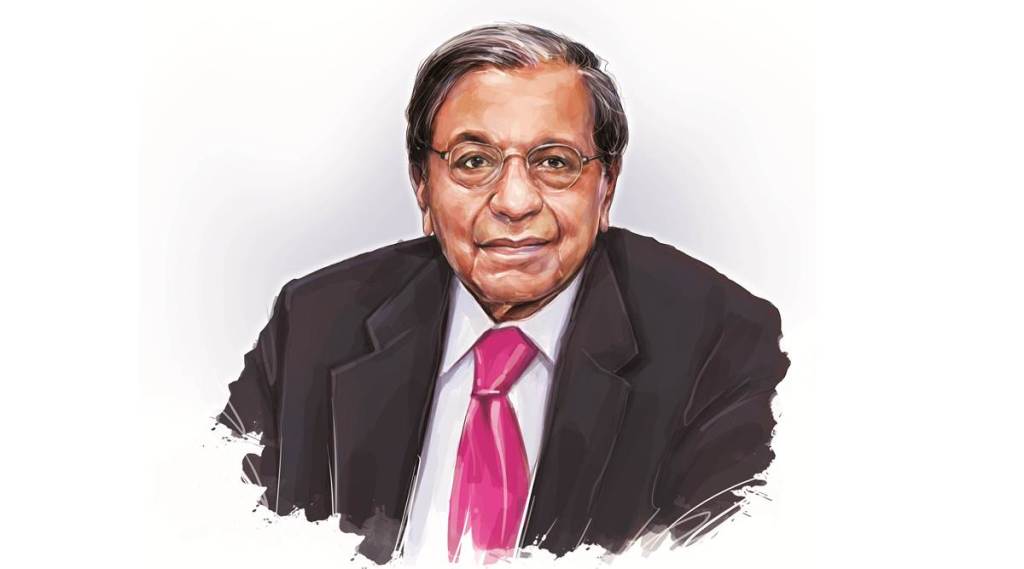
Singh bats for making states equal partners in fiscal responsibility, calls unpaid power dues the “big devil” in state finances, and explains why a non-lapsable fund is the answer given the asymmetry in defence procurement cycle. The session was moderated by Executive Editor (National Affairs) P Vaidyanathan Iyer.
P VAIDYANATHAN IYER: There were expectations from the Finance Commission to make a qualitative comment on cesses and surcharges in its report. Why did the commission not take this up?

Well, it hasn’t escaped my attention. If you look at paragraphs 3.63, 3.8, 4.25, and 4.26 of the 15th Finance Commission’s report, there is a very distinct mention of cesses and surcharges. But to address the more basic question, let me make three brief observations. First, we know that the incidence of cess and surcharge has gone up rather significantly. In 2010-11, cesses and surcharges were close to 10% or so… It has crept up to 19.9% in the Budget Estimate (BE) of 2021… The gross revenue receipts (GRR) for the five-year period (2021-26) is Rs 153.4 lakh crore, which includes all dividend payments, return payments or interest for loans, all user charges, and dividends of not only PSUs but also the RBI and so on. So, this is a broad figure. Out of this, the gross tax revenue (GTR), which includes cesses and surcharges but excludes the others, is Rs 135.4 lakh crore for this five- year period. Out of that, the gross divisible pool, on which the Finance Commission has to pronounce, shrinks to Rs 103.4 lakh crore. So, the difference between Rs 135 lakh crore and Rs 103 lakh crore is attributable to the non-divisible component of the GTR shrinking rather significantly, which is borne out by the figure which I have mentioned, and which is creeping up from 2010-11 to the BE of 2020.
So how has this happened? This is not a new phenomenon. In the 80th Constitutional amendment in 2000, the ingredients of the divisible pool underwent a tectonic shift… Before that, corporate taxes and import duties were outside the divisible pool. So, the divisible pool was redefined by the 80th Constitutional amendment. It made the divisible pool to include all taxes and then, by means of Article 269 and 270 of the Constitution, it left out cesses and surcharges. So that is something on which the Finance Commission has absolutely no say. So, what was in our domain? What we have done is that, going forward, we have recalibrated cess and surcharge to come down from 19.9% to 18.4% during our award period (2021-26)… The reckoning which I have taken is that during this period the total impact of cesses and surcharges will come down… So, I have not only written about it in the four paragraphs, I have acted on what I have written by bringing it down.
The issue of cess and surcharge is not within the domain of the Finance Commission. It is in Parliament’s domain. Parliament will have to amend Article 269, Article 270 and perhaps some other connected Articles to make cesses and surcharges a part of the divisible pool. As long as they are not a part of the divisible pool, it is outside the mandate of the Finance Commission to recommend them. The issue requires a much wider debate.
P VAIDYANATHAN IYER: You have recommended a non-lapsable fund for defence and internal security. Can the Finance Commission do that for a five-year period when Parliament itself can vote for only one particular year?
Firstly, this was not a suo motu decision of the Finance Commission. We were responding to rather unusual and new Terms of Reference (TOR), given by the President, to examine the rationale for the non-lapsable fund and to also consider a financing mechanism… I had constituted a group under my chairmanship which had the Defence Secretary, Chief of Staff, Finance Secretary and Home secretary, to deliberate on this issue. We were persuaded as a commission that given the asymmetry in the procurement cycle for defence and internal security… a non-lapsable fund would be an appropriate response to ensure that the capital expenditure does not create problems. We then obtained the best possible legal opinion from Mr K Parasaran. He said, “First, upholding India’s sovereignty, including by ensuring adequate defence and internal security, is the duty of the Union with a corresponding duty of various states and the citizens to cooperate in this task. Secondly, the fulfilment of this duty is a shared responsibility of states as well as the Union..” So, we were persuaded by this legal opinion that it was a shared responsibility of the Union and the states, which transcends the classification in the Seventh Schedule of the Constitution…
We were persuaded (by the TOR) of the need for a non-lapsable fund for defence. One of the proposals was for a defence cess, on which we did not proceed… What we have done is a combination of harnessing internal resources of the Defence Ministry, namely monetisation of land, proceeds from disinvestment of defence PSUs and a recalibration of the GRR by 1% point to create fiscal space from the Consolidated Fund of India. There are multiple sources of funding for this non-lapsable fund about whose logic we were persuaded.
SUNNY VERMA: Are you satisfied with the fiscal consolidation roadmap outlined in the Budget, or do you think there is need for a high-powered panel on the Fiscal Responsibility and Budget Management (FRBM) law?
The Central government has fully accepted the roadmap which we have given for states… Under exceptional circumstances and given the uncertainties, both domestic and global, we have given a fiscal range for states, which has been accepted… I have argued in favour of an inter-governmental committee for two principal reasons. First, we must recognise that the last FRBM report concentrated largely on the Central government. If you want to have fiscal consolidation… which is more meaningful… you need to make states equal partners. It’s because investors, both domestic and foreign, look at macro-economic stability of the ‘general’ government, implying both the Centre and states… Therefore, we need to look at both debt and fiscal deficit of the general government, which we felt an inter-governmental panel was best designed to do.
ANIL SASI: The Central government has been consistently missing the fiscal glide path. Also, some of the fiscal stress that you see on states is on account of actions by the Centre — delays in GST transfers, schemes like UDAY which place a burden on states….
One of my lasting, elusive quests in the FRBM Committee was (to look into) the total lack of transparency and the opaqueness with which fiscal numbers were being cloaked through subterfuge methods of clever financial engineering, through parastatals, contingent liabilities etc… Full credit to the Finance Minister for coming up with far greater transparency on fiscal numbers. This transparency partly explains why this year the numbers look quite apart from any other FRBM numbers taken together . If this transparency continues, there would be much greater credibility and reliance on these numbers.
We know that today’s debt numbers are quite misaligned with what we had suggested in the FRBM report. But it was our endeavour that, in the consolidations we have given in the Finance Commission’s report, at least at the end of our award period, the needle should point in the south direction and not the north direction… It is always a debatable question that given our level of per capita income, and given the unrealised growth potential, what would be the ideal debt levels. Based on certain very, very conservative assumptions, we had said that 60% would be an ideal figure. Of course, we know today that the debt figures are much, much higher. In our fiscal consolidation roadmap, we have suggested a path which would enable the debt numbers to get recalibrated in the southward and not in the northward direction.
As far as states are concerned, I mean, they voluntarily signed onto all these power schemes… There was no compulsion, there was an incentive… There was nothing compulsory about UDAY (Ujjwal DISCOM Assurance Yojana) either. It was a voluntary obligation that states took upon themselves. That is why when we went and examined the finances of all the states closely, we came to the inescapable conclusion that the giant elephant in the room was the power sector. The unpaid liabilities of power distribution companies… is the big devil.
As far as management of state finances is concerned, instead of giving a grant, we have given an incentive in the form of 0.05% borrowing space, subject to their undertaking of critical obligations. It includes the obligations pertaining to bridging the gap between the average cost of power and the average realisation, billing cycles, bringing down the liabilities of power distribution companies etc.
PRANAV MUKUL: The government now seems to be moving towards a stable direct tax regime. In the current environment, where there is a need for a demand-based push, do you think a stable regime will work?
… As far as direct taxes are concerned, we favoured a predictable, stable tax regime… The great virtue of the 1997 tax changes is stability… There is a constant battle between widening the tax base and increasing the threshold of exemption. I am of the view that one needs to widen the tax base, let people come into the net… Every effort at increasing the threshold may be popular but may not be the most conducive. Broadly speaking, the predictability and stability of rates are very desirable objectives, particularly on direct tax policies… But I think that equally (important is) the need to eliminate exemptions…
SANDEEP SINGH: In the Budget, the Finance Minister announced plans to privatise two public sector banks and one insurance company. How do you see the role of the government in the banking space? What will this do to the recapitalisation of the remaining banks that the government owns?
… On the issue of ownership of banks, this is the first time that the Finance Minister has made a decisive beginning in terms of wanting to rethink it. We certainly need a much deeper banking recapitalisation, but we need to take a view on how the non-performing assets are to be treated, and whether the particular asset reconstruction company, which is being talked about, is the optimum answer.
I also think that we need to watch carefully how the new mindset on banking ownership plays itself out. But these are very positive developments… This Budget, in many ways, represents a mindset change. It represents a change in which after decades we have been able to bid goodbye to the legacy of Fabian socialism, which had cluttered our thinking and limited our horizon. We already lagged behind China, which began its economic reforms in 1974. We waited till 1991… But the fact is that the more deeper structural reforms are something which had remained mired in one controversy or the other. We did big things in telecom, whose multiplier effects one can see till today. We did some big things on road connectivity. But beyond that, we become exceedingly hesitant on issues of banking and banking reforms. We were not able to get over the excessive hangover of an over-regulated socialist era.
SUNIL JAIN: Since the Accelerated Power Development Programme reform, there seems to be a power package every two-three years, where state governments get a lot of money. Why don’t the states, the SEBs (state electricity boards) and the RBI sign a tripartite agreement? As a result, when an SEB defaults on a payment, the RBI can deduct the money from the state government’s balance…
… Why not privatise the state power distribution companies? Not all states have so far done the unbundling in the most satisfactory way. It’s a mixed picture… So they should unbundle… But that requires other reforms most importantly, like the doing away with ‘regulatory capture’. I chaired the first power committee in the Planning Commission, which led to the appointment of the first national regulator on power. Thereafter, each state government in their own legislations had their power regulators… The greater transition of power distribution companies must be coupled with freeing up the state power regulator because they do not really exercise the kind of function with domain knowledge to have tariff fixation… I think merely doing one would not really serve the purpose. So the most preferred option would be genuine reform in the power regulators. The Power Minister told me that he was about to change the Central Power Act for enabling much greater diligence to be exercised in appointing the state power regulators and giving them much greater flexibility. That is a desirable change. Second, is the progressive privatisation of state power distribution companies coupled with a genuinely autonomous regulator? This will resolve many of the issues.
To the question of an automatic debit on the RBI, this proposal was put forth to the Commission in an impassioned way by the Ministry of Power. First of all, under which provision can the RBI resort to this? Unlike other federal structures, we don’t have sub-national bankruptcies… Today, when states do market borrowings or market development loans, the market does not differentiate between a fiscally irresponsible state and a state whose finances are better managed… The only catch is Article 293 (3) of the Constitution, which does not enable states to borrow without the permission of the Centre… One of the things I explored but with mixed success is if in some way states can be encouraged to do a rating and the markets can differentiate on the cost of state borrowings depending on the quality of their overall financial management. There is some tweaking we have done in the report which will perhaps encourage this.
LEENA MISRA: Do you see the Central government having more control on the way states conduct themselves and their finances in the future?
I see no particular devious ways of greater centralisation… The main recipients of the revenue deficit grants have been states, which do not have the same ideological hue of any particular party. On the financial issue, the principle organ which balances this out is the Finance Commission of India… It has no centralising tendencies. If you look at the grants component, they are completely given on the basis of quantifiable normative parameters, a methodology in which there is no opaqueness. So, as far as the Finance Commission is concerned, (there is) no centralising tendency.
VANDITA MISHRA: Today, any exercise of fiscal federalism will operate in the context of political federalism. And political federalism is made of the fact that we have a strong Centre and weakening states. The argument that federalism is in danger was even made in the context of the three new farm laws. Did you weigh in on this political context while drafting the report?
It didn’t even cross our mind… The entire thing is about non-Finance Commission grants. Non-FC grants, primarily in the financial sphere, relate to centrally sponsored schemes and central outlays. Based on our recommendations, the fundamental exercise has been initiated by the Finance Minister, which she mentioned in her Budget speech… That of course raises an important question — what about the Central action on subjects which are in the domain of states? Take the case of farm laws. The farm laws have been made into a legal rubric but so far nobody has questioned the constitutional validity of these laws or nothing has been pronounced on whether or not this is in the concurrent list…
The Seventh Schedule (which specifies allocation of powers and functions between Union and states) should be re-examined from today’s perspective. In whose list should employment be?… In whose list should food and food security rest?… I believe that it’s time to rethink — looking at today’s challenges and priorities — who should be assigned the responsibility of carrying out these functions.
P VAIDYANATHAN IYER: What is your view on the ongoing farmer protests?
In Punjab, the dependence on two crops has meant highly intensive water use. There is a need to improve farm productivity, and consolidation of land holdings has remained elusive. The farm laws are the beginning of much deeper reforms in agriculture.
P VAIDYANATHAN IYER: How do you look at the arrest of an activist in connection with the farm protests and the foreign conspiracy claims that have become a part of the government discourse now?
I have no view on this… I don’t know the sifting of facts from interpretation. I don’t know the full facts… I have read many versions of this, I wouldn’t have any comment.


 Share


