2 min readUpdated: Sep 12, 2026 12:13 PM IST
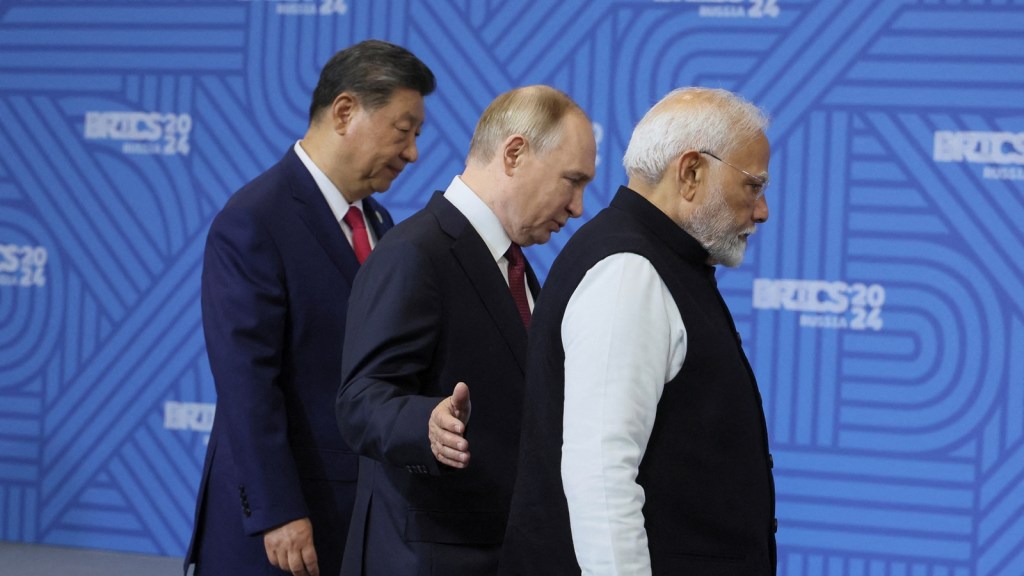
Prime Minister Narendra Modi met Russian President Vladimir Putin Friday afternoon – a 45-minute sit-down at Delhi’s Bharat Mandapam, the venue for this weekend’s BRICS summit. On Saturday evening – at close on Day 1 of the summit – Modi is due to meet Chinese President Xi Jinping.
There will be other meetings too. Several of them, in fact. The PM’s schedule starts from 10 am and includes meetings leaders of Ethiopia, Malaysia, Abu Dhabi, and Vietnam, with more to come tomorrow. But the bilateral with Xi is arguably the most important.

Meetings between an Indian prime minister and a Chinese president are infrequent, at best, and come with layers and decades of geopolitical, economic, and military tension to unpack. That’s no different this time, on Xi’s first visit in seven years.
What will be different is a trade deficit that has ballooned since 2019 – from roughly $11 billion in China’s favour then to over $112 billion now, still in its favour. A chunk of the Modi-Xi talks will certainly focus on that. Indeed, sources told the Express a ‘strategic economic dialogue’ will address this and related issues, including Indian companies’ access to Chinese markets. The two are also expected to review recent talks in Beijing on the contentious border issue.
- 01
'New engines of growth'
At a BRICS business forum on Friday - after Modi and Putin had their bilateral - the Russian leader said 'the world is undergoing structural, deep, profound shifts' in which 'new engines of growth' are replacing 'the so-called old leaders', and that 'together with our partners, we stand ready to contribute to world energy and food security...'
- 02
'Safety of seafarers'
At the same event the PM highlighted the fact that global trade could only progress if shipping routes are secure, supply routes remain open, and seafarers are safe. "India is a staunch supporter of freedom of navigation and the safety of seafarers," he said, while also reminding Putin that dialogue and diplomacy were the only way forward in resolving conflicts.
- 03
Trade and nuclear push
During their sit-down, both leaders reaffirmed the target of lifting bilateral trade to $100 billion by 2030 by focusing on industrial cooperation, rail, steel, and improving market access for Indian products in Russia. Expanded civil nuclear ties was also discussed, including topics like additional reactors and broader collaboration, while also sustaining discounted crude oil flows that underpin India’s energy security.
- 04
War context
Modi and Putin shared perspectives on conflicts in West Asia - the US-Israel war on Iran - and the Black Sea region - Russia's war on Ukraine - with the Prime Minister's remarks on seafarers' safety coming after the deaths of Indian sailors in July. Five of them were among 10 killed after a Russian missile hit a merchant vessel departing Ukraine’s southern port of Odesa.
- 05
BRICS leverage
As 2026 chair, India is pushing BRICS toward practical cooperation on trade, finance, energy, critical minerals, and supply chains, rather than an anti-West posture, and seeks Russian backing for that agenda.
- 06
Xi returns
Today's Modi–Xi bilateral is the first in India in seven years, marking a high-symbolism test of whether the cautious thaw since the edition of the summit hosted by Russia in Kazan - in October 2024 - can move beyond border disengagement to broader stabilisation.
- 07
But border first
- 08
Trade imbalance
India will press on the record bilateral trade (about $127.7 billion in FY 2024–25) and the swelling deficit (around $112 billion), seeking fair market access for Indian pharmaceuticals, IT, and agriculture, and more balanced commerce.
- 09
Strategic autonomy
The twin meetings - with Putin and Xi within 24 hours - underlines India's delicate balancing act - i.e., deepening ties with Moscow and repairing relations with Beijing, while refusing to be boxed into either a Western or Sino–Russian camp.
- 10
Why it matters
Together, these meetings define how India uses BRICS: to lock in defence and energy security with Russia, nudge China toward border stability and fairer trade, and project Delhi as an indispensable, independent pole in a fragmenting order.