


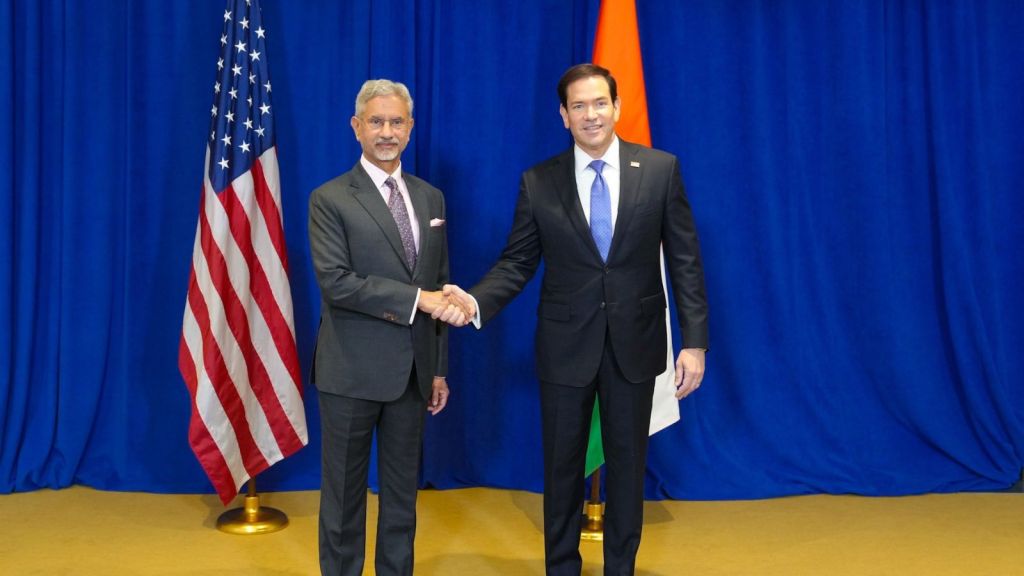
 External Affairs Minister S Jaishankar with US Secretary of State Marco Rubio
In remarks after his meeting Wednesday with External Affairs Minister S Jaishankar who flagged India’s concerns over the new US law to punish Russia’s energy buyers, Secretary of State Marco Rubio said the US was “well-positioned to help regional partners address their energy security challenges”.
The Lindsey O. Graham Sanctioning Russia and Iran Act, which was signed into law by President Donald Trump last week, authorises the US to impose up to 100 per cent tariffs on Russian energy purchasers, including India and China. India depends on imports to meet over 88 per cent of its crude oil needs, and Russia currently accounts for nearly half of these imports.
A US Department of State statement after the Rubio-Jaishankar meeting on the sidelines of the UN General Assembly said, “The two also discussed sanctions that could be levelled against states that engage economically with Russia and Iran. The Secretary emphasised that the United States remains well-positioned to help regional partners address their energy security challenges.”
In his talks with Rubio, Jaishankar conveyed India’s economic and strategic concerns regarding the Russia sanctions Bill. He said they also discussed the situation in the Gulf and Ukraine.
In his address to world leaders at the United Nations, Trump said he signed the “powerful new law” that provides him with “enormous new tariff authorities” on major buyers of Russian oil. “If necessary, I will have to use them. It’s time to stop the killing,” he said.
These developments come at a time when Delhi and Washington are working to finalise a bilateral trade deal. From India’s point of view, the Russia sanctions Bill does give powers to the US President to waive the application of its provisions. India will almost certainly push for a waiver.
Meaningfully reducing Russian oil imports is just not an option for Delhi given the prevailing global energy situation due to the crisis in West Asia. Analysts believe that even for Washington, removing millions of barrels of Russian oil from the global market when energy flows from West Asia remain highly constrained will not be prudent.
India’s hefty imports of Russian oil have been a point of friction in the bilateral relationship between Delhi and Washington. The Trump administration has been trying to push Delhi to cut down on Russian oil purchases and increase energy imports from the US.
In March this year, when India was granted a waiver on Russian imports amid the war in West Asia, US Treasury Secretary Scott Bessent said, “India is an essential partner of the United States, and we fully anticipate that New Delhi will ramp up purchases of US oil.”
Over the past few years, the US has consistently featured among the top five-six suppliers of crude oil to India. In the first eight months of 2026, it was India’s sixth-largest supplier of crude oil behind Russia, Saudi Arabia, the UAE, Iraq and Brazil, according to tanker data from commodity market analytics firm Kpler. India’s oil imports from the US in the January-August period averaged at 177,000 barrels per day (bpd).
While the US has also been among the large suppliers of LNG to India in recent years, the West Asia conflict has made it the top supplier because import volumes from traditional West Asian suppliers have plummeted. Kpler data shows that India’s LNG imports from the US surged 172% year-on-year in April-July to 2.39 million tonnes.