


Stay updated with the latest - Click here to follow us on Instagram
© The Indian Express Pvt Ltd
Tags:


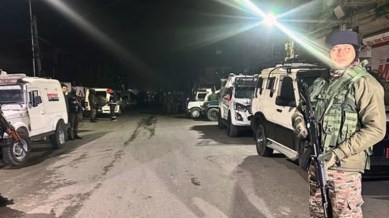
Investigators probing the November 14 explosion at the Nowgam police station in Srinagar, where 9 persons were killed while examining explosives seized from a terror module linked to the car blast near the Red Fort, are looking at the use of a halogen lamp by a forensic team as a possible trigger for the explosion.
It is suspected that a halogen lamp kept close to a suitcase with explosive material for a significant time may have generated enough heat for the explosion.

Sources said the forensic team had taken samples from all but one suitcase containing the explosives. A liquid, sources said, had been found oozing out of one of the suitcases. Since it was night already, a halogen lamp was placed near the suitcase to examine it properly and take a sample.
“Halogen lights can generate considerable heat. It is suspected that the liquid that was oozing out of the suitcase was an inflammable substance mixed with ammonium nitrate. It is possible that the heat generated by the halogen light led to the liquid catching fire which in turn generated enough heat to trigger an explosion in the ammonium nitrate beneath. However, more investigation is required to confirm this,” said an official privy to the details of the ongoing probe.
The cache of ammonium nitrate that exploded at the Nowgam police station on November 15 had been recovered from a Faridabad house rented by Muzammil Ahmed Ganai, a doctor who police said was a member of the terror module linked to the Red Fort car blast.
The explosives, packed in suitcases, were transported to Nowgam police station for investigation since it was the Nowgam police which had uncovered the terror module involving Ganai and other doctors from Jammu and Kashmir.
A part of this cache of explosives had been shipped out by Ganai’s associate Umar Nabi, days before the police raids. Umar was driving the car when it exploded near the Red Fort on November 10.
Meanwhile, investigators have been able to trace the location of another foreign handler of the terror module. Identified as Hashim, the handler has been traced to Pakistan-occupied Kashmir (PoK).
“The IP address of his communication with the accused in the case has been traced to PoK. Further probe is on,” an officer said.
Along with Hashim, two other handlers, Ukasha and Faisal Iqbal Bhat, are said to have coordinated the group’s actions from across the Line of Control. The trio not only radicalised the doctors but also shared bomb-making tutorials, instructions on setting up clandestine laboratories at home, and gave precise operational guidance. Investigators said more than 40 videos on explosives and chemical mixing were sent to the group through encrypted platforms, primarily Telegram.
A senior officer involved in the probe said Faisal Iqbal Bhat’s role stood out. “He could be in Pakistan or Afghanistan. The nature of his chats indicate he could be an ISI operative. His conversations are sharp. He gives clear instructions and assigns roles and responsibilities to various members of the module. In many chats he is giving instructions on how to create Telegram channels for specific tasks,” the officer said.
Ukasha’s location has already been traced to Afghanistan. It is learnt that Ukasha is in Pachir Wa Agam district of Nangarhar province in Afghanistan, near the border
with Pakistan.
Stay updated with the latest - Click here to follow us on Instagram


