


Journalism of Courage
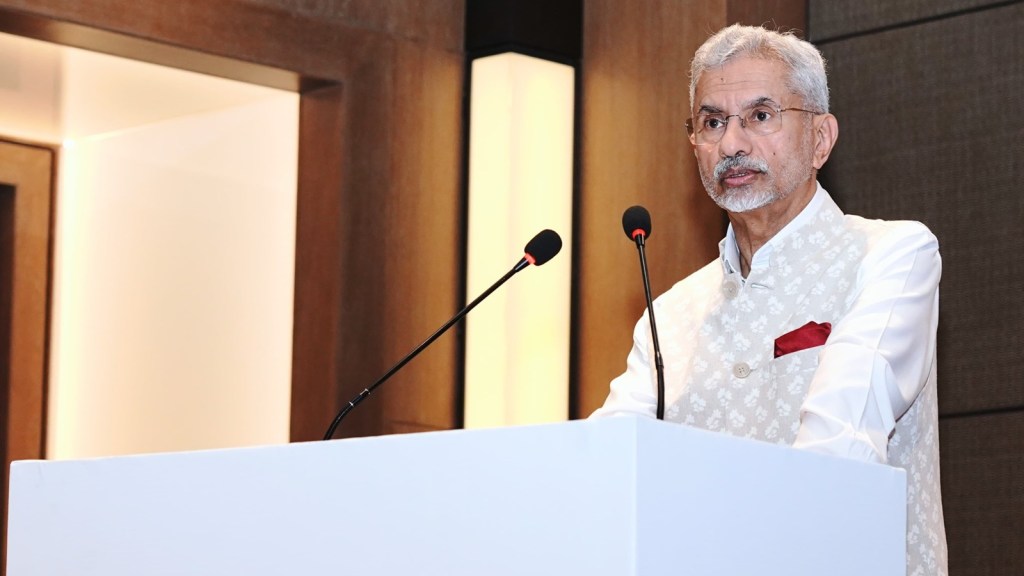 External Affairs Minister S Jaishankar added that there were around 34 million Indians and persons of Indian origin living and working abroad, of which about 50 per cent are citizens.(Source: X/@DrSJaishankar)
With the changing demands of the global workplace, it is important to promote legal mobility while stopping illegal immigration, External Affairs Minister S Jaishankar said Tuesday, adding that the government was examining an amendment to Emigration Act, 1983 for the same.
At the launch of the Global Access to Talent from India (GATI) Foundation, he said: “There is naturally the issue of how we adjust to the demands of the global workplace to optimise benefits. Conceptually, it is vital that we promote legal mobility and strongly discourage, I would argue even prohibit, non-legal ones.”
He said the challenge of “black economy” should be faced with the viewpoint of flow of talent, societal good and national security.
“Currently, mobility is largely regulated by Emigration Act, 1983, which was designed to address demands of a particular geography in a certain era. However, times have changed… We need to be more promotional and aware of new possibilities even while taking care of the vulnerable. This issue is currently being examined by the government,” he said.
The Act regulates recruiting agents and gives the government the power to prohibit emigration in certain situations, including outbreak of epidemics, among other provisions.
The minister said there were around 34 million Indians and persons of Indian origin (PIOs) living and working abroad, of which about 50% are citizens.
“Perhaps a third are located in the Gulf and the rest are spread across other geographies, mostly developed economies. However, given the trends that I spoke about, the possibility of expanding that even in the near term is very serious,” he said.
He highlighted the demand for Indian talent in different countries, including Japan, Israel, Malaysia, Germany, Singapore, Italy, Spain, Austria and Greece.
“… My short point is there is a demand in the world, availability in India and the basic groundwork done to enable Indian talent to gain global access is there. Now, how well they do that and what will be the scale – I think that is up to us,” he said.
At the launch, MoS (independent charge) for Education and Skill Development Jayant Chaudhary said: “In an age of rapid adoption of new disruptive technologies across industries, the skill ecosystem and regulators must be agile, inclusive, and global in their response to the dynamic demands of the job market.”
The GATI Foundation, a non-profit founded by Convergence Foundation, Manish Sabharwal, the Vice-Chairman of TeamLease Services and the Godrej Foundation, aims to work with governments, businesses and non-profits to help Indian workers avail of the opportunities in the international labour market.
Ashish Dhawan, founder-CEO of The Convergence Foundation, noted: “Today, nearly 700,000 Indians migrate to work overseas each year. However, 60% of this workforce is concentrated in GCC [Gulf Cooperation Council] countries. We have a real opportunity to expand our annual migrant flows to 2-2.5 million, by diversifying across geographies and job roles. Doing this can not only create more job opportunities, but also help us increase our remittances to $300 billion. Since remittances flow directly into households — enhancing consumption, education, and health spending — there is also a significant impact on poverty reduction.”
On the timing of the launch, Sabharwal said: “GATI is an idea whose time has come for India. The noise is high, but economics will trump politics if it is able to move the debate on migration from illegal to legal, migration to mobility, and citizenship to work. The notion that rich countries can avoid inflation or do care work without migration is impossible. The challenge for nations is to make migration orderly, temporary, and safe.”