19 min read
Stay updated with the latest - Click here to follow us on Instagram

Journalism of Courage



 The Catering Policy 2010 intended that large central kitchens operated by the Railways would supply food on trains.(Express Photo by Tashi Tobgyal)
A lot goes into 11 lakh meals a day, a global record. And Railways has tried everything — from IRCTC to zonal railways, from private operators to e-catering. Yet, complaints are at a new high in the past year, forcing a revised catering policy. The Indian Express tracks a food packet, from the kitchen to the berth.
It’s 2 pm on a Wednesday. Rajesh Kumar, the man in charge of a four-storey kitchen in Noida, is pacing up and down the landing near the exit gate. A half-empty refrigerator container van, doors wide open, stands next to him. The engine is running; the cooling is on.
The food is late. The van needs to reach New Delhi Railway Station, some two-hour ride away, with the food and the rotis that are getting packed upstairs. The Sealdah Rajdhani Express will leave at 4.25 pm sharp and won’t wait for the food truck if it doesn’t reach on time — Kumar’s worst nightmare.
“It happened once last year,” Kumar says.
That day, a day before Holi, Kumar’s consignment of around 1,000 packets of food meant for a Bihar-bound festival-special train leaving from Anand Vihar Railway Station had met an unexpected hurdle. The usual approach to the station was blocked, and the truck had to take a long diversion, wading through jam-packed East Delhi. They could load only half the packets, before it was time for the train to leave.
“Then the truck raced towards Ghaziabad, to try catch the train,” Kumar says. But they couldn’t. “Only we know how we managed to feed the over thousand passengers. We apologised and apologised, we made ad-hoc arrangements…”
At this ISO-certified Noida Central Kitchen, the only one owned and operated by the Indian Railway Catering and Tourism Corporation (IRCTC), such experiences are rare. In fact, it hasn’t happened again.
A giant machine with tentacles spread countrywide, the Railway apparatus — including private caterers, food suppliers, kitchens big and small, and railway officials at all levels — working 24X7 to serve cooked food to train passengers, does manage to catch the trains every single time. And feed 11 lakh meals every day, eight lakh to the travelling public — a global record.
But that’s just half the story.
In reality, a railway system infamous for running trains late or keeping its toilets dirty has always grappled with servicing this giant food machine. In 2016 alone, it received 8,486 complaints regarding food, representing a jump of around 37 per cent over the previous year. Most complaints were about overcharging. Complaints about quality of food came a distant second.
With avenues of lodging complaints in real time increasing thanks to social media, and the NDA government encouraging feedback through Twitter, the numbers have been growing. Twitter alone throws up around 200 food complaints every day, with Railway Minister Suresh Prabhu himself fielding dozens of them, apart from courting Parliament questions every session.
The NDA government wants to change that. Two months ago, a new catering policy was unveiled, seven years after the last one.
***
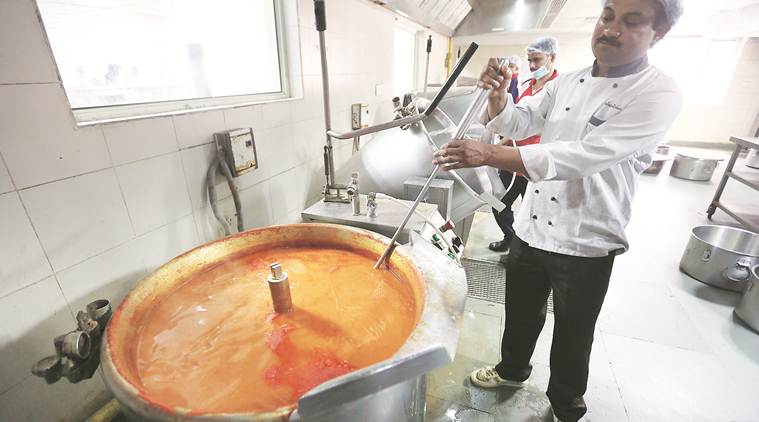 (Top and above) The 4-storey Noida Central Kitchen of IRCTC, the only one owned and operated by it, works like a factory with automated machines churning out dal and rotis. As IRCTC again takes centrestage, more such kitchens are planned
In the developed world, railway systems have reduced their direct engagement with serving food to passengers. China too has moved in that direction. But in India, the reverse has happened.
With long-distance journeys in India often stretching beyond 48 hours, and with food considered integral to the experience, the Railways has found it hard to hive off this business, even though it earns it little money and a lot of infamy. Instead, it has reacted by increasing its micromanagement, interference and control.
From dal to matar-paneer and samosa to sandwich, the Railway Ministry sets the menu for trains down to the last detail, including which parts of the chicken should not be served and how much should the gulab-jamun weigh. Given the scale of operations, too much variety or change is considered risky — the last tinkering was in 2014, and only in quantity.
So, for years, a Rajdhani ride has meant being welcomed with nimbu-paani and going to sleep with ice-cream.
The ministry also caps the prices of food items sold by licensed private vendors.
The abiding principle has been that the Railways would monitor what its passengers were eating, how much they were eating and for what price. Within this ecosystem, private vendors had to work.
But as has been proved time and again, the model has not worked. People have complained of finding dead cockroaches and human hair in their food, of falling sick after eating the food, of poor quality and even quantity, and of being overcharged. Between December 2014 and November 2015, the Railways fined authorised caterers Rs 12.67 crore over complaints — a 76 per cent jump over the previous year.
And yet, as per grand plans drawn up around 2010, these problems should have been exorcised by now.
***
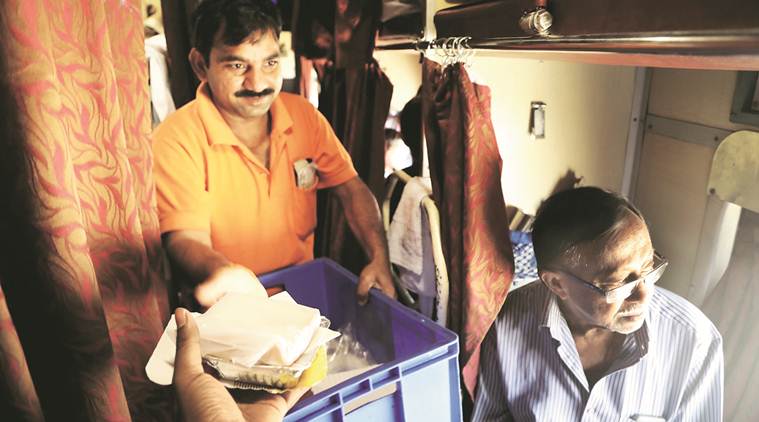 The meal reaches an AC-II tier passenger on Nizamuddin Durg Special Train. Vendor is Otik Hotels and Resorts Pvt Ltd
Till the late Nineties, zonal railways had handled catering operations on their own. Old-timers working in Railway Traffic Commercial departments in zones recall trips to wholesale markets to oversee procurement of perishables for Rajdhani trains. With the number of trains increasing, direct involvement became more and more difficult. So in the Nineties, private food vendors, or caterers, started getting roped in for trains to work in one of the earliest models of outsourcing in the Indian government.
In September 1999, the then Railway Ministry under the NDA-I government, headed by Nitish Kumar, conceived IRCTC as a Focused Business Organisation, with the freedom and flexibility of a PSU, to provide food to railway passengers. By 2002-03, all catering activities had been given to IRCTC. Within a couple of years, it had become a principal aggregator of contracts to vendors, which cooked, supplied and served food to passengers, after paying a licence fee and sharing revenue/commission with IRCTC.
In 2009-10, soon after taking over the ministry, Mamata Banerjee decided that IRCTC had made a mess. Officials say she saw the corporation as only interested in commission and not so much in the quality of food. Food was a service/amenity first and a profit centre later, she declared.
The Catering Policy 2010 was, therefore, implemented. It essentially wrested the business from IRCTC and gave a major pie back to the zonal railway units.
Those who carried out the change say that apart from quality, a major reason was hygiene. “IRCTC had given licences to all sorts of small players… We believed preparation of food in large-scale kitchens meant for passengers should be directly done by the government,” says Vivek Sahai, the then chairman, Railway Board.
Sahai says he inspected the kitchens of some of those private vendors and was “shocked”. “We found that chapatis for trains in Mumbai were being made in a slum.”
There were around 338 long-distance trains running with pantry cars at the time. IRCTC was allowed to retain only 49.
But it led to more problems..
***
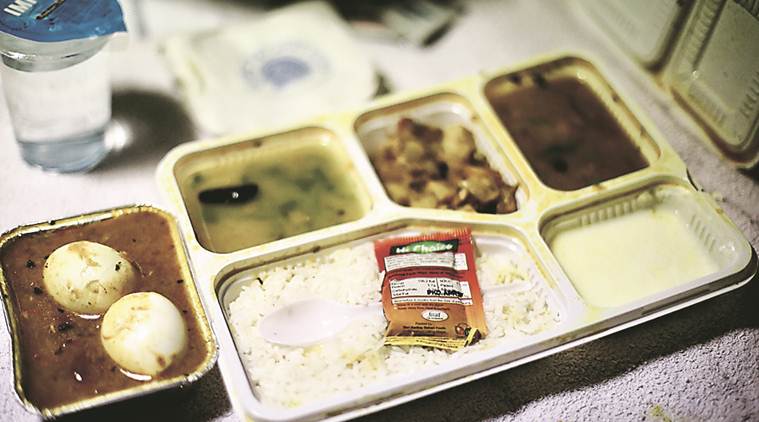 For trains without pantry cars, the licensee loaded food enroute after taking orders from passengers on board.
The Catering Policy 2010 intended that large central kitchens operated by the Railways would supply food on trains. However, the Railways found that it did not have the bandwidth to manage the operations on its own. Although the caveats of “strict quality control”, “supervision” and “inspection” were kept, the job started going to more or less the same private railway caterers once being managed by IRCTC.
The vendor quoting the highest amount as five-year licence fee was given the contract. The business model came to this: The licencee provided food to passengers of the Rajdhani and billed the Railways as per the number of meals served. Every meal, from breakfast to evening tea/snacks, was reimbursed as per a price pre-decided by the Railway Ministry. For all other kinds of trains where meals were not a part of the ticket price, the Railways went in for revenue sharing. For trains without pantry cars, the licensee loaded food enroute after taking orders from passengers on board.
Last year, an internal report prepared by the Railway Board as a prelude to the new catering policy found that the private players were overcharging passengers.
On an average, for example, a private caterer paid Rs 15.53 crore for licence to serve food on the Ernakulam-Nizamuddin Mangala Lakshwadeep Express. A Rajdhani to Bhubaneshwar attracted a licence fee of Rs 19.17 crore. “Any investor… would look to recover this amount from the railway passengers,” the Railway internal report noted. “It is an inescapable conclusion that the licencees are fleecing the passengers.”
Plus, with food a minefield, big players continued to stay away, leaving the field open to a select few, entrenched players.
One of them is R K Associates and Hoteliers, owned by Delhi-based Sharan Bihari Aggarwal and family, which owns licences for around 15 of the 254 trains which have pantry cars. Recently, the CBI arrested Aggarwal in the so-called Rail Neer scam. It was alleged that his company, in collusion with Railway officials, served packaged drinking water of brands other than the IRCTC-owned Rail Neer on trains. He was later released on bail.
Last month, control of the Ahmedabad Swarn Jayanti Rajdhani was taken from Varanasi-based Ambuj Hotels after repeated complaints, including a question in Parliament.
Recently, Union minister Babul Supriyo posted on Twitter that people from his constituency Asansol had fallen sick after eating food on the Sealdah Rajdhani, whose contract was also with R K Associates. The contract was terminated.
***
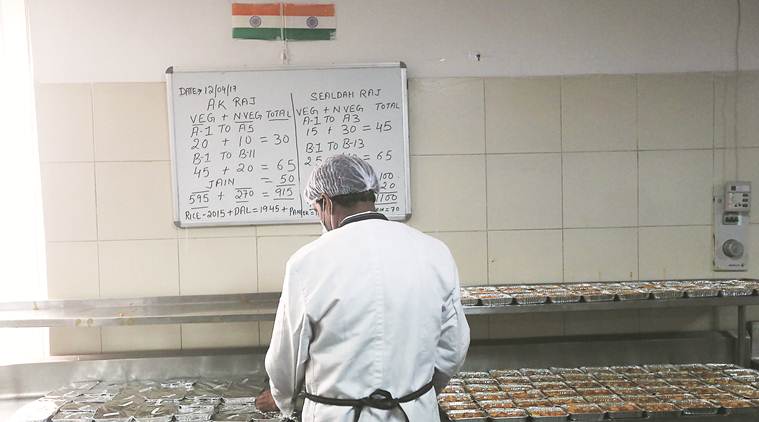 The Railway Ministry decides menu served on trains to the last detail, including which parts of chicken are not to be served and how much should gulab-jamun weigh. Despite the scale of operations, Railways failing to get food on a train is a rarity
By the time Suresh Prabhu took over the reins of the transporter, the existing models of the rail food business had run their course.
In 2015, Prabhu appointed E Sreedharan to look into various processes within the Railways and to prescribe solutions. One of the many recommendations of the Sreedharan Committee was that the Catering Policy 2010 be done away with and that IRCTC again be given the job of exclusively handling the food business.
Enter Catering Policy 2017.
Released in February, the policy takes its essence from a simple idea: unbundling. IRCTC will supply food from its own kitchens set up along routes and in major centres, while private vendors would be in charge of distributing it to on trains.
The Railways hopes this works. “Whatever the past decisions may have been, the point is we have renewed our faith in the IRCTC. See, food is a non-core activity for the Railways. It is a passenger amenity, like waiting rooms. It’s best if a separate organisation runs it,” says Mohammad Jamshed, Railway Board Member, Traffic, the senior-most official handling passenger-related matters in the Railways.
But for a document that seeks to govern an area as complex and as contentious, the Catering Policy 2017 is surprisingly bereft of finer details — it addresses the “what” questions, leaving the “how” questions open.
How IRCTC can set up so many kitchens and where the private sector stands vis-a-vis its future relationship with IRCTC are points yet to be finalised. IRCTC will not be allowed to “outrightly outsource” or issue licences for provision of catering services to private operators.
More significantly, the policy is yet to address the issue of the larger bouquet of trains where food is served but do not have pantry cars, what is called ‘train-side vending’.
The IRCTC will also continue to decide the menu “in consultation” with the Railway Board, though it is rigid control and micro-managing that are believed to have rendered earlier catering policies ineffective.
Even the Railway Board admits this. “…Ministry of Railways gave directions on several catering issues on Menu, Tariff and process of tender awarding. This Policy was to be followed by IRCTC in totality. It is felt by several experts that this was the beginning of the end of IRCTC’s Catering initiative,” says an internal background report prepared by the Railway Board.
Jamshed assures that this time, the same mistakes will not be made. “We actually wanted to give IRCTC much more freedom as a PSU and not restrict it with a whole lot of micromanaging,” he says.
There is also talk of linking prices of food items charged on trains to the Consumer Price Index or the Wholesale Price Index, a long-standing demand of private players.
The feedback the Railways has received time and again while speaking to reputed players in the food business is that the model of running pantry cars leased out on a train-to-train basis does not work. So new models dovetailing with the new policy include giving out all trains originating from one zone to one player so that big, reputable names find it worthwhile to participate.
***
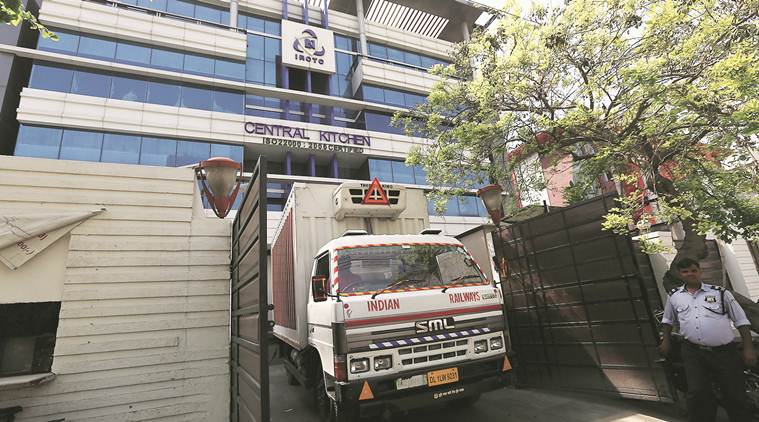 Van leaving with the meals for New Delhi Railway Station
But going by the past record of the Railways, industry stakeholders are sceptical. “The policy is a bit vague on how IRCTC can involve the private sector because obviously it cannot make and run all the kitchens on its own for all the thousands of trains. In so many years it could build only one big kitchen in Noida,” says Sharan Bihari Aggarwal of R K Associates.
How difficult engaging reputable players is was also evident last year when for the Gatimaan Express, India’s fastest train, the Railways gave the catering contract for six months on a nomination basis to Travel Food Services, which runs premium lounges at international airports. The company decided not to continue beyond six months. Company officials said it did not gel with their existing business model. The contract later went to R K Associates. Recently, IRCTC engaged Haldiram’s for the train.
Some private players have on their own tried to get into the business, sensing a demand from passengers. In 2012, Pushpinder Singh and his friends teamed up with restaurants in Jaipur to deliver food to passengers aboard Ashram Express, running between Old Delhi and Ahmedabad via Jaipur.
At 3.20 pm, when the train left Old Delhi, passengers were given pamphlets with numbers to call on to order for dinner. Kumar and his friends, who called their venture Travelkhana.com, would receive the orders and pass them on to the restaurant concerned, which would deliver them in Jaipur at around 8 pm. Travelkhana.com and the restaurant would then share the revenue.
From that idea emerged the Railways’ e-catering scheme, and Travelkhana.com is now one of IRCTC’s major partners in it.
“It took the Railways a good three-four years to figure out that this was a workable model. We were delivering to even trains which had a pantry service,” Singh says.
Now, a passenger who logs into the IRCTC website is given options of food providers by aggregators such as Travelkhana.com along her train route. The passenger can pay online or choose cash upon delivery. IRCTC, which charges food producers 12 per cent of the cost as commission, says it works like a charm.
Prabhu too has identified this as a sunshine sector. “Let private players operate with this kind of engagement and provide passengers freedom of choice,” he says. “Ideally, the Railways should not be directly involved in the food business at all.”
The minister has set a target of 1 lakh meals per day delivered through e-catering from the modest 5,000 meals per day now.
***
The Railways is also toying with ideas such as pre-cooked ready-to-eat meals soldiers eat, after dipping the packets in hot water for a few minutes. A trial was carried out after procuring the packets from a facility that makes these for the Army in Mysore. Passangers have been served this food during the fog season on late-running trains.
Besides, the Railways has implemented ‘Food Box’ — a large vending machine that automatically dispenses packaged meals — at Bengaluru railway station.
All these experiments are also because the transporter believes the passenger has not really given up on train food yet. A 45-day pilot project on three trains where food is built into the tariff threw up somewhat startling results last year. Passengers were give the option to opt out of the food and, naturally, not pay for it. Only about 5 per cent of passengers took the option.
“If you see the figures, even after so much talk of Railway food being not so good, only a minuscule percentage of complaints are actually about quality,” Jamshed says.
***
 Incubating food samples at specimen test facility at IRCTC kitchen
But e-catering or such measures still remain a nascent side-show. Food from IRCTC kitchens, like the model one in Noida, for now, remain central to the new policy.
It may be called a kitchen, but occupying around 43,000 sq ft over four floors, it is more like a factory. Huge imported machines do most of the heavy lifting, including chopping, kneading, cutting and making chapatis. While just 50-odd people run the show right now, that will change soon.
One machine from Finland chops 10 kg onions in a minute. A bakery machine from Italy makes the breadsticks to go with soup.
Right from the store where raw material is kept to the manual packaging area and the cooking/baking stations, the working areas are spotless. Kitchen workers in hygiene gear go about in clockwork routine. Many of them are hotel management graduates, as is in-charge Rajesh Kumar, who has also worked in the United States.
The kitchen has its own microbiology lab to test samples of cooked food and raw materials. Officials say the standards of how much impurity is permissible are far stricter than what the food industry follows.
The cooked food is transferred to smaller containers and finally to packets manually. Workers label each packet and stack them up for transit. Blast chillers then bring down the temperature of the packets to 3-5 degrees Celsius. After this, the packets are transported to stations in cooled container vans, which can accommodate around 1,000 meals per trip, from where they are distributed to hot containers located aboard the train coaches, near the doors.
The cold packets are heated and served at around 45 degrees Celsius to passengers.
***
 The packets being stocked in hot containers aboard coaches for the journey
It’s around 2.30 pm and the refrigerator container van seen off by Rajesh Kumar from this kitchen is making its way to the New Delhi Railway Station through heavy traffic on National Highway 24. After about 90 minutes, the van reaches a base kitchen next to the platforms in New Delhi. From here, it is loaded in batches into golf carts, which take the packets to the coaches.
On-board staff load the packets one coach at a time. Each coach carries around 75-80 meals, keeping a 10 per cent buffer.
The food from Noida has made it on time. It is being loaded into coaches amidst the jostling for space near the doors. Staff from the base kitchen are there to oversee. An official from the Noida kitchen who had accompanied the van has already called up Rajesh Kumar to say all is well.
As the train starts chugging at 4.25 pm sharp, the on-board catering staff stand at the doors. But just as it is about to pick up speed, it starts slowing down and comes to a halt. A woman is running towards a coach.
“Someone must have pulled the chain. It’s the Railways. These things happen,” an official says, smiling.
Stay updated with the latest - Click here to follow us on Instagram