


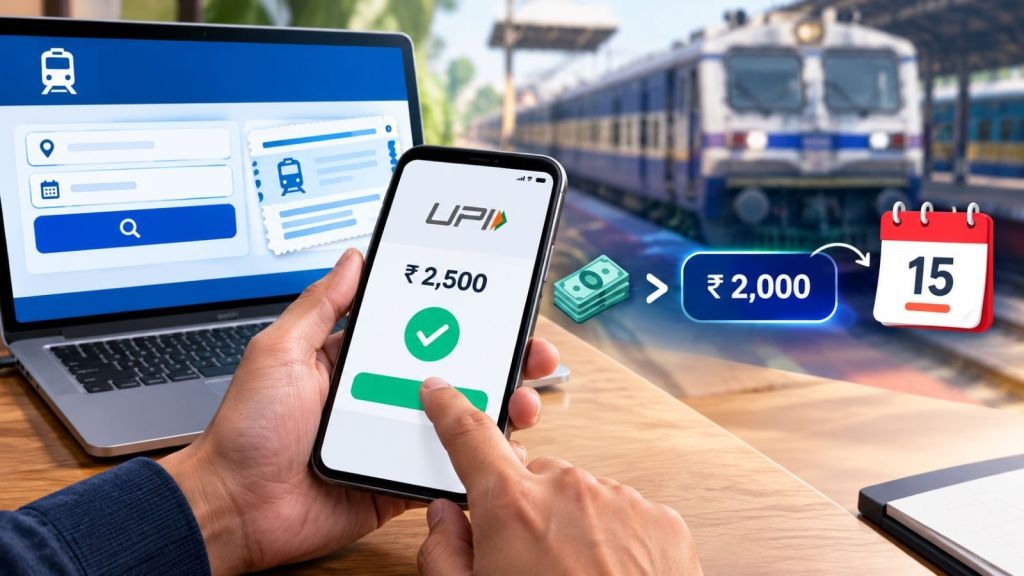
 Railway Ticket Booking | Train ticket booking: What changes for UPI payments above Rs 2,000 from October 15? (Image generated using AI)
Indian Railways train ticket booking: In Indian Railways, train ticket booking through UPI is set to see a change from October 15, 2026. The new Unified Payments Interface (UPI) framework will introduce a 0.4 per cent fee on UPI payments above Rs 2,000 made to regular merchants. However, railway ticket bookings have been placed in a special category.
For railway ticket payments above Rs 2,000, the applicable charge will be a flat Rs 5 per transaction, instead of 0.4 per cent of the ticket value.
According to a senior railway official, the Rs 5 UPI charge will not be passed on to passengers. The charge will apply on the merchant side.
“Passengers booking railway tickets worth more than Rs 2,000 through UPI will not have to shell out an additional amount when the new Merchant Discount Rate (MDR) regime comes into effect from October 15,” the official said.
The official also explained that Rs 5 is a Merchant Discount Rate (MDR), which is a payment-processing charge applicable on the merchant side. The Union Finance Ministry has advised banks to ensure that merchants do not pass this charge on to customers.
So, if you book a railway ticket costing Rs 3,000 through UPI, you should not have to pay Rs 3,005 simply because of the new MDR rule.
Similarly, if your railway ticket costs Rs 5,000, the applicable MDR would be Rs 5 on the merchant side, rather than Rs 20 under the regular 0.4 per cent rate.
The railway ticketing has been included in a special category along with sectors such as telecom, insurance, fuel and utility payments.
Under the new structure:
For example, a Rs 10,000 payment to a regular merchant would attract Rs 40 at 0.4 per cent. But a Rs 10,000 railway ticket payment through UPI would attract only the flat Rs 5 MDR on the merchant side.
“For instance, if a passenger books railway tickets worth Rs 5,000 and pays through UPI, the normal 0.4 per cent MDR would work out to Rs 20. In the case of railway ticketing, however, only a flat Rs 5 MDR will apply on the merchant side.
Similarly, a Rs 10,000 regular merchant transaction would attract Rs 40 as MDR, while a railway ticket transaction of the same value will continue to attract only Rs 5,” the railway official said.
The new MDR does not mean that railway fares will automatically increase. According to Jain, if you book a ticket for Rs 3,000 and pay through UPI, the ticket price should remain Rs 3,000. The Rs 5 payment-processing charge is intended to be borne on the merchant side rather than recovered from the passenger.
“A passenger purchasing a Rs 3,000 railway ticket through UPI should not see the fare increase to Rs 3,005 merely because of the new MDR. The additional Rs 5 is a cost associated with processing the payment and is not supposed to be recovered from the passenger. UPI transactions of up to Rs 2,000 will remain outside the new MDR levy, while person-to-person UPI transfers will also remain free irrespective of the amount,” the official added.
The Rs 5 charge may appear small for an individual passenger, but the overall cost could become significant because of the large number of railway tickets booked digitally.
The railway official said: “For illustration, if one lakh railway ticket transactions exceeding Rs 2,000 were made through UPI in a day, the Rs 5 MDR would amount to Rs 5 lakh per day, or about Rs 18.25 crore over a year.
The actual financial impact would, however, depend on the number of railway ticket bookings above Rs 2,000 that are paid for through UPI and how the cost is shared among the Railways, IRCTC, banks and payment service providers.
The special flat-rate structure gives railway transactions a significant concession compared with the general 0.4 per cent MDR applicable to large merchant payments.”
For passengers, the point is simple: if you book a railway ticket costing more than Rs 2,000 through UPI from October 15, the new Rs 5 MDR should not be added to your ticket price.
“For railway passengers, however, the takeaway is straightforward: booking a ticket worth more than Rs 2,000 through UPI should not become more expensive simply because of the new MDR. The Rs 5 levy applies on the merchant side, not to the passenger,” the official added.