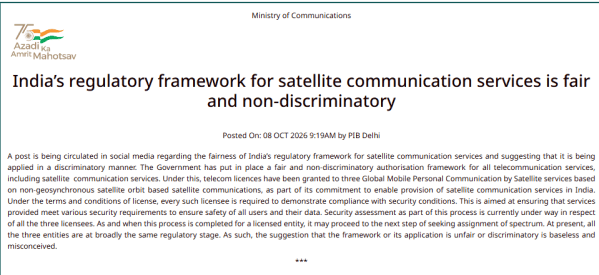
In a statement on Thursday, the Ministry of Communications clarified that it was yet to clear any applicant to launch satellite communication services in the country, and that service providers were required to showcase compliance with India’s security requirements.
“The government has put in place a fair and non-discriminatory authorisation framework for all telecommunication services, including satellite communication services… Under the terms and conditions of licence, every such licensee is required to demonstrate compliance with security conditions… aimed at ensuring that services provided meet various security requirements to ensure safety of all users and their data,” the ministry said, without explicitly naming Musk.
“Security assessment as part of this process is currently underway in respect of all the three licensees. As and when this process is completed for a licensed entity, it may proceed to the next step of seeking assignment of spectrum. At present, all the three entities are at broadly the same regulatory stage. As such, the suggestion that the framework or its application is unfair or discriminatory is baseless and misconceived,” it added.
However, Musk has doubled down on his earlier allegation. In a social media post on Thursday evening, he said, “Starlink is licensed in over 165 countries and has spent five years complying with every single law and requirement of the government of India, so why still no license? Is Ambani the real boss of India” — in an apparent reference to the Chairman and Managing Director of Reliance Industries. Before that, Musk had blamed “certain oligarchs” for blocking Starlink in the country, and calling it a “crime against the people of India”.
Reliance Jio did not respond to a request for comment until publication.

The statement came after Musk took to social media late on Wednesday night, blaming “certain oligarchs” for blocking Starlink in the country, and calling it a “crime against the people of India”.
“Unfortunately, we are being blocked by certain oligarchs in order to maintain their monopolistic chokehold on the Indian people. You can guess who they are… This is a crime against the people of India!” Musk said in a post on social media platform X. “Starlink in India would enable high-speed, affordable internet connectivity for those who can’t afford current prices or who don’t have a connection at all!” he added in another post.
In a subsequent post, he said, “Starlink will be of great help to areas of India that have bad or no internet and even no mobile coverage…” While prices for the service are not currently officially advertised, a temporary placeholder price of Rs 8,600 per month appeared on Starlink’s Indian website last year.
Regulatory delays, security issues
Musk’s comments come amid continued regulatory delays to Starlink’s launch in India, primarily over security concerns, even though the company says it has tailored its operations to meet the country’s security and regulatory requirements.
Starlink is among the operators that have secured GMPCS (global mobile personal communication by satellite) licences and other statutory approvals needed to launch satellite communication, or satcom, services in the country. Others who have received it include Bharti-backed Eutelsat OneWeb, and Jio Satellite Communications Ltd, a wholly owned subsidiary of Jio Platforms. Jeff Bezos-owned Amazon Leo is also in contention for a licence.
Bharti Airtel chairman Sunil Bharti Mittal — whose company Eutelsat OneWeb is also vying to launch satcom services — dismissed Musk’s claims saying that even his venture was awaiting necessary approvals to start operations in India.
Speaking on the sidelines of India Mobile Congress 2026, Minister of State for Communications Chandra Sekhar Pemmasani said that the Ministry of Home Affairs is looking into security-related issues with satcom services.
Last July, Starlink had received what industry executives said was the last regulatory approval needed to launch the service in India from the Indian National Space Promotion and Authorisation Centre (IN-SPACe) granted authorisation to the satcom company for its satellite constellation. Before that, the company had received an operator licence from the Department of Telecommunications (DoT), three years after first applying for one.
Despite the regulatory clearance, it is understood the government is yet to green-light formal launch of these services over security concerns. The concern particularly stems from anxieties around foreign satcom operators potentially bypassing Indian gateways to offer their services, an event when the government might lose control over the service.
The delay in Starlink’s final security clearance comes as Reliance Jio is building a sovereign low earth satellite constellation in India, and is considering a 1,600–1,650 satellite network costing an estimated $10–15 billion.




 Share


