
At 103, first-timer learns a lesson: Easier to get a voter card than a ration card
Mamata Banerjee conceded in her speech Tuesday that “there are demands” even in the enclaves and if re-elected she promised to “deal with all demands”.
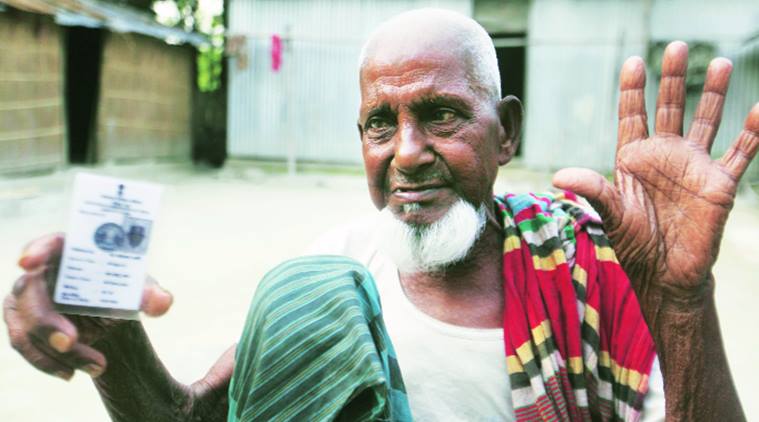 Asgar Ali in Dinhata. (Express photo by-Subham Dutta)
Born in 1913, he is convinced that he is the oldest first-time voter in India. A resident of three countries, now a citizen of India, 103-year-old Asgar Ali has gathered that democracy is like a game where everyone cheats. “They gave us election cards, but not ration cards. We can vote. But what do we eat?”
Thursday will have 9,776 residents of erstwhile enclaves voting for the first time in Cooch Behar. Asgar Ali believes it will also be his last time, and tempers his delight with cynicism.

“It took them 15 days to give us our election cards,” he said. “There are mistakes. Men have been listed as women and names have been spelled wrong. We got the voter cards. But where are our ration cards? Where is the kerosene we were promised?”
At each of her 200 rallies, Chief Minister Mamata Banerjee has highlighted the implementation of the Land Boundary Agreement under which Bangladesh and India exchanged 162 adversely held enclaves on August 1, 2015. A total 14,864 residents of 51 Bangladeshi enclaves became Indian citizens. At Madhya Moshaldanga, there is talk of redemption and eager discussions about politics. But after Mamata’s rally Tuesday, anger too is setting in.
“She said she has been giving rice at Rs 2 per kg to all residents of enclaves. That’s a lie,” said Jaynal Abedin, 24, Ali’s grandson. “We haven’t even got 200 gm rice at that price, let alone a kilogram. Those in the camps who have come from Bangladesh and are being hosted by the Indian government, they are the ones getting free rice.”
Mamata conceded in her speech Tuesday that “there are demands” even in the enclaves and if re-elected she promised to “deal with all demands”. But it’s this growing discontent that the Opposition is eager to play on. The 9,776 new voters are spread across five constituencies, the highest number concentrated in Dinhata at 5,486. The Forward Bloc’s Akshay Thakur has accused the BJP-led central government and the Trinamool Congress of “betraying the residents of enclaves” while TMC candidate Udayan Guha, who switched from the Forward Bloc, credited Mamata with “rescuing those who lived in these enclaves”.
“Who cares what they say,” Asgar Ali said. “Let me explain something. I have seen a lot of things and I don’t always remember all of it but I do remember one night, when I had to plough an entire field by myself because I had vowed I would do so.” He mused: “We were promised rice, kerosene, electricity and roads. If an election card can be made in a fortnight, why not the rest? It’s like a game where everyone is lying and cheating. I am going to vote, it has always been my dream. But I don’t think I will live to see the enclave change,” he said.
Change, however slow, is happening in the enclave. A milestone that once marked the territory as Bangladeshi is now obscured by the village’s first pucca home. Students who would earlier forge documents to get into school now find themselves faced with the task of explaining the sudden need for a “change in address” form.
WATCH INDIAN EXPRESS VIDEOS HERE
“I can’t remember how many different addresses and ages I have given while filling out different forms. I will sit for my school final exams this year and will also vote for the first time. I will have to make sure that my address is the same on both applications,” said Alamgir Hosain Mollah, 18.
For seven decades, Madhya Moshaldanga has lived a unique existence, not quite a part of any country, its citizens denied all fundamental rights. As the enclave goes into its first election, it also comes across a reality that most in West Bengal are already familiar with — it is easier to get an election card than a ration card.
 Share


