Pakistanis took selfies with Indians, and children ran after women visitors asking if they had any ‘bindis’. However, under the bonhomie as Indians took over the Pakistani town of Nankana Sahib on November 24 this Gurpurab, there were signs of the tensions in India-Pakistan relations.
The incidents of Guru Granth Sahib alleged desecration were fresh on the minds of pilgrims, as well as the fact that the Akali government in Punjab had talked of a cross-border hand in it. Pakistan’s own uncertain security situation as well as the ubiquitous Bhindranwale posters made it more edgy.
Pakistan had beefed up security all along the pilgrimage route, particularly from just off the main Sheikhupura highway towards Nankana Sahib, which is almost a two-hour drive from the Attari-Wagah border.
All roads leading to the gurdwara were blocked with razor wire and concrete blocks, and the pilgrims could only approach it on foot. Shops in the proximity were ordered shut, with their locks sealed to prevent tampering.
Local residents, who were not allowed near the gurdwara, said they had never seen such stringent security arrangements before. Only Sikh and Hindu devotees were allowed near and inside Nankana Sahib. Some Pakistani Muslims caught near the gurdwara were even beaten up by police.
“Given the volatile conditions in Indian Punjab over the desecration incidents, we cannot take any chances and do not want someone to instigate a fight between Sikh groups. Coupled with the security scenario in Pakistan itself, even if one untoward incident occurs, it will be a blot on our reputation,” said Abdul, a police Inspector.
Posters of Khalistani leader Jarnail Singh Bhindranwale were everywhere at Gurdwara Janam Asthan, including in the inner courtyard housing the room where Guru Nanak is said to have been born.
While some posters announced a ‘Sikh Referendum’ in 2020 — part of a campaign by some Sikhs in the US and Canada for self-determination — others had photographs of slain Sikh militants.
Another poster listed out “enemies of Sikhs”, including drugs, the RSS and media. In the gurdwara compound, apart from Kisan ghee and selfie sticks, Rs 350 t-shirts with Bhindranwale’s image were on sale. The Pakistani Sikhs in the congregation said they did not want to talk about the alleged desecration row in Punjab. “We know little about the incidents,” said Ram Singh.
Ram Chander, a Hindu who had come from Quetta in Balochistan, a journey of 17 hours by road, said he did not have time for the posters or politics. “I have come to pay obeisance to Guru Nanak, as this is one of the few festive occasions for our community,” he said.
While Pakistan Sikh Gurdwara Parbandhak Committee office-bearers refused to talk about the posters or other signs of Sikh radicalism, security officials at the gurdwara said they had been instructed to keep such elements away.
As the kirtan chanting procession receded into the distance, a Bollywood song started blaring from a corner shop (one of the very few open, to sell mineral water to the visitors), underlining why India’s links to Nankana would survive the strain.

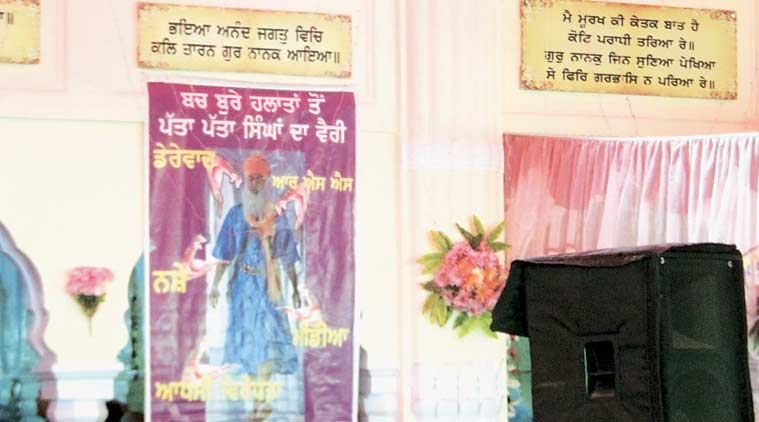 Posters against ‘derawaad’ at Nankana Sahib Gurdwara in Pakistan during Gurpurab celebrations. (Express Photo)

 Share


