


Journalism of Courage
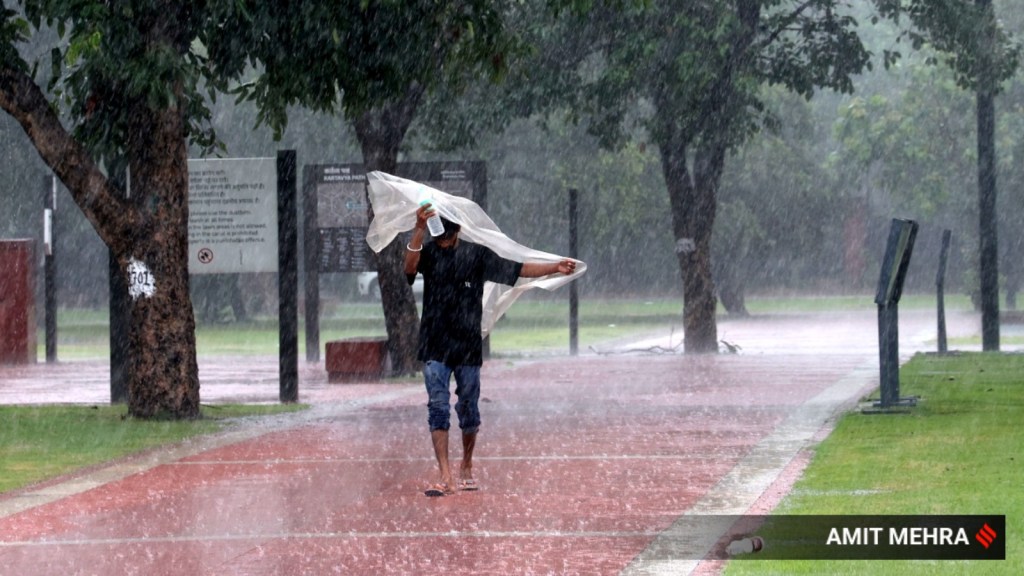 The last time India's seasonal rainfall fell below 90 per cent of LPA was in 2015, which, like this year, was affected by a strong El Nino in the equatorial Pacific Ocean. (File Photo)
The monsoon season ended on Wednesday with a 13 per cent deficit in overall rainfall, the largest in more than a decade. India Meteorological Department (IMD) said rainfall over the country as a whole during the four-month monsoon season was 87 per cent of long-period average, or LPA.
In quantitative terms, India received 759.4 mm of rainfall against the LPA of 868.6 mm. LPA is the average rainfall received in the monsoon season over the 50-year period between 1971 and 2020.
The 13 per cent deficit makes this monsoon the driest in 11 years, the fourth driest in this century, and the 13th driest since 1901.
The last time seasonal rainfall fell below 90 per cent of LPA was in 2015, which was also affected by a strong El Nino in the equatorial Pacific Ocean. El Nino, which refers to an abnormal warming of surface waters in the equatorial Pacific Ocean, is known to suppress rainfall over India. The opposite phase, La Nina, when the surface waters are cooler than normal, generally favours good rainfall. This year, the developing El Nino is expected to turn into the strongest ever.
In the last ten years, there have been only two occasions when the monsoon rain has dropped below normal (96 to 104 per cent of LPA). In 2017, India had received 95 per cent rain while the following year it was 91 per cent.
Three of the four months of the season saw large deficits of rainfall. June had a deficit of more than 35 per cent, while August and September had shortfalls of 16.3 per cent and 7.6 per cent respectively. Only July received normal rainfall, about 1 per cent more than the LPA.
Punjab, Assam, Meghalaya and Arunachal Pradesh recorded deficient rainfall throughout this season, while parts of Marathwada, Vidarbha, north Karnataka experienced prolonged dry spells through July, August and September, IMD officials said.
Over 38 per cent of the country’s area, or 282 districts, received deficient rain while 312 districts received normal rain.
The impact of El Nino was expected to be stronger in the second half of the monsoon season. However, many areas of the country, except southern peninsular India, continued to receive normal to above normal rainfall.
The rainfall during June – September is also influenced by the Madden Julian Oscillation (MJO) and local low pressure systems. After June, there were several low pressure systems that developed in the Bay of Bengal and their subsequent landward movement maintained the rainfall momentum over many parts of central Indian regions.
“Rainfall activity continued due to the formation of low pressure systems. This year, there were 77 days against a normal of 57 days, when the country remained under the influence of low pressure systems,” explained Mrutyunjay Mohapatra, director general, IMD.
MJO, which is a band of rain-bearing clouds with a periodicity of about 30-60 days, remained unfavourable over southern India.
“Being El Nino year, MJO could not contribute much to the seasonal rainfall. The influence of MJO on the rainfall over the southern peninsular is generally high,” IMD chief said. All southern states have ended with deficit rainfall this season.
The ongoing El Nino is forecast to touch peak in November this year and the event is likely to cease by March 2027.