Journalism of Courage
 4 min read


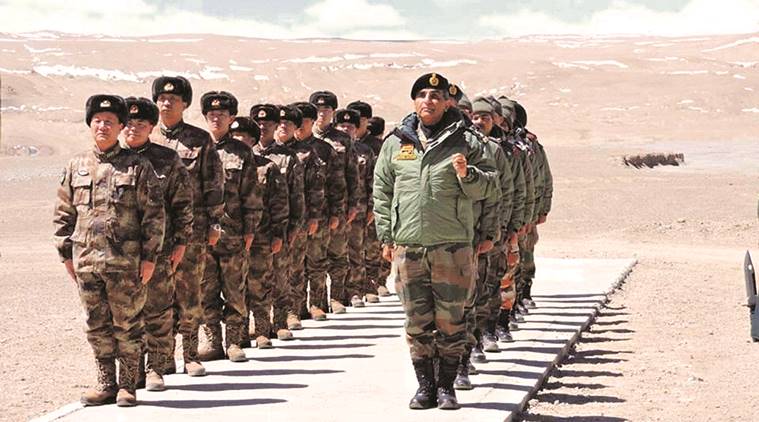 A file photo of Indian and Chinese personnel on the LAC. ANI
As India and China discuss the process of lowering tensions along the Line of Actual Control in eastern Ladakh, Indian Army sources Thursday said both countries had moved troops forward from their usual positions across the entire length of the Sino-Indian boundary at the height of the faceoff in May.
Army sources said the troop movement, not similar to the deployment in eastern Ladakh, took place in the depth areas of all three sectors — western, middle and eastern – of the 3,488-km boundary that India shares with China.
While the faceoff has been restricted to eastern Ladakh, which is in the western sector, armies on both sides, sources said, have augmented their military strength even in the middle and eastern sectors.
This happened in May, much before the June 6 meeting between XIV Corps Commander Lt General Harinder Singh and South Xinjiang Military District Commander Major General Liu Lin.
Don’t miss from Explained | India-China stand-off: Everything we know about the unfolding situation in Ladakh
Sources said troops in other sectors are “not engaged face-to-face” since it is an “in-depth deployment”.
“Since May, China has increased its troop presence in other sectors as well. Accordingly, India too has increased troop presence in other sectors,” sources said, underlining that “it happened before the June 6 meeting” and “they are not deployed along the LAC”.
Read | Chinese have walked in, taken our territory, says Rahul Gandhi
“If you see some more troops are required, you deploy more troops. If you feel they are not required, you move them back. It is a dynamic process, based on what the other side does,” sources said.
In the depth areas of Ladakh, away from the frontline, India has deployed around 10,000 troops. The strength was increased with reserve forces after China moved additional forces and equipment to its depth areas—this came up during the June 6 meeting. Since then, there has been some retreat by both sides at a few points in Galwan and Hot Spring areas, but the roadmap for further easing of the situation is still to be discussed.
Explained: The strategic road to DBO
Divisional commanders of the two sides met Wednesday. Army sources said the date for the next discussion has not yet been confirmed. “Negotiations will be slow, and will take some time,” sources said. For the Indians, one of the main points of concern continues to be the north bank of Pangong Tso, where Chinese troops have stopped Indian patrols at Finger 4, eight kilometres west of Finger 8 which India says marks the LAC.
Since the process for troops to step back will take time and has to be verified on the ground by each side, both Delhi and Beijing have been careful with their choice of words, not calling it disengagement. On Wednesday, Chinese Foreign Ministry spokesperson Hua Chunying said: “Recently, the diplomatic and military channels of China and India held effective communication on the situation along the border and reached positive consensus. The two sides are following this consensus to take actions to ease the situation along the borders.” And in first remarks Thursday, the spokesperson for the MEA, Anurag Srivastava, responding to questions on the LAC situation, said: “A meeting was held between the Corps Commanders of India and China on 6th June 2020 in the Chushul-Moldo region. This meeting was in continuation of the diplomatic and military engagements which both sides have maintained to address the situation in areas along the India-China border. It was agreed that an early resolution of the situation would be in keeping with the guidance of the leaders.”
Read | India-China to resolve border tensions as per bilateral agreements: MEA on LAC standoff
“The two sides are, therefore, maintaining their military and diplomatic engagements to peacefully resolve the situation at the earliest as also to ensure peace and tranquility in the border areas. This is essential for the further development of India-China bilateral relations,” he said.