Journalism of Courage



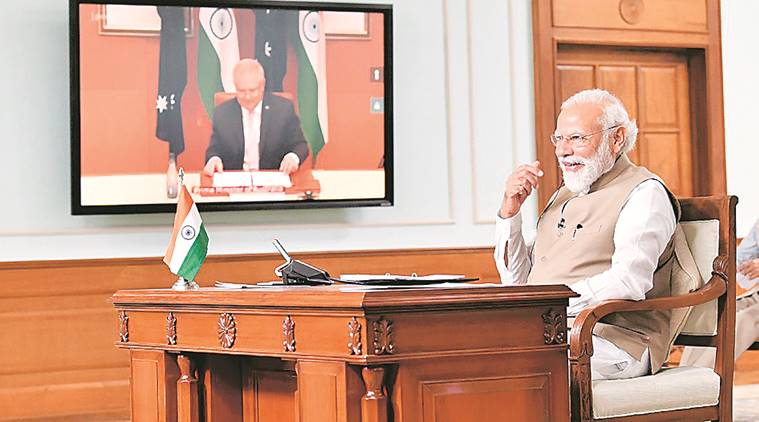 Prime Minister Modi during the virtual summit with his Australian counterpart Scott Morrison. (PTI)
Elevating the 2009 bilateral Strategic Partnership to a Comprehensive Strategic Partnership (CSP), India and Australia Thursday decided to upgrade the existing 2+2 dialogue between their Foreign and Defence Secretaries to the Ministerial level.
This lends significant political heft to the bilateral mechanism and brings it on a par with the 2+2 ministerial level dialogues India already has with the US and Japan, the other members of the Quadrilateral grouping.
At the virtual summit with PM @ScottMorrisonMP. https://t.co/6JIpZRae21
— Narendra Modi (@narendramodi) June 4, 2020
“Our Foreign and Defence Ministers will meet in a ‘2+2’ format to discuss strategic issues at least every two years,” the joint statement said after the first virtual bilateral summit between Prime Minister Narendra Modi and his Australian counterpart Scott Morrison.
READ | China long haul: After Trump-Modi call, India briefs Russia
Officials said there was no discussion on the ongoing tension along the India-China Line of Actual Control (LAC) but with an eye on Beijing, the two sides announced a roadmap “for maritime cooperation in the Indo-Pacific region to harness opportunities and meet challenges together as comprehensive strategic partners”.
The two sides signed the much-anticipated Mutual Logistics Support agreement, which will allow use of each other’s bases, and increase “military inter-operability through defence exercises.” India has such agreements with US, France, Singapore and South Korea.
Express Opinion | Modi-Morrison summit can help plug a gap in India’s diplomatic tradition
Ahead of the talks, Modi said that the bedrock of deepening India-Australia ties are “shared values, shared interests, shared geography and shared objectives.” He said that, in recent years, cooperation and coordination between the two countries have picked up momentum.
Morrison said, ”We are committed to an open, inclusive and prosperous Indo-Pacific, and India’s role in that region. Our region will be critical in the years ahead.”
“The relationship we are forming around those issues on our maritime domain, I think, is the platform for so many other things between our countries,” he said.
While there was no specific proposal on Australia joining the Malabar exercises, both sides agreed to continue to “deepen and broaden defence cooperation” by enhancing the scope and complexity of their military exercises to address shared security challenges.
Referring to the ongoing debate over World Health Organisation’s role in dealing with the Covid pandemic, the statement said that both sides will reflect on the recommendations of the ongoing independent evaluation of the international response.
“We will work together to strengthen international institutions to ensure they are inclusive and rules-based,” the statement said.
On the bilateral effort to fight the pandemic, they said that they were committed to a new phase of the Australia-India Strategic Research Fund to promote innovative solutions for responding to and treating Covid as well as other jointly determined priorities, to be preceded by a one-off Special Covid Collaboration Round in 2020.
Both sides jointly decided to work together in digital economy, cyber security and critical and emerging technologies as identified by the framework arrangement on Cyber and Cyber-enabled critical technology cooperation.
During the talks, Australia said India could consider it as a “stable, reliable and trusted supplier” of high-quality mineral resources to India. Both sides jointly decided to diversify and expand the existing resources partnership.
A pact on cooperation in the field of mining and processing of Critical and Strategic minerals identifies specific areas where both sides will work together to meet the technological demands of the future economy. Both countries jointly decided to cooperate on new technologies for exploration and extraction of other minerals.
Both sides identified agriculture as an important pillar of the Australian and Indian economies with shared challenges and climactic conditions. To that effect, both agreed to work on grains management and “logistics to reduce post-harvest losses, rationalise costs and ensure farmer income is not affected by supply chain disruptions (particularly in light of the pandemic).”
Vijay Thakur Singh, Secretary (east), MEA, said there was no discussion on the Regional Comprehensive Economic Partnership (RCEP). India had pulled out of RCEP last November and Australia has expressed hope that India would reconsider joining the trade agreement with 15 countries, including China, south-east and east Asian countries.
To monitor the comprehensive strategic partnership, the two sides expressed their desire to increase the frequency of Prime Ministerial contact through reciprocal bilateral visits and annual meetings on the margins of international events.



 5 min read