A few kilometres from Moinabad, on the Hyderabad-Vikarabad highway, travellers find a welcome reprieve in the shade of giant banyan trees. Stretching across this section of road, the nearly 900 banyans provide respite for motorists and shelter for hawkers, and are also home to a variety of animals, birds and insects. But these canopies could soon be a thing of the past as the National Highways Authority of India (NHAI) is all set to commence four-laning of NH-163.
Since 2019, the proposed highway expansion has sparked resistance from environmentalists and activists, who argue that these ancient trees are irreplaceable. For the NHAI, however, they are “as good as any other tree.” The officials argue that the road expansion project should be looked at “positively”, and that they would translocate the banyans.

“As children, every Hyderabadi must have taken a trip to Vikarabad and Ananthagiri Hills. Even if you are not a Hyderabadi, if you have travelled once on this stretch, you will fall in love with the banyans of Chevella,” says Asiya Khan, a member of ‘Save Banyans of Chevella’, a citizens collective, advocating for the protection of the 100-year-old trees.
‘Will take up translocation’
NH-163, earlier a Nizam-era state highway, has been a contested site since 2019 when the NHAI announced the road-widening project, saying the proposed expansion will lead to better commute and reduce accidents. But activists and nature lovers opposed the idea and launched several campaigns to raise awareness about the need to protect local ecosystems. The contention between eco-warriors and the authorities reached the National Green Tribunal (NGT) in November 2021 when the citizens collective, Save Banyans of Chevella, filed a petition. The activists said the stretch includes 1036 banyans, but NHAI put the number at 759. Later, an NGT-appointed committee found 915 banyan trees on the 46-km stretch between Moinabad and Manneguda which may be affected during road expansion. It said the proposed alignment would need 683 trees to be translocated and 232 trees would be saved.
In its November 2023 order, the green tribunal had ordered the NHAI to conduct an Environmental Impact Assessment (EIA) study to minimise the loss of trees and directed the Ministry of Environment, Forest and Climate Change (MoEFCC) to issue terms of reference (ToR) and complete the process within four months.
Even as activists cite last year’s NGT order to claim a moral victory, NHAI officials said all clearances have been received. “Everything (case) is over, we are going to take up this work this month or next month. All clearances are given,” NHAI project director Nageswara Rao told indianexpress.com. Asked about the trees, he said, “They have given clearance for translocation. So, we will take up translocation. We are building so many things, why can’t this be done. We can think of it positively,” he said.
The minutes of the meeting of the expert appraisal committee (EAC) of the MoEFCC in July 2024 suggest that an EIA study was submitted to the ministry in June 2024, with recommendations of an EAC sub-committee visit to the site. However, neither this document nor the recommendations are available in the public domain yet. On the Parivesh portal, where the timeline of the project is available, there is no mention of the EIA report though it mentions that the terms of reference were granted in February 2024. The NHAI has also been exempted from holding a public hearing on their request to the ministry.
Even as activists cite last year’s NGT order to claim a moral victory, NHAI officials said all clearances have been received. (Express Photo/ Rahul V Pisharody)
In the EAC meeting, NHAI submitted that the design has been modified to save another 50 banyan trees, thus taking the total number of trees to be retained to 393 and to be translocated to 522. It added that there is no proposal to widen the road along Mrugavani National Park.
Meanwhile, activists have raised questions over the ‘mysterious’ EIA study, saying it should have been made available on the Parivesh portal as with the case of other projects in the country, affected by the environment. The fact that it is not available in the public domain only suggests either such a study has not been done, or the authorities have something to hide, they say.
‘Road bhi Jhad bhi’
Save Chevella Banyan has been running a campaign ‘Road bhi Jhad bhi’ since 2019. Call it the HYDRAA effect, activists who have been fighting to save the Chevella banyans seek the chief minister’s intervention.
HYDRAA (Hyderabad Disaster Response and Asset Protection Agency) has been proactive in removing encroachments on lakes across the city by demolishing buildings illegally constructed or under construction in and around water bodies. Over the last two months, it has demolished at least 266 such structures, including those belonging to the rich and mighty.
“The NGT order came during the BRS government which was very much for the project. With the change in government, we were hoping the new government would be better than the earlier one. Clearly not,” said Natasha Ramarathnam, one of the petitioners who approached the NGT.
One of the first decisions taken by the Congress government after it came to power in December 2023 was to reverse the previous government’s decision to reinstate the state government’s order of March 1996, which prohibited big constructions and industries within 10 km radius of Hyderabad’s twin reservoirs – Osman Sagar and Himayat Sagar. Coupled with this, the recent activities of HYDRAA have given the chief minister the image of a champion of environmental causes.
“On the one hand, you (the government) are razing illegal constructions on river beds and lakes, on the other you are going ahead with cutting down trees. Removing these trees located in the catchment areas of river Musi and the twin reservoirs might just cause more flooding in future,” Ramarathnam adds.
Echoing similar views, Asiya Khan says, “The Hyderabad-Vikarabad road when it was laid took into account the flow of river from Ananthagiri hills to Hyderabad and the boulevard is close to a century old. It retains a lot of rainwater in the catchment areas. The road should be declared as our heritage.”
Another member of the group, Tejah Balantrapu, says their petition before the NGT sought to direct NHAI to consider an alternate plan so that the trees could be conserved. “Many highways across the world are built by incorporating the natural environment. This is the new way of building. But it requires an extra bit of effort which no one wants to take. Unless we as citizens demand it, all the trees would be felled,” Balantrapu says.
Ramarathnam says if an EIA study is conducted by NHAI, the terms of reference should be made public, a consultant should be appointed and a survey should be conducted. “On the Parivesh website, there is no ToR or naming of a consultant which essentially means no EIA was conducted,” she says, adding “If an EIA is conducted, they (NHAI) would have to change the alignment.”
‘Like cutting a person’s limbs’
As soon as NHAI announced its plan in 2019 to expand the existing highway, two petitions were started online. Uday Krishna Peddireddi of the Vata foundation, an NGO in Hyderabad, started the first petition and submitted it to Union minister Nitin Gadkari.
“We managed to convince NHAI for translocation before the NGT petition was filed. But now the order might have closed down translocation as an option (as the NGT order merely confined itself to the EIA study and said nothing about translocation). I had demanded translocation as the last option to be considered,” says Peddireddi. Further, he adds that his proposal involved the NHAI, the state forest department, and his foundation. “From 980 trees, I told them (the government) that I can make 10,000 trees by propagating branches and saving old trees. The forest department was willing to give me space for the nursery. A private corporation had come forward to adopt many trees. A lot of individuals wanted to adopt them. Even if half of them survive, it is a big number,” he states.
Balantrapu is not ready to believe the NHAI’s claim of translocating trees. “It is hard to believe. Each of them requires a lot of attention. If you (NHAI) really believe it can be done, present a plan on how you will do it.” Ramarathnam says, underlining that a translocated banyan does not have a high survival rate.
“It is like chopping the limbs of a person and saying the person is still alive. Translocation is as good as killing the tree. Afforestation elsewhere does not balance out cutting down of trees on this stretch.” They point out that the project is contrary to the “precautionary principle, principle of sustainable development, and principle of intergenerational equity.”
Meanwhile, activists unanimously agree that many of the banyans are already lost to miscreants who allegedly set fire to the bottom of the trees to make them fall. This, they say, is done for a better frontage to their properties, restaurants, and layouts. According to their estimates, at least 200 trees have been lost to fires in the last three years. In some of the instances, the Save Chevella Banyans have registered FIRs against unknown persons.

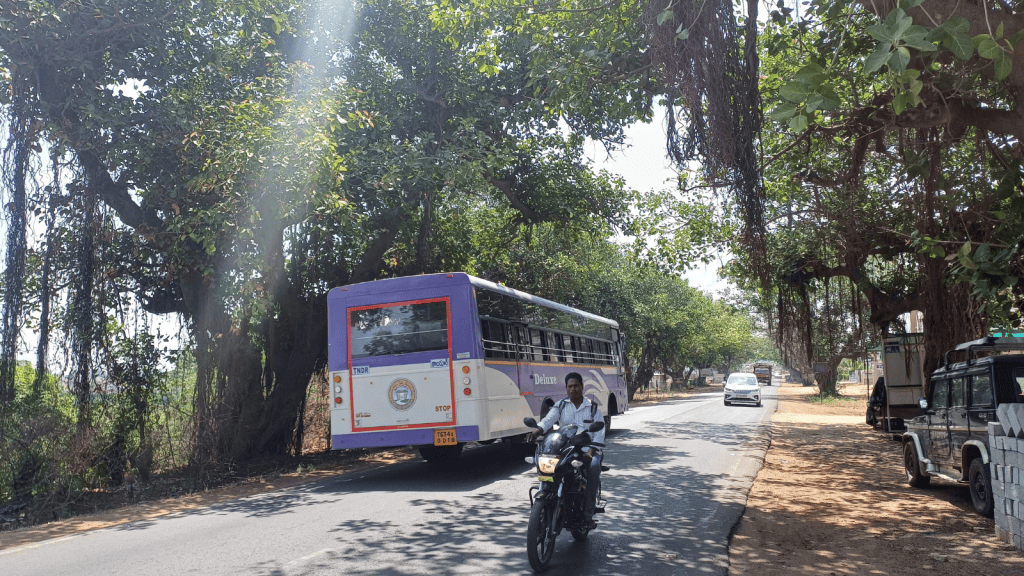 Since 2019, the proposed highway expansion has sparked resistance from environmentalists and activists, who argue that these ancient trees are irreplaceable. (Express Photo/ Rahul V Pisharody)

 Even as activists cite last year’s NGT order to claim a moral victory, NHAI officials said all clearances have been received. (Express Photo/ Rahul V Pisharody)


 Share


