
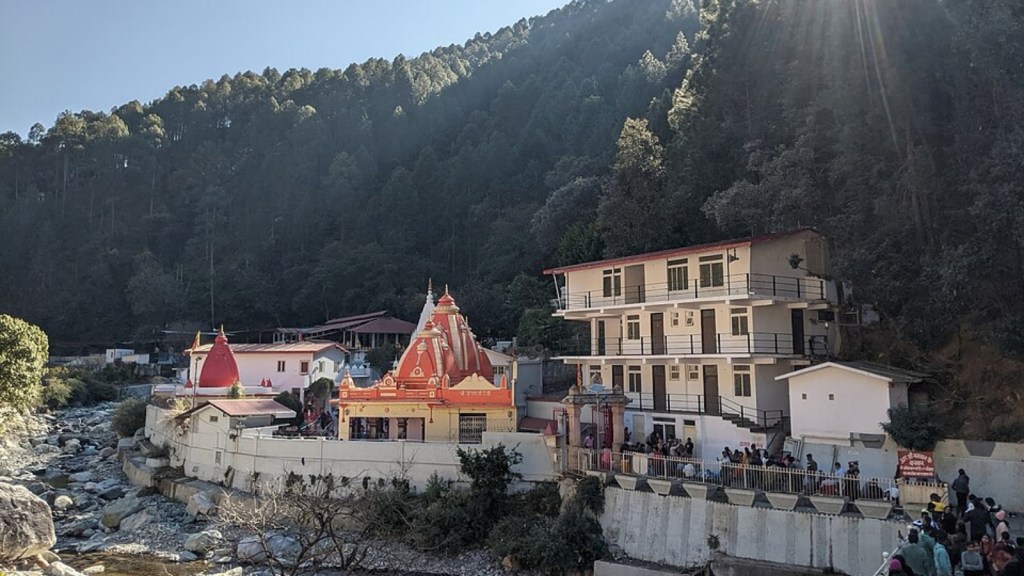
The Nainital district administration is set to introduce a registration system for pilgrims visiting Kainchi Dham, initially on weekends, as the Kumaon shrine grapples with a sharp rise in visitors and traffic congestion, The Indian Express has learnt.
The proposed system will be modelled on the registration mechanism used for Uttarakhand’s Char Dham pilgrimage and is expected to allow the administration to know in advance how many devotees are expected at the shrine on a given day and regulate the flow when crowds swell.

Currently, there is no registration requirement to visit Kainchi Dham. Pilgrims can arrive at the shrine and enter for darshan without any prior registration.
Nainital District Magistrate Lalit Mohan Rayal told The Indian Express Wednesday that a joint report by him and the Senior Superintendent of Police will be sent to the state government’s Tourism Department recommending the system.
“The proposal is to introduce registration at Kainchi Dham, similar to what is done for Char Dham,” Rayal told The Indian Express. “A joint report of the DM and SSP will be sent to the government.”
The proposal was discussed at a meeting involving the district administration, police and other stakeholders, including the temple committee and taxi union on Tuesday.
For now, the administration plans to restrict the system to weekends, when the shrine sees its largest crowds.
“We will keep it for weekends,” Rayal said. “Later, when the regular season comes, we will assess the expected crowd and implement it according to the estimated footfall.”
“It will take about a month for the government to develop the portal and everything else,” he said, adding that the administration would seek to “replicate” the existing Char Dham model at Kainchi.
How the Char Dham system works
The Char Dham registration system the administration is looking to replicate runs through Uttarakhand’s Tourist Care portal and mobile application. Pilgrims first create an account, then create a tour by entering their travel dates, number of pilgrims, and the Dhams they intend to visit, along with the dates they plan to visit each shrine. They then enter the required details of each pilgrim.
Once registration is complete, pilgrims receive a Yatra Registration Letter with a QR code, which they must keep with them. At the destination, designated counters at the shrine verify the registration. The official system describes registration and verification as compulsory for the Char Dham and Hemkund Sahib pilgrimage.
Individuals, families, and tour operators can use the system. Pilgrims can register online through the portal or mobile application; physical registration facilities and assistance through “Yatri Mitra” are also available for those unable to complete the process online.
The Char Dham system also allows pilgrims to obtain darshan slot tokens, while vehicle registration is part of the system for those travelling by personal or public vehicles.
The Kainchi administration now proposes to adapt this broad framework, rather than simply asking pilgrims to provide their names at the temple gate.
Behind the decision
The proposal follows an unprecedented surge in visitors to the shrine, associated with spiritual leader Neem Karoli Baba.
Rayal said the administration normally expects around 25,000 visitors a day at Kainchi Dham. During the long weekend beginning October 2, however, the daily footfall crossed 35,000.
The extra visitors overwhelmed the road connecting Kainchi with Bhowali and Mukteshwar. “Both the pilgrims and the locals use the same road to Kainchi, which also goes up to Mukteshwar, causing a traffic jam for hours,” Rayal said.
The congestion stretched through Bhimtal, Bhowali and Kainchi over the long weekend, with vehicles crawling for kilometres and journeys taking hours longer than usual.
The administration is now pursuing both crowd management and additional road capacity.
A key development discussed at the meeting was the proposed alternative route around Kainchi.
Rayal said the Forest Department has now given the required permission for the 18-km Ratighat bypass, which will provide a more direct route towards Almora, Ranikhet and Kausani and help separate through traffic from the road leading to Kainchi.
“The bypass has received permission from the Forest Department,” Rayal said. “Earlier, the in-principle approval had been given. Now the practical permission on the ground has also come.”
Around eight kilometres of the bypass have already been hot-mixed, while work remains on roughly 10 kilometres. Rayal said the state government is currently considering a Rs 21-crore estimate for hot-mixing the remaining stretch.
“There is a discussion in the government today regarding the Rs 21-crore estimate for hot-mixing it,” he said. “Once that is approved, the road should become functional in four to six months.”
According to figures accessed by The Indian Express, 24.34 lakh people visited Kainchi Dham in the first six months of 2026, compared with around eight lakh visitors during the entire previous year.
Rayal earlier attributed the latest surge partly to the end of the monsoon, when tourists who had avoided the hills because of rain and landslides began returning, and partly to the release of Hanuman Ansh, a film based on the life and teachings of Neem Karoli Baba.


 Share


