


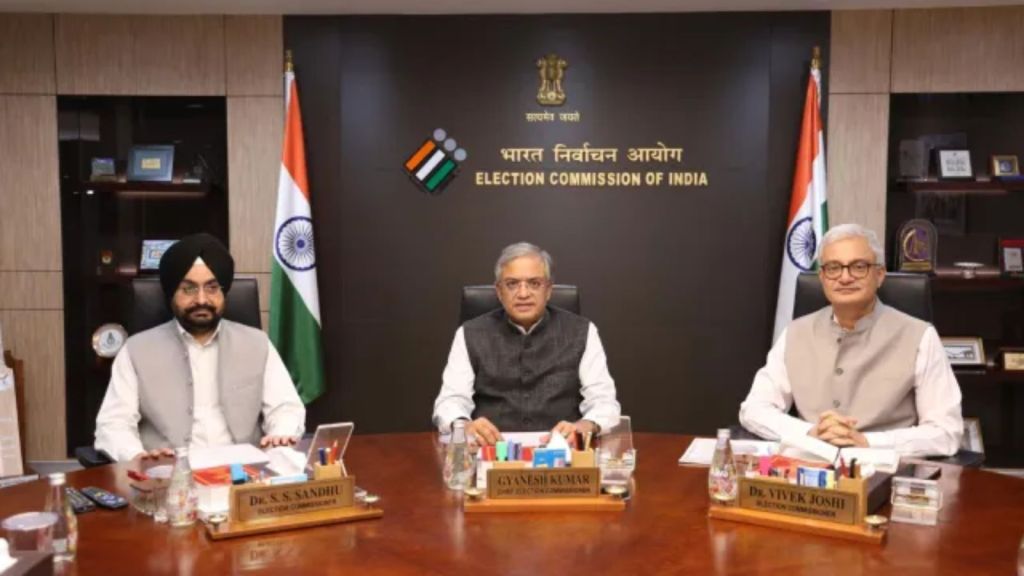
 The Commission said any further flexibility required by field officers would be made operational. (Express photo)
IN ITS first meeting since The Indian Express reported on the deep divide within the Election Commission over the past 10 months, the poll panel on Saturday sought to address several concerns raised by its two commissioners Sukhbir Singh Sandhu and Vivek Joshi.
Electors who were issued notices for “logical discrepancies” and for being “unmapped” in the ongoing Special Intensive Revision (SIR) of electoral rolls will not be required to attend hearings to establish their eligibility, a statement issued by the ECI said.
This exemption from in-person hearings will be a relief to lakhs of electors who were issued notices in the ongoing SIR. The decision comes as hearings are being held across states on the basis of system-generated notices.
“Unmapped” voters are those whose names did not figure in the rolls of the previous intensive revision, and who were unable to provide the names of their parents or grandparents too during that revision. “Logical discrepancies” refers to certain discrepancies flagged by the ECI’s centralised software based on which voters are issued notices following which they need to submit additional documentary proof to stay in the rolls.
“In case of any person to whom notice has been issued during the ongoing SIR, for being unmapped and logical discrepancies, BLOs will visit the homes of such persons for collection of documents and thereafter upload them on the ECINet, for decision by the ERO. Such persons need not be called for hearing to ERO/AERO office. Only in exceptional circumstances, as decided by the ERO, the hearing will be held preferably online. Any adult member of the family can be authorised by the elector to attend the hearing on their behalf, if required,” the EC announced.
The Commission, comprising Chief Election Commissioner Gyanesh Kumar, and ECs Sandhu and Joshi, held a meeting at 3pm on Saturday, the EC statement said. It underlined that the press note had the “approval of the full Commission” and released a photo of the three-member EC at the meeting.
In its statement, the Commission also said that a declaration that was added without amendment to the voter enrolment form or Form 6, would go back to the original after the SIR. The Indian Express had reported that the two ECs had said this addition was “illegal, unauthorised” and called for its removal so that young, first-time voters are not harassed.
Responding to some specific concerns, the EC said agendas would be circulated in advance for all commission meetings and minutes issued. The Annual Performance Appraisal Reports of officers would be completed within the stipulated time frame, which is by December 31 each year, and that the commission’s approval will be taken for foreign trips of the officers. Further, in its statement, the EC said, “All directions issued by the Commissioners to the officers of the Commission shall be meticulously complied with.”
The EC also clarified that the Form 6, which is the statutory form for new voter enrolment, would revert to the original one as per the Registration of Electors Rules, 1960. Earlier this year, the EC had added a declaration to the online Form 6 that requires applicants to answer if they or their parents/grandparents were on the rolls of the previous intensive revision of electoral rolls. While a separate declaration form was created by the EC for the SIR, the declaration was inserted within the online version of the Form 6, which can only be amended by the Law Ministry. The two Election Commissioners had raised concerns with the same.
“The declaration attached to Form 6 for SIR has been upheld by the Hon’ble Supreme Court. For non-SIR period, the Forms applicable as per Rules (the Registration of Electors Rules 1960) will be used,” the EC said in its statement.
The two ECs, Sandhu and Joshi, had also flagged concerns with the centralisation of the ECINet portal. The EC on Saturday announced the setting up of a committee to review ECINet and double-check if it complies with the law. “Field officers have role-based access to the ECINet system as per their statutory powers. A Committee headed by Sr. Deputy Election Commissioner (DEC) and including an independent expert from IIT/IIIT will review the ECINet to double-check that it complies with the provisions of the Acts and Rules and submit report to the Commission,” it said.
According to the statement, various upgradations of the portal have already been made based on the inputs from State CEOs in the past few months. “In case, any further flexibility is required by the field officers, that will be made operational. Henceforth, all the new initiatives about IT modules and portals will be discussed in the Committee of Officers (COO) before approval by the Commission,” it said.
WATCH | Sukhbir Singh Sandhu & Vivek Joshi: Who Are The 2 ECs Who Objected To SIR?
The EC said that the letters written by the two ECs to Cabinet Secretary T V Somanathan were in relation to the conduct of an officer. “The letter to Cabinet Secretary was not related to any policy matter of the Commission or IT division but related to the working of an officer on deputation to ECI. The work re- distribution orders issued by the concerned officer were not actually implemented after the orders of the two Commissioners and the oversight over the IT division by the DEC was never actually withdrawn,” the EC statement read.
With regard to the ongoing SIR, which has been completed in 20 states/UTs so far, the EC said: “Any person whose name has got left out during SIR or thereafter, and any person including young/first-time voter, may apply to the concerned ERO, for inclusion of their names in the electoral rolls under the process of continuous updation. CEOs have been directed to facilitate the same. The CEOs, DEOs, EROs will immediately launch a special drive for enrolment of these electors.”
Regarding the issue of 97 Goa electors who had been deleted from the final roll despite the statutory officials recommending their inclusion during the SIR earlier this year, the EC said the Chief Electoral Officer of Goa had directed the Booth Level Officers concerned to collect enrolment forms from them, and 81 of those electors had already filled the Form 6.