4 min readHyderabadUpdated: Sep 10, 2026 07:50 AM IST
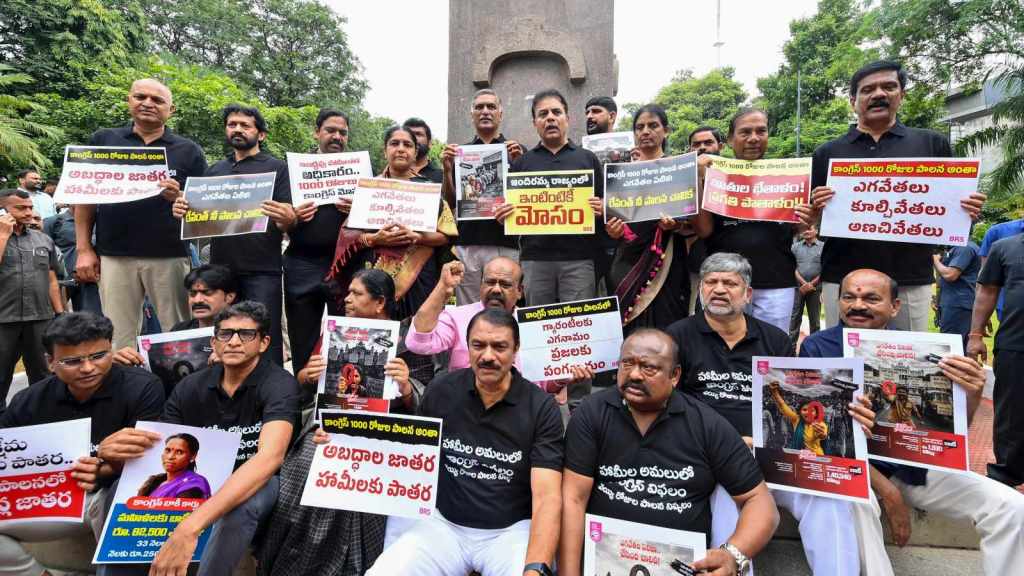
The Telangana Assembly witnessed heated exchanges between the BRS and the Congress for the third consecutive day, leading to the suspension of 21 BRS MLAs — including the pink party’s senior leaders K T Rama Rao and T Harish Rao — for the rest of the Monsoon Session. The stormy scenes followed an alleged purification ritual that Congress alleges was performed by BRS workers after a Dalit protest in Siddipet.
Speaker Gaddam Prasad Kumar suspended the MLAs after Minister D Sridhar Babu moved a motion over disruptions in the Monsoon Session for three consecutive days.

The other MLAs suspended are Anil Yadav, G Jagadish Reddy, Gangula Kamalakar, Kaushik Reddy, Madhavaram Krishna Rao, Kova Lakshmi, K Manik Rao, Chinta Prabhakar, K Prabhakar Reddy, M Rajashekhar Reddy, P Rajeswar Reddy, Sabita Indra Reddy, Kalvakuntla Sanjay, Talasani Srinivas Yadav, D Sudheer Reddy, V Sunitha Laxma Reddy, K Venkatesh, Vijayudu and KP Vivekananda.
The BRS has a total of 27 legislators in the Assembly.
The House commenced with BRS leaders demanding “justice” for Leader of Opposition K Chandrasekhar Rao, against whom Congress MLA Veerlapally Shankar had allegedly made disparaging remarks. The MLA had wished for “KCR’s demise” in a public statement, the BRS leaders alleged, and demanded his suspension.
The Treasury benches, meanwhile, alleged that BRS workers conducted a purification ritual in Siddipet after Dalit Congress leaders staged a ‘Dappu’ (drum) protest there. Siddipet is where KCR’s Erravalli farmhouse — a major political hub for the party — is located.
Deputy Chief Minister Mallu Bhatti Vikramarka and Minister M Sridhar Babu called the alleged ritual an “insult [to] Dalit workers”.
Story continues below this ad
“On the first day of the Assembly, BRS MLC Tata Madhusudan [known popularly as Tata Madhu] insulted the Speaker, a Dalit. On the second day, BRS leaders held purification rituals in Siddipet. How long will you carry on with the anti-Dalit politics?” Vikramarka said, adding that the Congress stands for “self-respect of Dalits and other backward sections in the state”.
The confrontation continued for over an hour, with both the Treasury and Opposition benches remaining firm on their demands.
The suspended BRS leadership — including K T Rama Rao and T Harish Rao — met Telangana Governor Shiv Pratap Shukla in the afternoon. In a press briefing after meeting the Governor, KTR accused the Congress government of “trying to divert attention from real issues plaguing the state”.
“All the images released by the Congress today were AI-generated. We will lodge a police complaint regarding the same. If the police do not register the complaint, we will look at other avenues to lodge the complaint,” said Rama Rao. Congress leadership, including ministers, had brought photographs of the “cleansing ritual” to the House. The Congress party also released photographs of BRS leaders allegedly manhandling the police during their protest before the Legislative Assembly gate.
Story continues below this ad
When the House reconvened, BJP floor leader E Maheshwar Reddy demanded that the suspension of BRS leaders be revoked and relevant issues concerning the state be discussed. “Yesterday when you were verbally attacked, we came to your rescue,” Reddy told the Speaker. To this, Deputy Chief Minister Mallu Bhatti Vikramarka said: “What is this rescue? It is the responsibility of all the members of the House to honour the Speaker and maintain the dignity of the chair.”
The Treasury benches went on to discuss and condemn the “purification” ritual, which they claim was conducted on the ground and road where the ‘dappu’ protest was held.
Speaking at the end of the short discussion, Chief Minister A Revanth Reddy compared the “purification ritual” to the one allegedly performed in Uttarakhand at Haldwani’s Ramlila Ground against Congress President Mallikarjun Kharge. There is “no difference between terrorists attacking the country and the BRS casteists attacking the honourable speaker of the house”, he added.
“Dappu is a way of life for Madigas (Dalits)…Why was the dappu protest of over 1,000 Dalit leaders then met with a purification ritual?” the chief minister asked.
Story continues below this ad
The government has taken the issue “very seriously”, he said. “Relevant sections of the Bharatiya Nyaya Sanhita and the Scheduled Castes and Scheduled Tribes (Prevention of Atrocities) Act will be invoked. A senior IPS officer has been appointed to probe into the farmhouse conspiracy that resulted in the casteist acts.”