For decades, Santiniketan’s Basant Utsav has been celebrated as Rabindranath Tagore’s creation— a refined spring festival where dance, music, and colour replace the chaos of street Holi. What that story leaves out is Tripura.
The small northeastern state, once an independent kingdom with a centuries-old tradition of music and Vaishnava devotion, had a direct hand in the aesthetic and institutional life of Tagore’s Santiniketan. Its royal family funded Visva-Bharati University for nearly fifty years, dispatched trained Manipuri dancers who shaped the curriculum, and influenced the very songs Tagore wrote. That connection came into formal view in September 2023, when Santiniketan was inscribed as India’s 41st UNESCO World Heritage Site —a recognition of a cultural legacy that was, in part, built in Agartala.
 The royal family funded Visva-Bharati University for nearly fifty years, dispatched trained Manipuri dancers who shaped the curriculum. (Express photo)
A festival recreated
The event now known as Basant Utsav began in 1907 as Ritu Utsav, a modest seasonal observance initiated by Tagore’s youngest son, Samindranath.
By 1923, it had taken its current form and name. Tagore’s ambition was specific: to replace what he called the “riotous” character of traditional Holi with something he described as “sacred and well-cultured”—structured around music, movement, and a deliberate visual palette.
That palette had a source. When Tagore visited Agartala in 1926, he encountered the city’s own Vasant Utsav—processions in yellow basanti attire, the percussion of khol and kartal, devotional song woven through the streets. The experience prompted him to write the Holi song Faguner Nobeen Anonde. It was one of seven visits he made to Tripura over his lifetime.
When Tagore visited Agartala in 1926, he encountered the city’s own Vasant Utsav—processions in yellow basanti attire, the percussion of khol and kartal, devotional song woven through the streets.(Express photo)
The kingdom behind the poet
The Manikya dynasty’s engagement with Tagore began not as patronage but as grief. In 1881, following the death of his wife, Maharaja Bir Chandra Manikya read Tagore’s Bhogno Hridoy (Broken Heart) and was moved enough to send his minister, Radha Raman Ghosh, to Kolkata to convey his admiration to a then-teenage poet. It was the start of a relationship that would span four generations.
Financial support from Tripura to Visva-Bharati began under Maharaja Radhakishore Manikya and continued for close to five decades. In 1939, Maharaja Bir Bikram Kishore Manikya sent two members of the royal household—Rajkumar Buddhimanta Singh and Prince Nabakumar Singh, both trained in Manipuri dance—to Santiniketan, where they helped establish the form as part of the curriculum. Their contribution gave birth to Rabindra Nritya, the dance style now inseparable from the Spring Festival.
Three months before his own death, Bir Bikram Kishore conferred on Tagore the title Bharat Bhaskar—”Indian Sun.”
The festival of color—was a fixture of the dynasty from the reign of the legendary Maharaj Trilochan, whose rule the text places in the era of the Mahabharata.(Express photo)
Deep roots
The kingdom’s cultural influence predates its connection to Tagore by centuries. According to the royal chronicle Srirajmala, compiled by Kaliprasanna Sen, Maharaja Dhanyamanikya (r. 1490–1529) brought music teachers from Mithila to the Tripura court. Scholar Sukumar Sen documented that some of the earliest known verses of Brajabuli—the devotional poetic language of 16th-century Vaishnava literature—originated with court poets in Tripura.
The Holi tradition itself runs deeper still. Professor Manika Das of the Sachin Debbarman Memorial Music College in Agartala cites the Trilochan section of the Srirajmala as evidence that Dolotsav—the festival of color—was a fixture of the dynasty from the reign of the legendary Maharaj Trilochan, whose rule the text places in the era of the Mahabharata.
The Manipuri infusion
A decisive turn came in the 1780s, when Maharaj Rajdhar Manikya married Harisheshwari, a princess from Manipur. Historian Jagadish Gan Chaudhuri has written that the marriage brought a wave of Vaishnavism into the Tripura court, popularising Raas Utsav and Dol Utsav in forms shaped by Manipuri practice. The fusion deepened under Maharaj Birchandra Manikya (r. 1862–1896), whose Manipuri queens extended the tradition across both court and common life.
Tagore’s aesthetics and philosophy reshaped how Tripura understood and practiced its own traditions, and that cross-pollination continues.(Express photo)
The royals were not passive consumers of this culture. Maharaj Bir Chandra Manikya composed the Holi song Laale Laal Aji Kaal Tanu. Maharaj Birendra Kishore Manikya wrote the Dol Leela dance drama. Maharaj Bir Bikram Kishore founded the Fagua Sangha, a procession group he personally led through Agartala’s streets each spring, queen and princess alongside him, singing Holi songs. Others in the royal circle who contributed compositions and performances included Maharani Tulsivati, Prabhavati Devi, and Kumar Sachin Deb Burman—later known as S.D. Burman, one of Hindi cinema’s most celebrated composers.
An exchange, not a debt
The influence moved in both directions. Tagore’s aesthetics and philosophy reshaped how Tripura understood and practiced its own traditions, and that cross-pollination continues.
“Tripura has a unique and rich cultural heritage,” said Pradyot Kishore Manikya Debbarma, the current titular head of the royal family. “Tripura princes contributed to the dance, musical, and overall cultural landscape of Santiniketan—and we have learnt a great deal from them as well. It has been a cultural exchange over generations.”
This year’s Basant Utsav, scheduled for March 6 at Visva-Bharati University, will feature a performance of Tagore’s dance drama Natir Pooja. (Express photo)
Sankarshan Ghosh, a singer and composer from Udaipur in Tripura, put it plainly: “Manipuri dance, floral foundations, and Tripuri culture are mixed into Santiniketan’s iconic festivals today. Some Tripura kings composed great pieces of music. And we, at Tripura, have an immense influence of Tagore’s music and culture here. Our children sing and perform Tagore throughout the year.”
This year’s Basant Utsav, scheduled for March 6 at Visva-Bharati University, will feature a performance of Tagore’s dance drama Natir Pooja—the same work that Nabakumar Singh organized during his time at Santiniketan, and that incorporated Manipuri dance from the outset. That continuity is, in its own way, the story.

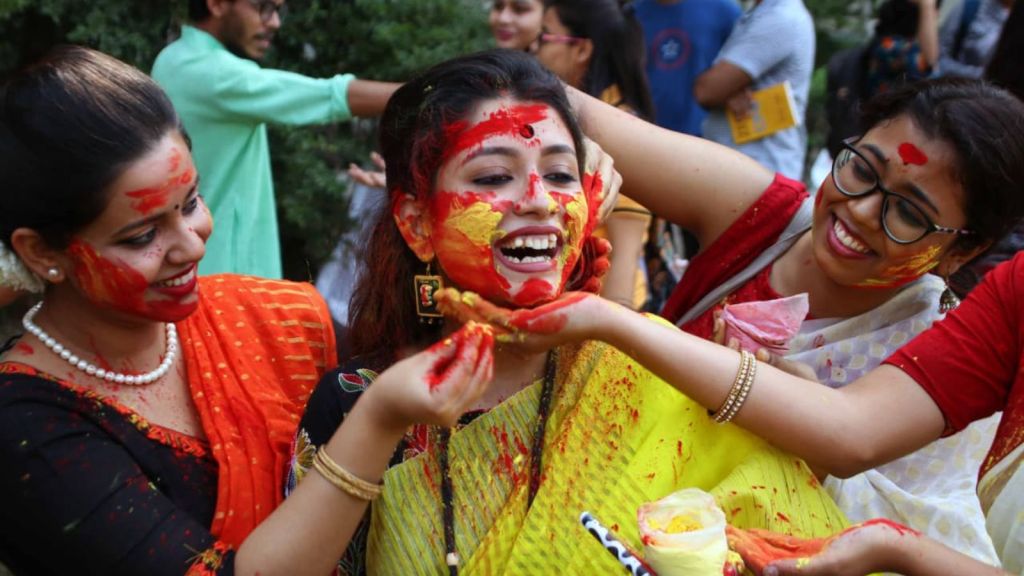 The event now known as Basant Utsav began in 1907 as Ritu Utsav, a modest seasonal observance initiated by Tagore's youngest son, Samindranath. (Express photo)

 The royal family funded Visva-Bharati University for nearly fifty years, dispatched trained Manipuri dancers who shaped the curriculum. (Express photo)
 When Tagore visited Agartala in 1926, he encountered the city’s own Vasant Utsav—processions in yellow basanti attire, the percussion of khol and kartal, devotional song woven through the streets.(Express photo)
 The festival of color—was a fixture of the dynasty from the reign of the legendary Maharaj Trilochan, whose rule the text places in the era of the Mahabharata.(Express photo)
 Tagore’s aesthetics and philosophy reshaped how Tripura understood and practiced its own traditions, and that cross-pollination continues.(Express photo)
 This year’s Basant Utsav, scheduled for March 6 at Visva-Bharati University, will feature a performance of Tagore’s dance drama Natir Pooja. (Express photo)

 Share


