Known for its unique ideas and incisive rhetoric in Durga Puja themes, Agartala’s Blood Mouth Club has taken a bold step this year with a theme centred around ‘Bangabandhu’ Sheikh Mujibur Rahman.
Walking down Ramnagar’s streets toward Ker Chowmuhani, named after the indigenous Ker Puja of Tripura, one is greeted by the sounds of Rabindranath Tagore and Qazi Nazrul Islam’s verses, along with defiant songs by university student and singer Sarker Sangit. These songs, criticizing recent incidents in Bangladesh where statues of ‘Bangabandhu’ Sheikh Mujibur Rahman were desecrated, blast through the loudspeakers.
Speaking to indianexpress.com, Blood Mouth Club Secretary Sebak Bhattacharjee revealed that the decision to shift this year’s Durga Puja theme to ‘Bangabandhu’ was a sudden but necessary response to the current political situation in Bangladesh. “We based our theme on social reformer and renaissance icon Raja Rammohun Roy last year. This year was supposed to be all about Netaji Subhash Chandra Bose. But considering the context of the Bangladesh situation and its significance, we have changed our theme and adopted ‘Bangabandhu’ for this year, keeping Netaji for next year,” Bhattacharjee said.
International impact and radical threats
Bhattacharjee, who also runs several socio-cultural organizations and a local television channel, noted that their Puja theme has garnered international attention, particularly in Bangladesh. “Our Durga Puja theme has succeeded in sending out its message internationally, especially in Bangladesh, where many have endorsed the idea, but a few others have also issued threats of retribution after NE India would supposedly be occupied by Bangladesh,” Bhattacharjee added.
 This year’s Durga Puja theme is heavily focused on Sheikh Mujibur Rahman, his connection with Tripura, the 1971 Liberation War, and the contribution of Indian soldiers. (Express Photo: Debraj Deb)
Noted author and Agartala Press Club President Jayanta Bhattacharya reflected on Sheikh Mujib’s legacy, emphasizing Tripura’s emotional connection with Bangladesh’s Liberation War. “Change of regime might be an internal issue of Bangladesh, but people of Tripura will never forget Sheikh Mujibur Rahman’s commitment to secularism, tolerance, and his intrinsic connection with Agartala. I feel choosing Bangabandhu as the theme for Durga Puja is a great tribute to the history and legacy of Tripura’s connection with the Liberation War,” he said.
This year’s Durga Puja theme is heavily focused on Sheikh Mujibur Rahman, his connection with Tripura, the 1971 Liberation War, and the contribution of Indian soldiers. Partha Chakraborty, the organizing secretary of this year’s Puja committee, explained, “We have built our pandal as a replica of Dhakeshwari Mandir of Dhaka. We have set up separate tableaus portraying Bangabandhu and Tripura’s connection with the Bangladesh Liberation War. People are liking our pandal very much. We have also got positive messages from abroad.”
The Pandal’s historical tableaus
The club has set up tableaus on both sides of the road depicting significant historical events, such as the Muktijuddho Shahid Minar, Bhasha Shahid Smarak, Sheikh Mujib’s visit to Agartala, and his imprisonment in the Agartala Conspiracy Case from 1967-68. They have also portrayed scenes from the 1971 war, including the Pakistani army’s surrender to Indian General Jagjit Singh Arora.
However, Chakraborty mentioned that the Puja organizers have been receiving threats on social media from a few radicals, who claim they do not believe in idolatry and would not tolerate such Puja themes in North East India, suggesting it would become part of Bangladesh in the future.
Chakraborty echoed Bhattacharjee’s sentiments, explaining that the club has also sought to portray the growing anti-Indian sentiments in Bangladesh, drawing comparisons between attacks on intellectuals and minorities in Bangladesh today and the mass killing of intellectuals by the Pakistani army before the Liberation War. “We have tried to show this by comparing how the attack on intellectuals and minorities in Bangladesh today is similar to the mass burial of intellectuals by the Pak Army before the liberation of Bangladesh and the Jewish Holocaust in Nazi Germany. We have tried to make it contextual for people to think,” Chakraborty said.
Public reaction: A different kind of theme
Many pandal hoppers feel that the message is being well-received. Chunilal Goswami, a government official from Agartala, who was visiting Puja pandals with his family, said, “We have seen previous themes on nationalistic and patriotic issues. I believe this theme has Indian nationalistic elements apart from the emotional connection with Bangladesh as well. They have portrayed the supreme sacrifice of Lance Naik Albert Ekka, who laid down his life at the Gangasagar operation.”
Referring to Tripura’s 856 km border with Bangladesh, Goswami added, “History shows any major incidents in the neighboring country have the potential to affect Tripura. We have seen East Pakistani refugees before 1971. Anything happening in Bangladesh is a matter of serious concern here. A democratic government was thrown out, anti-Indian sentiments are rising…these are matters of concern for us.”
With a modest budget of ₹6 lakh, Blood Mouth Club has focused on historical and emotional significance rather than erecting large structures like other big-budget Puja organizers. Despite its unassuming pandal, the club’s theme this year is hard to miss and has left a lasting impression on Durga Puja celebrations in Agartala.
Tripura’s crucial role in the Bangladesh Liberation War
Back in 1971, with a population of 1.5 million, Tripura provided refuge to nearly 1.4 million East Pakistani refugees. The state also hosted several Muktijoddha (liberation warrior) training camps, with the government stepping in to care for the influx of people, supported by the central government. The struggle for Bangla language rights, beginning in the 1950s, later saw Sheikh Mujib emerge as the leader of the movement. Tripura, as one of the hubs of liberation war activities, played a vital role in supporting the Muktibahini fighters.
Tripura’s significance in Bangladesh’s liberation was further cemented with the ‘Agartala Conspiracy Case,’ which involved Sheikh Mujib’s 1963 visit to Agartala. His meeting with then Chief Minister Sachindra Lal Singha helped lay the groundwork for the toppling of Pakistan’s President Ayub Khan and boosted the Muktibahini’s rebel activities, leading to the birth of Bangladesh.
Deep ties between Tripura and Bangladesh
Since Bangladesh’s liberation in 1971, Tripura has maintained strong emotional ties with the nation. Many who fled from East Pakistan before March 1971 were granted Indian citizenship under the 1974 Indira-Mujib Pact, further intertwining the people of Tripura and Bangladesh. These deep-rooted connections make the recent desecration of Sheikh Mujib’s statues and rising anti-Indian sentiments in Bangladesh all the more painful for the people of Tripura.

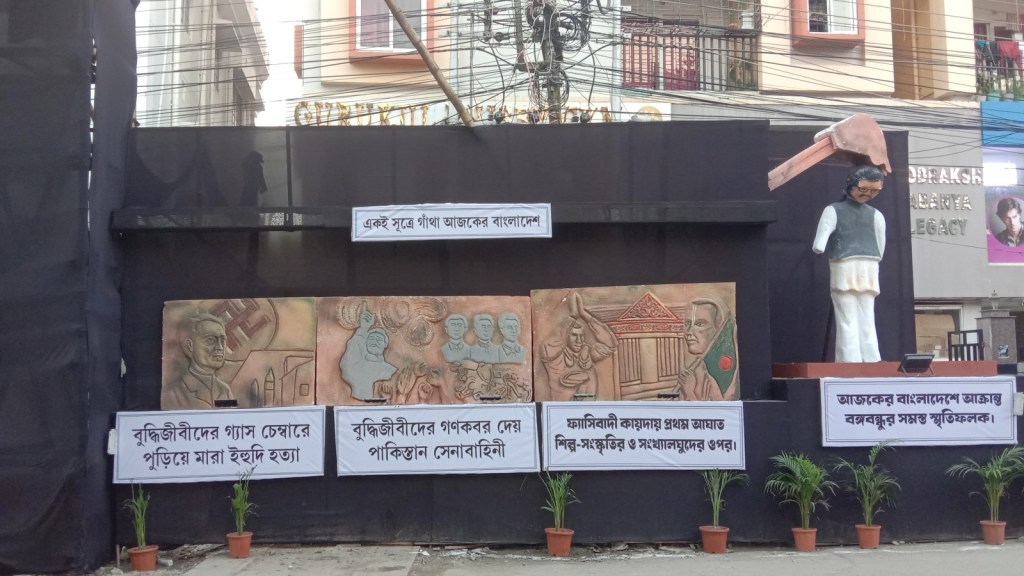

 This year’s Durga Puja theme is heavily focused on Sheikh Mujibur Rahman, his connection with Tripura, the 1971 Liberation War, and the contribution of Indian soldiers. (Express Photo: Debraj Deb)

 Share


