Journalism of Courage



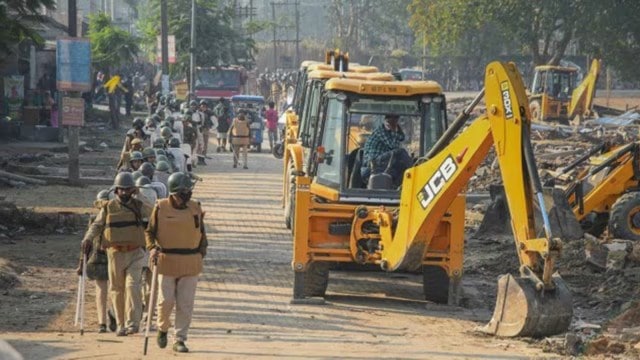 Since 2016, at least 10,620 families have been removed from government land through evictions in Assam. (PTI Photo)
Twelve days after an eviction drive in Kachutali village in Assam’s Kamrup metropolitan district took a violent turn, leaving two dead and many injured, evictions resumed there on Tuesday, with the homes of 150 families being demolished.
On September 9, the Kamrup metropolitan district administration and police arrived at the village, where most of the residents are Bengali Muslims. The eviction drive had been launched on the grounds that the area was under the notified tribal belt of South Kamrup.
The sale, purchase, lease, and settlement in notified tribal belts and blocks is restricted to “protected classes”, which include Scheduled Tribes, Scheduled Castes, Santhals, tea tribes, and Gorkhas.
Over the next three days, 151 families were evicted and 237 structures demolished. On the fourth day of the eviction, things took a violent turn.
Police alleged that residents attacked them with sharp weapons and stones and that police personnel fired in retaliation and used teargas shells. This led to the deaths of two residents, Haidar Ali (22) and Zubahir Ali (19), and the wounding of 11 residents. As many as 22 police personnel and government employees were injured, including the Circle Officer and the officers-in-charge of two police stations.
The same day, many of the residents left the village, located 20 kilometres from Guwahati. A few dozen of those evicted, however, continued to live among the debris.
Assam Director General of Police G P Singh suggested that there could have been a “conspiracy” behind the violence. Residents, however, claimed they got agitated after police began throwing their food and belongings.
In the days that followed, villagers also had to contend with being labelled “Bangladeshi” and being accused of carrying out “land jihad”.
Visiting the site the day after the violence, the DGP had said the village had first come under scrutiny last month, when two tractors found ferrying construction material on the road leading to the village at midnight led to a “suspicion” that “Bangladeshis” were moving in.
And, Assam minister Ashok Singhal claimed, “After our Assam government’s eviction drive, the encroachers of the tribal lands in Sonapur are now going back. They came from Morigaon and Darrang, and encroached on the tribal belt’s land in Sonapur… This is how they are enforcing ‘land jihad’ in Assam, being supported by some political parties.”
When The Indian Express visited the village, residents expressed annoyance at such allegations. “Many of us have been here for around 20 years. We have not occupied the land here, we bought it, but we are being called Bangladeshi citizens. My family moved here from Gagalmari panchayat in Morigaon district because of the destruction caused by river erosion there. Most of the families here are from the same belt in Morigaon,” said Ali Hussain (60).
Since September 12, eviction activities had come to a stop in the area and some residents had approached the Gauhati High Court for relief. Forty-nine residents had challenged the eviction order claiming that they had been issued land pattas in the 1920s, before the area had been notified as a tribal belt. The court directed the Deputy Commissioner to decide on their claims and ensure that they are not evicted till their representation was disposed of.
Speaking to reporters, Sonapur Circle Officer Nitul Khataniar said that the homes of the petitioners were not affected by Tuesday’s evictions.
“In the first phase, we had conducted evictions on government land. This is the second phase where we are conducting it on personal patta land . On the first day, we kept a target of 150 families, but we can see that people have left. We have removed the structures and are carrying out demolitions so that they don’t come and settle again,” he said.
Tuesday also saw another eviction drive in Goalpara district, where 450 families, accounting for around 2,000 people, were evicted. According to officials, they were illegally occupying 55 hectares of the 118 hectare Bandarmatha Reserve Forest and that the eviction exercise had been carried out in line with a Gauhati High Court order to clear all protected forest areas in Goalpara – a hotspot of man-elephant conflict – from encroachment.
Since 2016, at least 10,620 families have been removed from government land through evictions in Assam.

 4 min read