


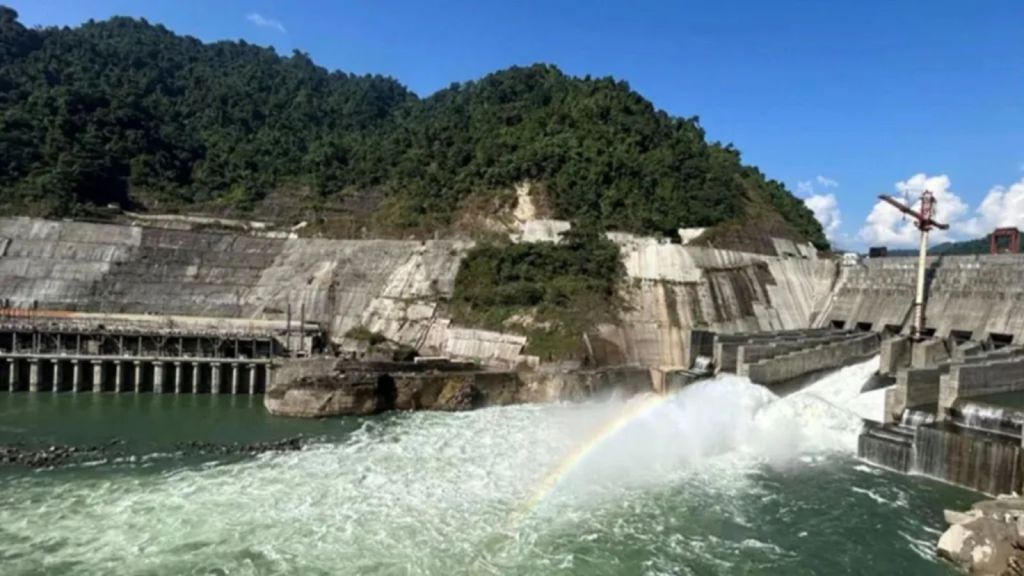
 Upper Subansiri (map) is one among the cascade of projects proposed on the Subansiri river basin, which is a key tributary of the Brahmaputra River. Subansiri Lower hydel project on Arunachal-Assam border. (NHPC)
Even as it expressed concern over the felling of a “substantial” number of trees for the Subansiri Upper Hydroelectric Project (SUHEP), an Expert Appraisal Committee (EAC) of the Environment Ministry recommended environmental clearance for the run-of-the-river project on Subansiri basin in Arunachal Pradesh.
The final environmental clearance, however, will be subject to a Stage-1 forest clearance (an in-principle approval given by the Centre under the Forest Conservation Act), as the project requires the diversion of 2,733 hectares of forest land and the felling of approximately 1,35,733 trees, as per the minutes of the EAC meeting.
The EAC observed that the proposed tree felling may have implications for forest structure, habitat continuity, biodiversity, wildlife movement and associated ecosystem services, the minutes show.
It also advised National Hydroelectric Power Corporation Limited (NHPC), which is the project proponent, to formulate a comprehensive, site-specific and timebound Ecosystem Restoration and Biodiversity Management Plan.
Even though the forest clearance proposal remains under scrutiny, compensatory afforestation has also been proposed across as many as 14 districts of Madhya Pradesh.
Normally, when forest land is diverted for non-forest purposes, an equivalent patch of non-forest land must be found locally for afforestation.
Since Arunachal Pradesh already has a high forest cover, specific guidelines by the Environment Ministry allow it to fulfill their compensatory afforestation obligations on non-forest land in other states which have lower forest cover.
However, the FCA says that if no equivalent non-forest land is available, then a plantation twice the size of the diverted forest land has to be raised on degraded land.
In the SUHEP case, about 5,466 hectares of degraded forest land in Madhya Pradesh has been identified for compensatory afforestation, documents related to the project reveal.
Incidentally, until February 2026, Arunachal Pradesh had not complied with compensatory afforestation conditions for the Subansiri Lower project, also implemented by NHPC downstream, and the Environment Ministry had sent six reminders about it, The Indian Express had reported in February.
While appraising the SUHEP, the EAC noted the Supreme Court’s August 2009 directive that “any proposal on the upper stream of the Subansiri River would be considered independently on its own merit by the Standing Committee as and when submitted by the proponents.”
Earlier, the standing committee of the National Board for Wildlife had given a wildlife nod for the Subansiri Lower project on the condition that there would be no upstream projects constructed in the future. However, the SC modified this condition based on a plea by the Arunachal Pradesh government.
The EAC also noted that the water discharge due to glacial lake outburst flood was assessed, along with peak flood discharge and scenarios of impact of dam breach on the downstream Subansiri Lower hydel project, as per the minutes of the meeting.
The 1,605 MW Subansiri Upper hydropower plant is planned near Menga, 20 kilometres from Daporijo, the district headquarters of Upper Subansiri district. Power generation and flood moderation are the two stated objectives of the project, which envisages the construction of a 237m-high storage dam from the deepest foundation level of the Subansiri River.
The reservoir surface area is 22.2 sqkm at full reservoir level (FRL), whereas the reservoir length is around 50km at FRL, as per project documents.
SUHEP is one among a cascade of projects proposed on the Subansiri River, which is a key tributary of the Brahmaputra River. The proposed Dengser hydel project is immediately upstream of SUHEP, while above it, Oju, Niare, Naba and Nalo projects are proposed. The Oju project was granted a green nod last year.
Downstream, there’s Subansiri Lower, which is already approved and being implemented. Meanwhile, the Kamala hydel project (formerly known as Middle Subansiri project) on the Kamala river, a tributary of Subansiri.
All these projects were initially conceived in the 1980s as a single, large project for flood moderation. However, they were later split as individual projects — Upper, Middle and Lower Subansiri projects.
The meeting’s minutes also show that about 1,139 households are likely to be affected due to land acquisition for the Lower Subansiri project.
The 2,220MW Oju, 2,000MW Subansiri Lower and 2,880MW Dibang (on the Dibang River) hydel projects have also received approval and are under various stages of implementation.