


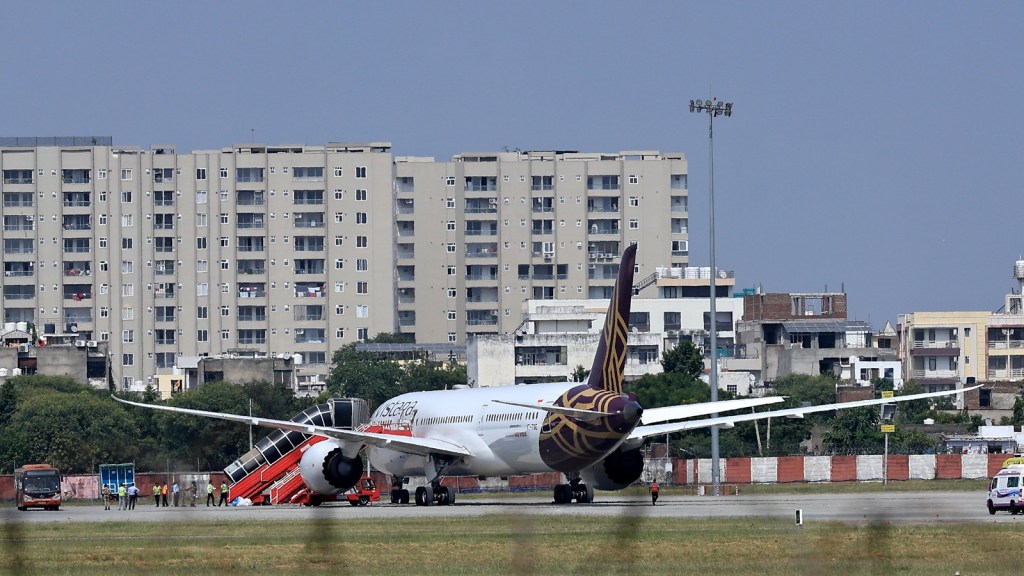


A puzzling sequence of events unfolded Wednesday after Air India flight AI2030 – a Frankfurt-Delhi service that was diverted to Jaipur after it squawked 7500.
For airlines and air traffic controllers worldwide, a plane squawking 7500 is an immediate red flag. Why? Because it is the universal shortcode for ‘unlawful interference’ and is generally used by pilots to covertly signal an attempted hijacking.

But, and here’s the puzzling bit, when the plane transmitted that code it was within Mumbai airspace. And when ATCs responded, the pilot said they did not squawk an emergency at all, much less the hypercritical 7500.
Nonetheless, given a possible security threat at play, protocol was followed and the plane – a Boeing 787-9 – was diverted to Jaipur. And so it did.
This was at 9.20 am. Fifteen minutes later it landed and was isolated per protocol.
Meanwhile, the 306 people de-boarded and waited while the plane was checked.
All pax and crew were given a thorough security check too. Jaipur airport chief Charan Singh stressed to all stakeholders then that ‘the situation is under control’.
Roughly five hours later the all-clear was sounded, passengers got back on the plane, and it left – flown by the same pilots – for Delhi. And at 3.12 pm it landed at the city’s Indira Gandhi airport.
“Air India teams worked proactively with authorities to minimise passenger inconvenience,” the airline later said, “We sincerely regret the inconvenience caused to our passengers due to this unforeseen disruption and appreciate their patience and understanding. The safety and security of our passengers and crew remain Air India’s highest priority.”
What happened to flight AI2030?
A preliminary report suggests the pilot may have issued the ‘hijack’ call by mistake, Singh said, adding that an investigation is underway to establish the facts.
At this stage, it is not clear what triggered the squawk code.
It may have been a mistake or a technical glitch with the aircraft or ATC systems.
There have been instances of technical faults leading to hijack alerts being transmitted. In fact, on Tuesday, a Corendon Airlines flight from Greece to Germany squawked 7500, prompting the German air force to scramble two fighter jets.
The plane landed safely in Nuremberg and the airline said that the code had been transmitted due to a brief malfunction in the radio communication system.
What does squawking 7500 mean?
First, ATCs establish contact. They let the pilot know their distress call has been heard and that help is on the way. Communication is switched to a secure frequency.
Second, airspace around the hijacked aircraft is isolated, i.e., it gets complete and absolute priority over all other aircraft. This involves multiple ATCs working together to keep other planes out of the flight path and the plane away from populated areas.
And third, military interception.
flydubai Omani co-pilot barred at home, OK for Israel flight
In the flydubai case, for example, Israeli fighter jets were reportedly scrambled to fly alongside. Crucially, in a post 9/11-world, most militaries are authorised to use deadly force if a hijacked aircraft ignores comms and/or commands and moves to a populated area.
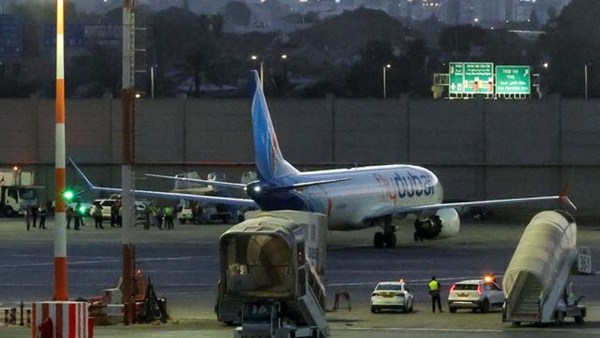 The flydubai aircraft bound for Israel was diverted to Saudi Arabia following an emergency signal. September 30, 2026. REUTERS/Ammar Awad
That said, there is no recorded instance in which lethal force has been employed.
Once phases 1, 2, and 3 are active, ground control tries to negotiate a peaceful end; this could see involve the plane landing at a designated airport, where it will be isolated.