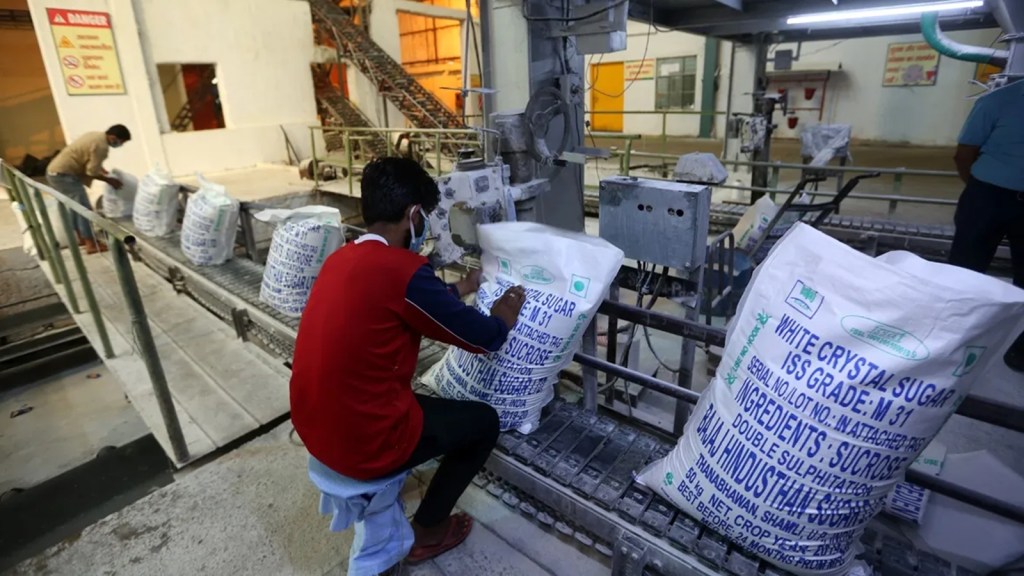
The Centre on Monday allowed the export of 10 lakh metric tonnes (LMT) of sugar during the 2024-25 season (October-September). Union Minister for Consumer Affairs, Food and Public Distribution Pralhad Joshi said the measure “will benefit 50 million farmer families and 500,000 workers”. It will also, he said in a post on X, boost the liquidity of sugar mills, ensuring timely payment of cane dues, besides balancing availability and prices for consumers.
India’s sugar production in the current sugar season is estimated to be 27 million tonnes in 2024-25, a decline from 32 million tonnes last year.

Prices have been stable over the past few months: According to data with the Department of Consumer Affairs, the all-India retail price of sugar was Rs 44.67 per kg, almost similar a month ago and a year ago. The retail inflation too has come down in recent months, with the Consumer Price Index-based retail inflation recorded at -0.40 per cent in December 2024.
In June 2022, the Centre took measures to restrict sugar exports in order to ensure sufficient availability for domestic consumption at a reasonable price. However, the export of sugar to the EU and the US under the CXL Concessions and the Tariff Rate Quota (TRQ) were unaffected.
ExplainedRemoving the bar
In the 2021-22 sugar season, before the restrictions to ensure domestic availability were imposed, India ranked number two in sugar exports, shipping 110 LMT of the sweetener to several countries including Indonesia, Bangladesh and the UAE.
Monday, an order issued by the Ministry said, “Export quota of 10 LMT have been pro-rated amongst those sugar mills which operated in at least one sugar season amongst the last three sugar seasons by taking into account their average production of sugar during the last three operational sugar seasons i.e. 2021-22, 2022-23 and 2023-24…”
“All the sugar mills have been allocated a uniform export quota of 3.174% of their three years’ average production of sugar,” it said. The sugar mills in Maharashtra, larger, will get the maximum share of the quota — 3.74 LMT — followed by Uttar Pradesh at 2.74 LMT.
As per the order, mills can export either directly or through merchant exporters until September 30. They have the option to surrender quotas by March 31 or exchange them with domestic quotas to reduce transportation costs. The policy also allows mills to swap export quotas with domestic monthly release quantities through mutual agreements, subject to the Food Ministry’s approval.




 Share


