When Rasika Bombatkar developed a persistent cough during the monsoon season four years ago, doctors initially saw little reason for concern. She was young, a non-smoker and, therefore, did not fit the conventional profile of a lung cancer patient. Two weeks later, still coughing, she sought help again — this time prompted by an awareness campaign featuring actor Amitabh Bachchan that urged people to get tested for tuberculosis (TB) if a cough persisted. Two months after her symptoms began, doctors finally diagnosed what had been missed: late-stage lung cancer.
“I was diagnosed only after I insisted that I get a CT scan, even though the doctors kept telling me about the side effects of getting unnecessary scans. I was lucky to be an allied health professional. I could do the research on my own, I could insist on the test at the hospital I worked at,” says Bombatkar, who was then working as a physiotherapist at Christian Medical College, Vellore. Once doctors saw the CT scan she had insisted on, the picture changed. The cancer had already spread from her lungs to her lymph nodes. A lymph-node sample confirmed the diagnosis.

Her experience, which she shared at the just-concluded World Cancer Congress in Hong Kong, illustrates a larger problem confronting efforts to detect lung cancer early: the people most likely to benefit from screening are not necessarily the only ones who develop the disease. “All the medical literature stating that the disease usually happens at a later age, among people who have been smoking for years, means that even doctors do not suspect it in the young. But the reality is that people like me also get the disease and the doctors should at least review such decisions when symptoms are present,” Bombatkar told The Indian Express.
This comes at a time when the International Agency for Research on Cancer (IARC) published its perspective on cancer screening in the New England Journal of Medicine. The study says that screening for lung cancer using Low Dose Computer Tomography (LDCT) can help in early detection and improve the odds of survival. However, with the radiation accumulated from the LDCT itself increasing the risk of other types of cancers, the screening is suggested only in high-risk groups — people who are between the ages of 50 and 80 years and have been smoking a pack a day for at least 20 to 30 years.
Living as the other
Even after diagnosis, Bombatkar found herself having to explain why she had lung cancer. “All the campaigns against tobacco smoking warn of lung cancer. But in doing so, it makes people think that the people who get the disease deserve it,” she says.
Bombatkar is now sharing her experience publicly because she wants other patients, particularly those who do not fit the conventional profile of lung cancer, to recognise that persistent symptoms should not simply be dismissed. “I wanted to talk about my journey to tell people that they are not alone, to tell them that they should trust their bodies,” she says. “Yet, my doctors, relatives and neighbours always rein me in, saying I should not be talking about my disease when I am doing okay. It’s because of my father’s support that I am here talking to everyone about it.”
The early detection challenge
Lung cancer is often diagnosed only after it has spread, when treatment becomes harder and the chances of survival fall. In India, it was the third most common cancer in 2024, affecting 1.12 lakh people and killing more than 98,000, according to Global Cancer Observatory data. It accounted for 7.2% of all cancers but 10.9% of cancer deaths in the country.
A study based on data from India’s cancer registries found that nearly 45% of patients were diagnosed only after the disease had spread. The researchers called for stronger lung-cancer-specific prevention and control measures and greater capacity among healthcare providers to ensure timely diagnosis and treatment.
But creating a national screening programme presents formidable challenges. The current evidence-based screening tool, LDCT, is expensive and not uniformly available.
This issue was among those discussed at the World Cancer Congress, where global cancer experts examined how screening could be made more effective without simply expanding it to entire populations. Dorothy Keefe, CEO of Cancer Australia, says that when examining whether lung cancer screening would be cost-effective in Australia, researchers found that most cases occurred among long-term smokers. That shaped the population selected for screening. But the picture is different in parts of Asia, where a substantial proportion of lung cancer cases occur among non-smokers, potentially making a case for identifying high-risk non-smokers too.
Hong Kong is already studying this question. Dr Anne Lee, vice chairman of the Hong Kong Anti-Cancer Society, says “a study is under way to examine whether screening could benefit high-risk non-smokers, including those with a family history of lung cancer. In Hong Kong, as in India, more than half of lung cancer cases are not directly linked to smoking.”
Béatrice Lauby-Secretan, who heads IARC’s work in this area, feels emerging risk-prediction models could help identify people who fall outside traditional screening criteria. “Such models could incorporate exposure to air pollution, second-hand smoke and occupational hazards. Emerging technologies such as AI-based chest X-rays may eventually help expand screening, although there is not yet strong evidence to support their widespread use.”
Indian researchers are examining other risk factors. Dr Abhishek Shankar of the All-India Institute of Medical Sciences (AIIMS), Delhi, is studying the impact of living in highly polluted areas on accelerating lung cancer risk.
The treatment battle
For Bombatkar, getting a diagnosis was only the beginning. She needed molecular testing to determine whether she carried mutations that could make her eligible for newer targeted therapies. The test itself can cost between Rs 50,000 and Rs 1 lakh, creating another barrier. When her results showed that she could benefit from osimertinib, accessing the drug proved even harder.
“You could buy the drug for Rs 1 lakh a month with no end date in sight or you could get enrolled in a clinical trial. At the time my salary was just Rs 35,000, I couldn’t even think of buying the medicine. My parents would have had to sell everything they owned. I tried to get into clinical trials but they accepted patients only up to stage 3a — by the time I was diagnosed I was at stage 3b. I couldn’t get it,” says Bombatkar.
She eventually did what many Indian patients are forced to do: look for a cheaper alternative. She bought an unbranded version of the medicine manufactured in Bangladesh, where patent rules allow certain flexibilities because of its lower-middle-income status. It cost her Rs 25,000 a month.
“I did not know whether the drug worked the same way as the branded version. The only way to tell that something was happening was to watch out for side effects,” she says. After surgery to remove part of her lung and several lymph nodes, followed by multiple rounds of treatment, Bombatkar has managed to push the disease back. But the experience has left her acutely alert to every symptom.
Speaking about the disease is part of making sure that other patients do not have to fight the same battles alone — first to be believed, then to be diagnosed and finally to access treatment. Her story raises a question that screening guidelines alone cannot answer: How many patients who do not fit the traditional profile are being missed before someone takes their symptoms seriously?

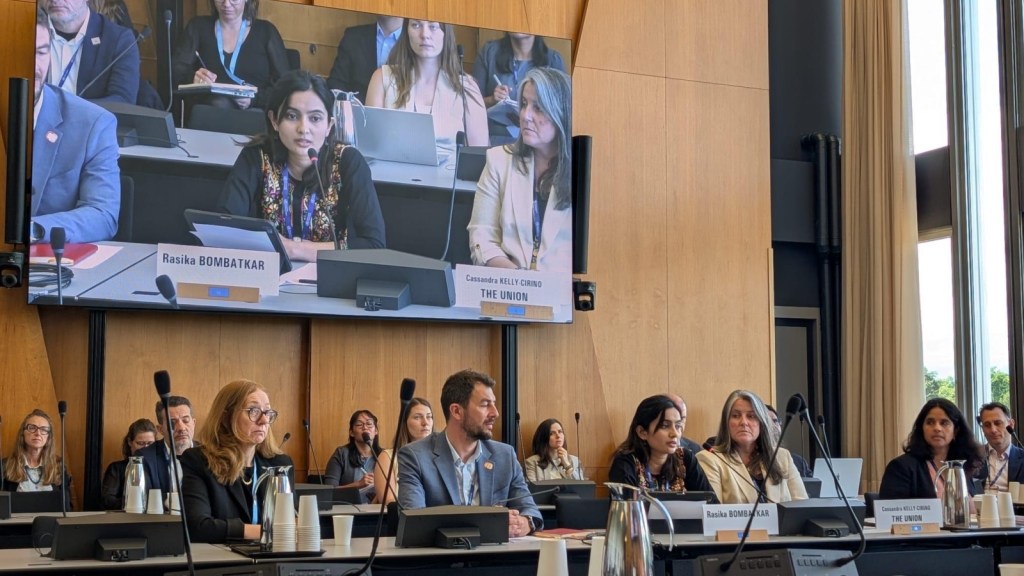 Rasika Bombatkar addressing the cancer conference. (Source: Express Photo)



 Share


