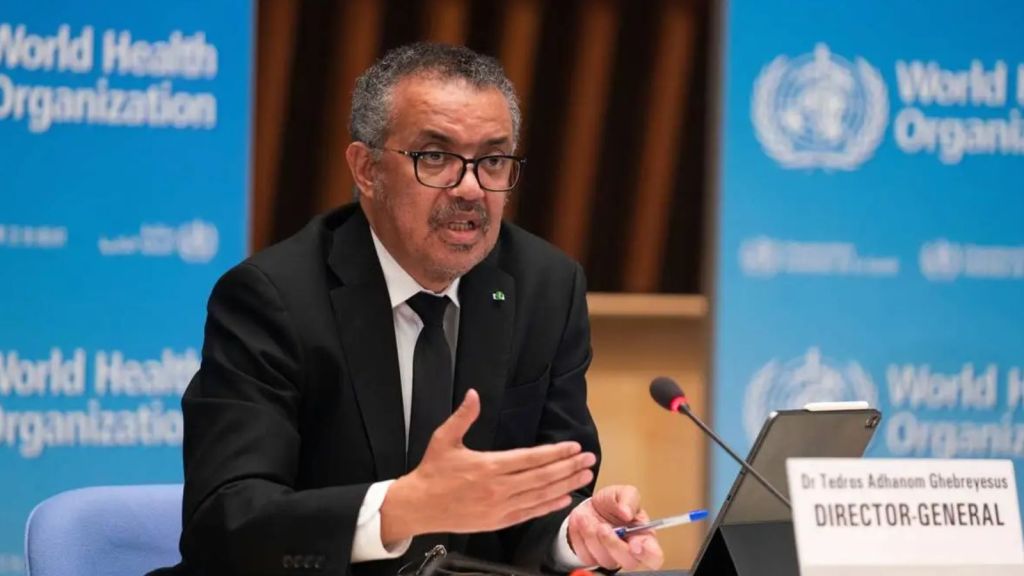
WHO chief says ‘matter of time’ before US joins top health agency

Tedros Adhanom Ghebreyesus says he remains in talks with US Health Secretary Robert F. Kennedy Jr as the WHO grapples with the loss of US funding and renewed concerns over pandemic preparedness.

WHO Director-General Tedros Adhanom Ghebreyesus said he believes it is only a matter of time before the United States rejoins the global health agency.WHO Director-General Tedros Adhanom Ghebreyesus said he believes it is only a matter of time before the United States rejoins the global health agency.

World Health Organization (WHO) chief Tedros Adhanom Ghebreyesus said he hopes the United States will rejoin the global health agency and disclosed that he has been in talks with US Health and Human Services Secretary Robert F. Kennedy Jr.

“The US leadership is very important and I want to assure you that we have continued to communicate from our side. It is a matter of time until the US joins the WHO,” Dr Ghebreyesus told reporters at a Health Coverage Fellowship programme conducted by the Centre for Health Communication at the Harvard T H Chan School of Public Health in Boston.

The US formally notified the WHO of its withdrawal in January 2026, citing concerns over the agency’s handling of the COVID-19 pandemic. Ghebreyesus, whose second term as WHO director-general ends next year, has rejected several claims made by the US administration.

Why US funding matters to WHO

The financial stakes are significant. The US has historically been WHO’s largest donor, providing both assessed contributions and voluntary funding. During the 2022-23 biennium, the US contributed $1.284 billion, according to WHO.

US funding has supported programmes ranging from emergency response and polio eradication to HIV, tuberculosis, immunisation, maternal and child health and other public health initiatives. WHO has said the loss of US support has created major funding gaps, forcing the agency to reprioritise programmes and contain costs.

The importance of the US, however, extends beyond money. Dr Ghebreyesus pointed to the expertise and global reach of institutions such as the Centers for Disease Control and Prevention and the National Institutes of Health. “No other organisation can replace what WHO does,” its chief said, pointing to its role in coordinating responses to major health crises such as Ebola. “We prefer to play a positive role because US leadership is important,” he said.

Pandemic preparedness remains a concern

Speaking ahead of the second United Nations General Assembly (UNGA) high-level meeting on “Pandemic Prevention, Preparedness and Response” on September 25, Dr Ghebreyesus said the world must not lose sight of the lessons of COVID-19, when health systems were overwhelmed and inequalities were exposed. “Of course, we can never say that the world is prepared enough for the next pandemic,” he said, while adding that global health security has nevertheless been strengthened since COVID-19.

Story continues below this ad

He cautioned against “politicising” or “weaponising” pandemics. COVID-19, he said, should be treated as a common threat requiring national and global solidarity rather than political division. “When political parties use the virus to attack each other, it can create divisions, weaken cooperation and ultimately lead to more people being affected,” he said, arguing that governments and opposition parties should work together during health emergencies.

Dr Ghebreyesus clarified there were no current indications of serious pathogens circulating beyond existing public health emergencies of international concern. WHO is working with countries and the World Bank through the Pandemic Fund to address gaps in pandemic preparedness. He stressed that global health security depends on stronger surveillance and response capacity, particularly in countries where such systems remain weak.

COVID-19 origins: ‘All hypotheses remain on the table’

On the origins of COVID-19, Dr Ghebreyesus said WHO has repeatedly requested additional information from the Chinese government, including data relevant to the investigation, but some requested information has not been provided.

As the investigation remains incomplete, WHO’s position is that all hypotheses remain on the table, including a possible laboratory-related origin. The WHO chief said weaknesses in information-sharing could affect confidence in routine international cooperation. The amended International Health Regulations are intended to strengthen countries’ responsibilities and cooperation, but continued efforts are needed to improve information-sharing, surveillance and preparedness.

Story continues below this ad

India’s experience can help global south

Responding to a query from The Indian Express, Dr Ghebreyesus said India’s experience in improving health outcomes and expanding access to healthcare could offer lessons for other countries in the Global South. “The country has made significant progress in reducing maternal, infant and under-five mortality,” he said. “Last weekend, I had the opportunity to speak with the Union Minister of Health. Of course, we work together. I believe this experience can be very helpful for the Global South,” he said.

He mentioned initiatives such as Ayushman Arogya Mandirs, which focus on health promotion, disease prevention, early detection and primary healthcare.

India’s vaccine and drug manufacturing role

Dr Ghebreyesus even noted India’s role as a major producer of generic medicines and vaccines, often described as the “pharmacy of the world.” Its manufacturing capacity, he said, can contribute to greater equity and affordability by making essential medicines and vaccines more accessible.

However, he cautioned against global health supply chains becoming dependent on production in a single country. Expanding pharmaceutical and vaccine manufacturing capacity in Africa and other parts of the Global South, he said, is important for long-term health security and equity. Technology transfer, knowledge-sharing and capacity-building can help countries develop sustainable production capabilities.

Story continues below this ad

(Anuradha Mascarenhas was among 13 journalists selected for the 2026 Class of the Health Coverage Fellowship programme at the Harvard T.H. Chan School of Public Health in Boston.)

Anuradha Mascarenhas is a Senior Editor at The Indian Express, based in Pune. With a career spanning three decades, she is one of the most respected voices in Indian journalism regarding healthcare, science and environment and research developments. She also takes a keen interest in covering women's issues . Professional Background Education: A gold medalist in Communication and Journalism from Savitribai Phule Pune University and a Master’s degree in Literature. Author: She authored the biography At The Wheel Of Research, which chronicles the life and work of Dr. Soumya Swaminathan, the former Chief Scientist at the WHO. Key Focus: She combines scientific accuracy with storytelling, translating complex medical research into compelling public and human-interest narratives. Awards and Recognition Anuradha has won several awards including the Press Council of India's national award for excellence in journalism under the gender based reporting category in 2019 and the Laadli Media award (gender sensitivity -2024). A recipient of the Lokmat journalism award (gender category-2022), she was also shortlisted for the RedInk awards for excellence in journalism-2021. Her debut book At The Wheel Of Research, an exclusive biography of Dr Soumya Swaminathan the inaugural chief scientist of World Health Organisation was also nominated in the Popular Choice Category of JK Paper AUTHER awards. She has also secured competitive fellowships including the Laadli Media Fellowship (2022), the Survivors Against TB – New Research in TB Media Fellowship (2023) and is part of the prestigious 2025 India Cohort of the WomenLift Health Leadership Journey.” Recent Notable Articles (Late 2025) 1. Cancer & Specialized Medical Care "Tata Memorial finds way to kill drug-resistant cancer cells" (Nov 26, 2025): Reporting on a breakthrough for triple-negative breast cancer, one of the most aggressive forms of the disease. Discipline, diet and purpose; How a 97-year-old professor defies ageing'' (Nov 15, 2025) Report about Prof Gururaj Mutalik, the first Head of Department at Pune's B J Government Medical College who at 97 credits his longevity to healthy habits and a strong sense of purpose. 2. Environmental Health (The "Breathless Pune" Series) Long-term exposure even to 'moderate' air leads to chronic heart, lung, kidney issues" (Nov 26, 2025): Part of an investigative series highlighting that even "safe" pollution levels are damaging to vital organs. "For every 10 µg/m3 increase in PM2.5 level, there was 6-8% jump in medicine sales" (Nov 23, 2025): Using commercial data to prove the direct link between air quality and respiratory illnesses in Pune. 3. Lifestyle & Wellness News "They didn't let cancer, diabetes and heart disease stop them from travelling" (Dec 22, 2025): A collaborative piece featuring survivors who share practical tips for traveling with chronic conditions. At 17, his BP shot up to 200/120 mmHG; Lancet study flags why child and teen hypertension doubled between 2000 and 2020'' (Nov 12,2025)--A report that focusses on 17-year-old-boy's hypertensive crisis and reflects the rising global trend of high blood pressure among children and adolescents. 4. Scientific Recognition & Infrastructure For promoting sci-comm, gender diversity: IUCAA woman prof highlighted in Nature" (Nov 25, 2025): Covering the global recognition of Indian women scientists in gender studies and physics. Pune researchers find a spiral galaxy like the Milky Way from early universe'' (December 3, 2025)- A report on how Indian researchers discovered a massive galaxy that existed when the universe was just 1.5 billion years old , one of the earliest to have been observed so far. Signature Beat: Health, Science & Women in Leadership Anuradha is known for her COVID-19 reportage, where she was one of the first journalists to provide detailed insights into the Covishield and Covaxin trials. She has a dedicated interest in gender diversity in health and science, often profiling women researchers who are breaking the "leaky pipeline" in STEM fields. Her writing style is scrupulous, often featuring interviews with top-tier scientists and health experts from various institutions.   ... Read More


Advertisement
Loading Recommendations...
Advertisement
Advertisement
Latest Comment
Post Comment
Read Comments