4 min readJun 8, 2024 10:39 PM IST
First published on: Jun 8, 2024 at 03:47 PM IST
You may not know swimming but what about doing some workouts in a shallow pool? Workouts in the water are low-impact activities that relieve stress on the muscles, joints and bones. Additionally, the inherent resistance in water helps strengthen your muscles without the risk of injury and burn more calories, accelerating weight loss.
The logic is fairly simple, your body relaxes and becomes buoyant. Your body feels light and won’t feel pressure on your joints or muscles. The floaty feeling eases your limbs and helps them move fluid-like, smoother than they would on land. That’s why squats, which might hurt and stress your knees, are doable in water. The resistance of the water is about 14 per cent more than on the surface. So If you do cardio exercises like jogging in water, you’re working against more resistance than if you were on land. This requires your muscles to work at their fullest and contract harder to overcome the extra resistance. This helps in building lean muscle mass. Moving water provides a gentle massage.

What are the health benefits?
Aquatic exercises lower stress levels, strengthen bones and joints, improve immunity, agility, stamina, boost cardiac health and keep your weight under check. Since resistance is higher in water, you end up burning more calories than you would on land. That’s because you end up working all muscle groups that you cannot on land.
These are particularly good for senior citizens, pregnant women and those recovering from joint injuries, like knees, hips, ankles and back.
Which are the best water workouts?
Make sure you are walking at the shallow end. In addition to walking, sideways walking, squats, leg raises and hip rotation, the following routines can be done:
(1) Try to suspend your lower body and cycle with your back against the pool wall while standing at the shallow end with your hands wide apart, either clutching the parapet or bar railing. Extend your body, inhale deeply and exhale gently. This strengthens your lower core and rehabilitates legs and knees.
(2) Face the parapet and hold the railings. Gradually you can move your legs upwards. Then kick sideways to the right and left. Make sure to breathe out when you kick and breathe in when you retreat.
(3) Put your hands on the parapet for a poolside push-up. Now pull your upper body so that your toes lift from the floor of the pool. Raise yourself out of the pool until your arms are fully extended. Lower your body back and repeat.
(4) Immerse yourself in water up to the neck. Then do arm raises to shoulder level. Extend your arms as you breathe in and retract them while breathing out. This is good for improving lung capacity and toning the arms.
(5) Plyometric workouts, sometimes called jump training or plyos, are designed to increase power (speed and strength) by having muscles exert their maximal force for brief periods. The water’s resistance adds intensity to these exercises. Floating, hold the parapet or railing and kick from the hips.
(6) Standing in a stationary position with knees shoulder-length apart, one can bend and do squats. This routine strengthens the legs as well.
(7) Simply floating can help you calm your mind and organise your body’s abilities for optimal endocrine and organ functions.
Finally, just have fun where you can hop, jump, and splash with your family or friends.

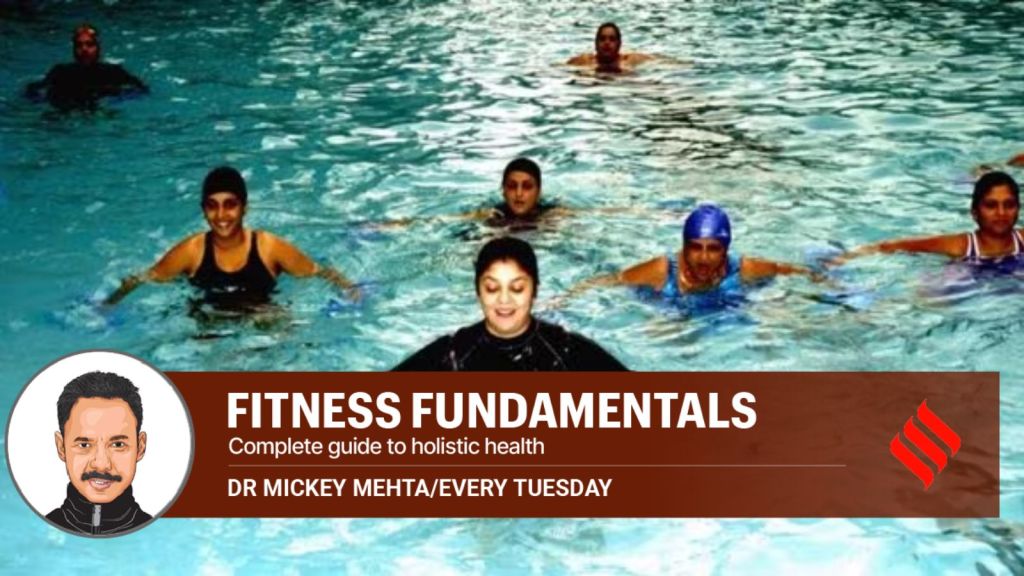 Aquatic exercises lower stress levels, strengthen bones and joints, improve immunity, agility, stamina, boost cardiac health and keep your weight under check. (File Photo)


 Share


