6 min read
© IE Online Media Services Pvt Ltd



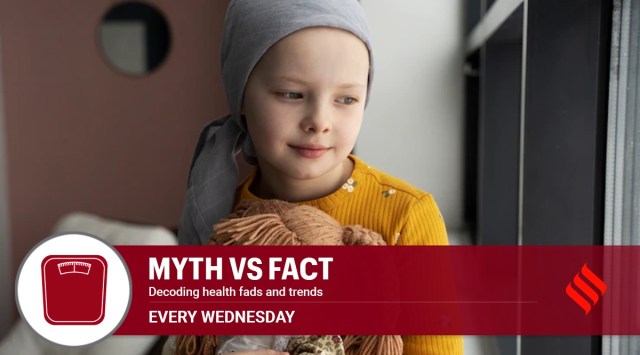 According to the National Cancer Registry Programme in India, leukemia is the most common type of cancer in children, accounting for approximately 25-30 per cent of all childhood cancers. (Source: Freepik)
Five-year-old Sarah (name changed) was a healthy and active child, but her parents noticed that she was often tired and seemed to be bruising easily. They took her to the doctor, who ordered a blood test and discovered that she had leukemia. Thanks to the early detection, Sarah was able to start treatment right away, which included chemotherapy. After several months of treatment, Sarah went into remission. She was able to return to school and resume her normal activities and is now a healthy and happy 10-year-old. “This case highlights the importance of seeking medical attention when the red flags show up and the benefits of early detection in the treatment of childhood leukemia. Unfortunately, many myths surround childhood leukemia”, says Dr Arpan Mehta, laboratory haematologist and molecular haemato-oncologist, Neuberg Centre for Genomic Medicine.
Myth 1: Childhood leukemia is not widespread in India
In fact, it is a devastating condition, affecting thousands of children and families annually. According to the National Cancer Registry Programme in India, leukemia is the most common type of cancer in children, accounting for approximately 25-30 per cent of all childhood cancers. “In addition, the incidence of childhood leukemia has been steadily increasing in India over the past few decades. Early detection and prompt treatment are critical in improving the chances of survival and cure for children,” says Dr Mehta.
Leukemia is a form of cancer that influences the blood and bone marrow, causing an excessive production of abnormal white blood cells. These abnormal cells crowd out normal cells, impairing the body’s ability to fight infection and stop bleeding. There are several childhood leukemia types, the most common being acute lymphoblastic leukemia (ALL) and acute myeloid leukemia (AML).
Symptoms of childhood leukemia, according to Dr Mehta, may include fatigue, pale skin, easy bruising or bleeding, frequent infections, pain in bones or joints, and a swollen abdomen due to an enlarged liver and spleen. Some children may also experience nausea, vomiting and a loss of appetite.
Myth 2: Childhood cancer is not curable
“Childhood leukemia is curable if detected early enough. For ALL, many children can be cured by chemotherapy alone. The disease can often be detected through a physical examination, which serves as the initial step. During this exam, a physician will check for signs of anaemia, swollen lymph nodes, and an enlarged spleen or liver. The doctor will check for any signs of petechiae, which are small red or purple coloured spots on the skin caused by haemorrhage (bleeding) under the skin. Blood tests are another important tool in detecting childhood leukemia. A CBC test can identify irregular amounts of white blood cells, red blood cells and platelets. A differential blood count can identify a child’s type of leukemia. A blood chemistry test can help determine if the liver and kidneys are functioning properly. Bone marrow tests are often used to confirm a diagnosis of childhood leukemia. Imaging tests, including X-rays, MRI, and CT scans, can assist in determining if the leukemia has spread to other important parts of the body. These tests can also help in determining if there are any other health problems that may be causing the symptoms,” adds Dr Mehta.
“The cure rates of ALL in children between two and six years is 94.1 per cent as of 2015 and 91.9 per cent in children younger than 15 years in high-income countries. In India, improved healthcare facilities have improved our response rates to almost 70 per cent as compared to 90-95 per cent in high income countries,” says Dr Liza Bulsara, paediatric haematologist oncologist at Ruby Hall Clinic, Pune.
Myth 3: Childhood leukemia is hereditary
“The exact cause of childhood leukemia is unknown, but several risk factors have been identified. These include exposure to ionising radiation, and certain chemicals, having a sibling with leukemia, and having certain genetic conditions such as Down syndrome,” says Dr Mehta.
Myth 4: Chemotherapy is not safe for the child
“There is a lot of mistrust in the modern form of therapies, especially chemotherapy. People often are worried about the long-term side-effects to the heart and lungs but what is important is addressing the current problem of cancer at hand. This dilemma also delays decision-making by the family resulting in unwanted disease progression,” says Dr Bulsara. There is no need to worry as it’s given as per weight and age of the child. “Since it’s a very small dose, adverse effects tend to be minimal in children. Moreover, all precautions are taken while administering chemotherapy in children as well as adults. Children tolerate chemotherapy rather well,” she adds.
Myth 5: All treatment is costly
The complete treatment of a child with ALL is approximately US $ 103,250 which is equal to approximately Rs 80 lakh. “However, our Indian peers are doing the same treatment for Rs 3-7 lakh, making it much more affordable. Still, it is admittedly a cost burden. Now access to facilities is being widened. With schemes like Ayushman Bharat and private trusts helping in this fight against childhood cancer, the financial cost burden needs to be addressed,” adds Dr Bulsara.
Myth 6: Children with leukemia cannot live long
Overall survival of cancer patients depends on the type and nature of cancer. “Most cured children have an event-free survival and tend to lead a normal life. Even if some of them do relapse, further options of targeted therapy, bone marrow transplant and CAR T-cell therapy have brightened the prospects of childhood oncology treatment,” says Dr Bulsara.
The life expectancy of a child with cancer can be determined by the stage at which he/she has been diagnosed with cancer and the treatment modules they are being given. “If the cancer is detected at an early stage and treatment starts well in time, then the life expectancy also increases, and the child can live longer. On the other hand, if the cancer is detected in later stages, say Stage 3 or 4, then it totally depends on the type of cancer and the treatment being given to the child,” says Dr Pooja Babbar, Consultant, Medical Oncology, CK Birla Hospital, Gurugram.
📣 For more lifestyle news, follow us on Instagram | Twitter | Facebook and don’t miss out on the latest updates!